A Gloss on Van Eyck’s Lips: Genetic invariability or Self-reference?
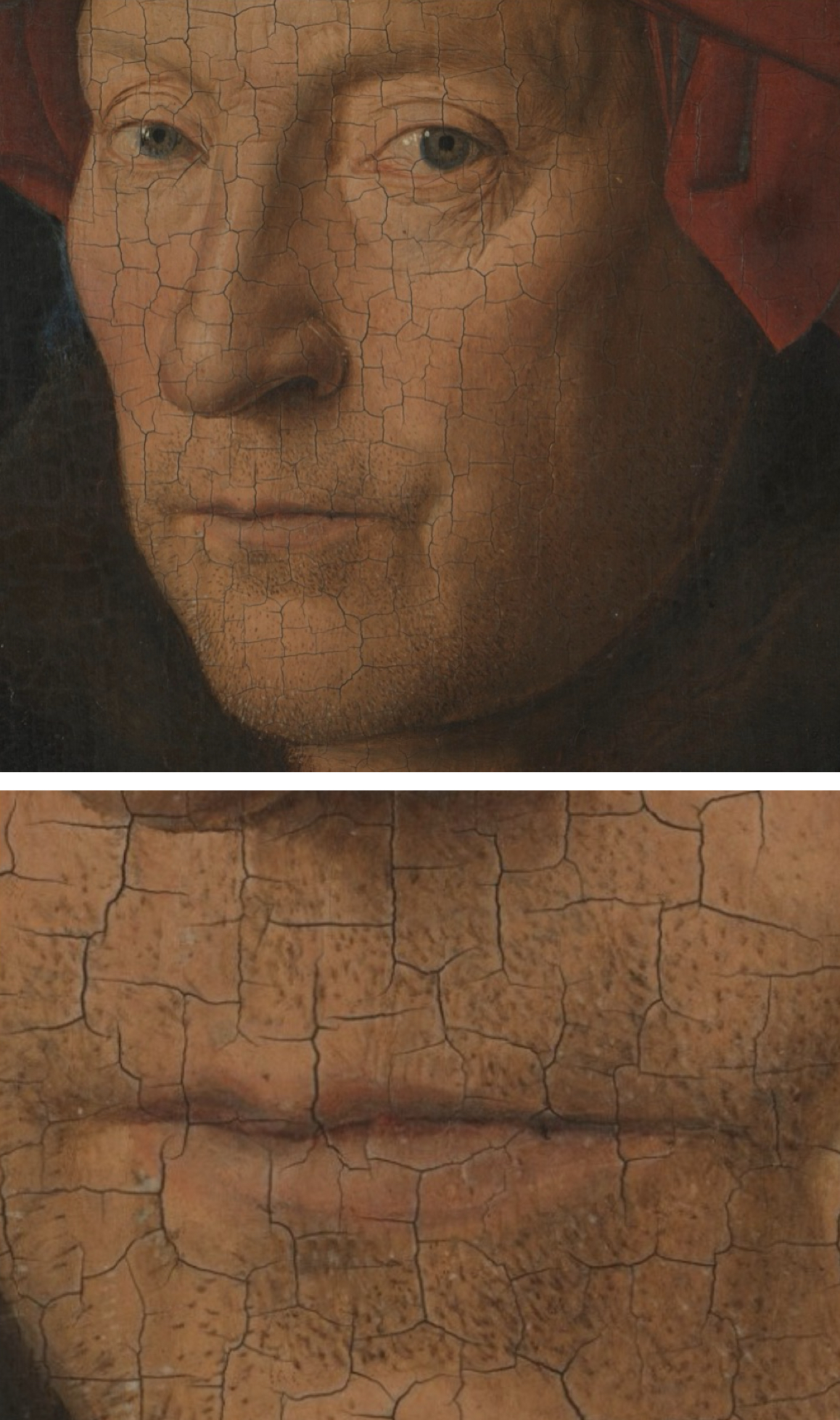
Portrait of a Man in a Red Turban (Self-portrait), two details
Click image to enlarge.
What is it with Van Eyck’s lips? Jan’s upper one is thread-like with the tick of a philtrum; the other seriously off-center. Even if his presumed self-portrait is mis-identified (unlikely), it’s worth noticing as part of a pattern. Everyone has certain odd features, but why do so many of his figures have similar smackers, a thin one over an unbalanced one? Given his penchant for depicting minor details with mesmerizing verisimiltude, the use of a “facial type” for speed of execution is unlikely.
Click next thumbnail to continue*
* The images are courtesy of a wonderful website, Closer to Van Eyck.
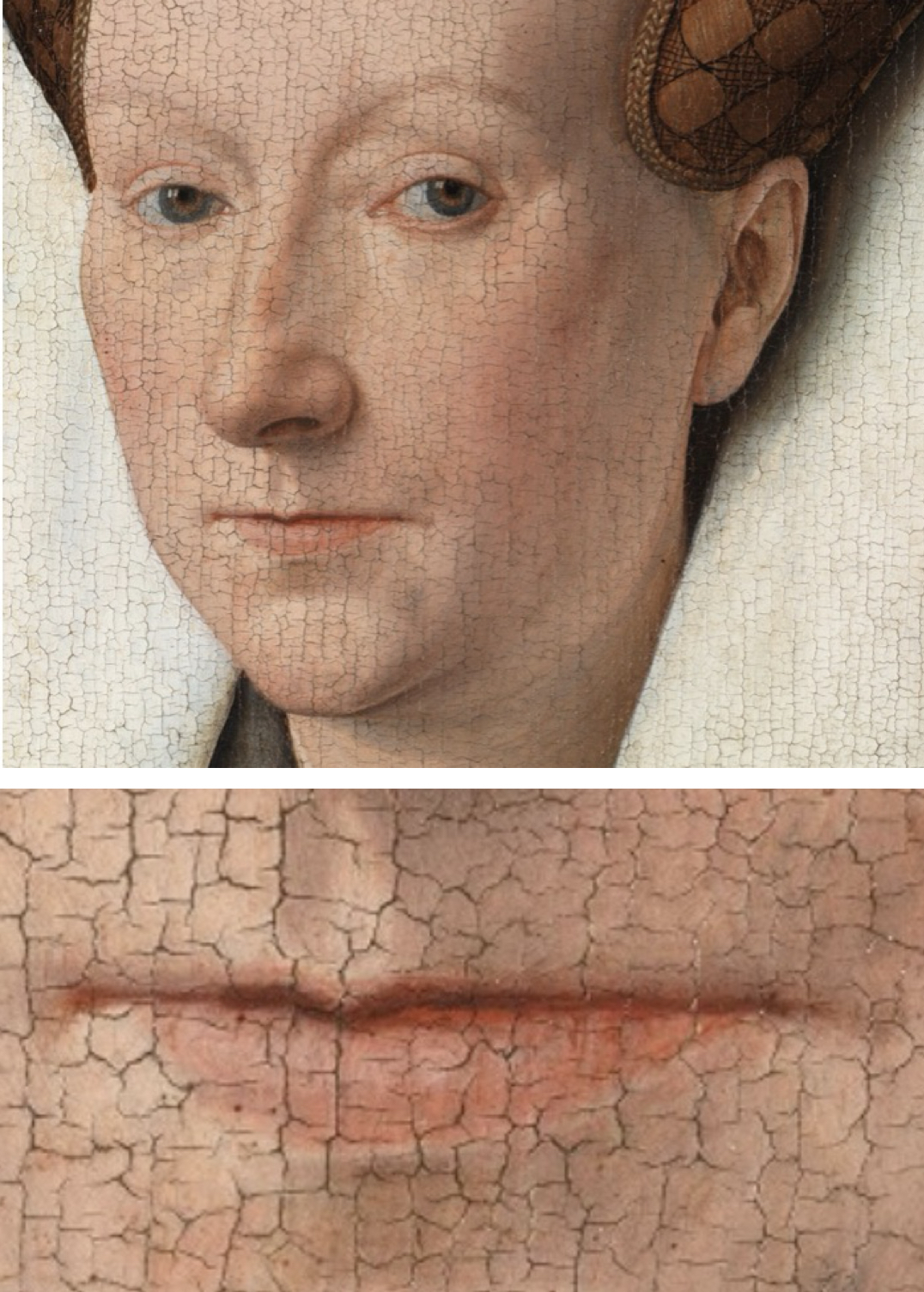
Portrait of the Artist's Wife, Margaret Van Eyck, two details
Click image to enlarge.
The image of Jan’s spouse, Margaret, like all his portraits is so photographic in appearance that it is taken to be an accurate likeness which, though the reasoning sounds plausible, is illogical because even fictional characters can be made to look real. Besides, it is self-evidently not a portrait as commonly understood: she has the same lips, eyes, eyebrows, nose, and chin as her husband, all feminized.1
Click next thumbnail to continue
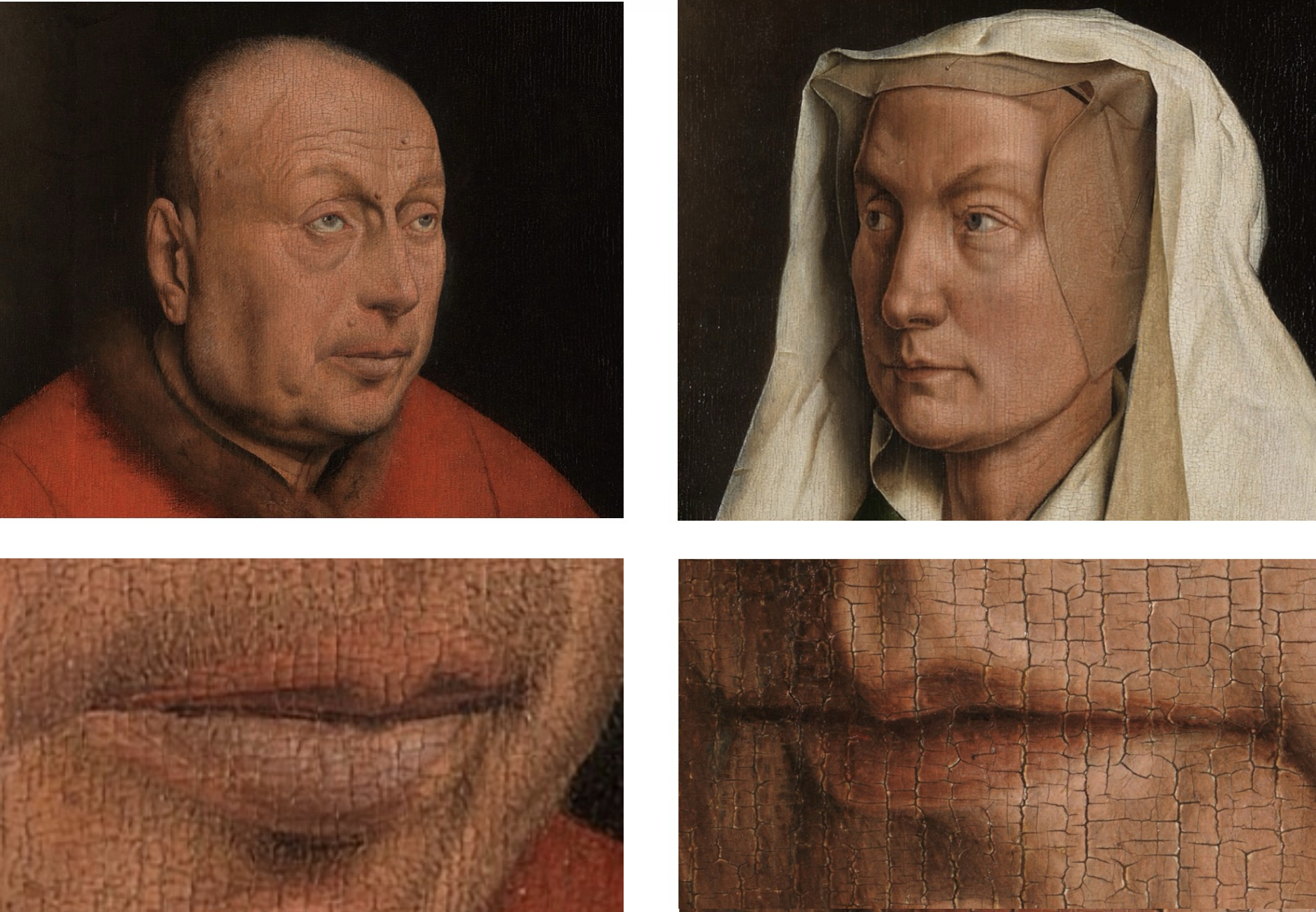
Portraits of Joos Vijd and Elisabeth Borluut, four details from the Ghent Altarpiece.
Click image to enlarge.
And, even if he did marry his twin sister, were his patrons relatives too? Joos Vijd, the donor of The Ghent Altarpiece, has a similar labial mismatch, as does Joos’s wife, Elisabeth Borluut.
Click next thumbnail to continue
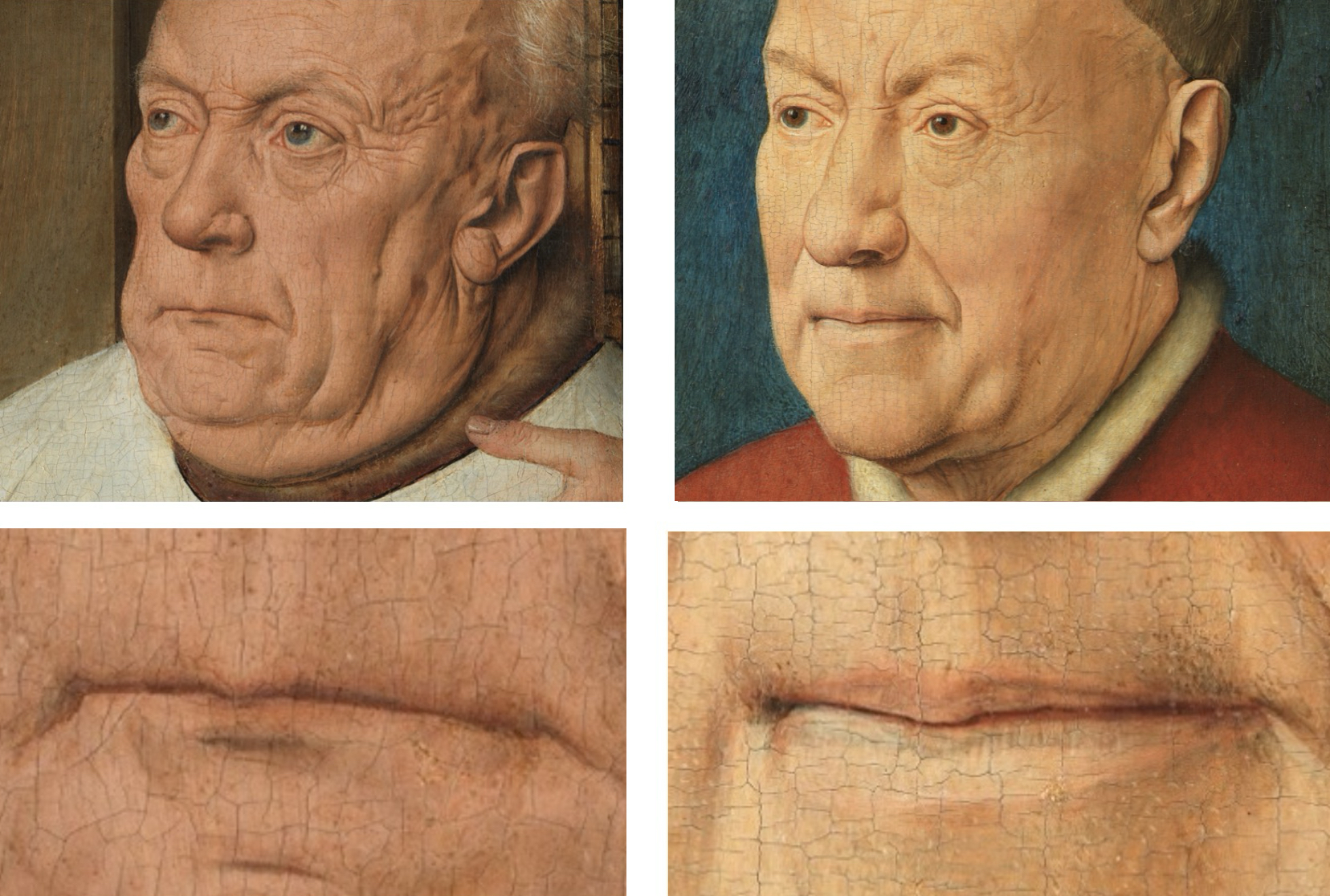
L, top and bottom: The Virgin of Canon van der Paele, two details of the Canon.
R, top and bottom: Portrait of Cardinal Albergati, two details
Click image to enlarge.
The color and shadow on Canon van der Paele’s shriveled lower lip indicates that its position is slightly off-center. Also, the lower lip of Cardinal Albergati, another important patron, is swollen on the left.
Click next thumbnail to continue
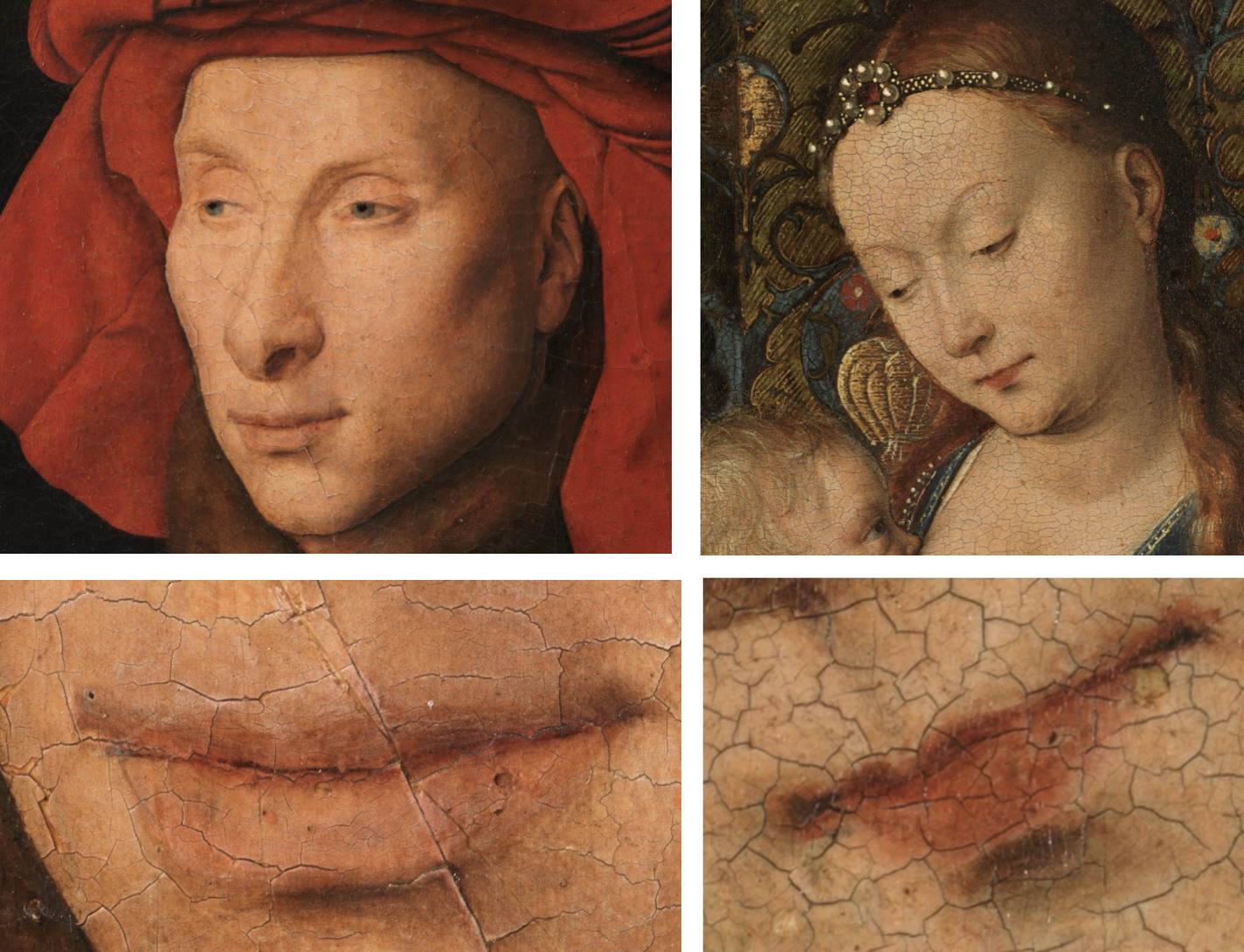
L, top and bottom: Portrait of Giovanni Arnolfini, two details
R, top and bottom: Lucca Virgin, two details of the Virgin
Click image to enlarge.
Even Giovanni Arnolfini and two Virgin Marys have a thin upper lip over an asymmetrical one. Five other portraits have similar problems, as does Saint George crowned with a laurel wreath in the Ghent altarpiece.
Van Eyck's lips became a self-reference like Michelangelo's fractured nose which Leo Steinberg observed on an angel and Virgin in the same painting.2 Goltzius used the same method with his deformed hand. So it's useful to study self-portraits (certain or not) when studying an oeuvre because, on looking closely, you may find a pattern in the larger whole.
More Works by Van Eyck
Notes:
1. See Abrahams, Who's Who in Portraits: The Artist's Wife (2008)
2. Leo Steinberg, Michelangelo’s Painting: Selected Essays by Leo Steinberg. Ed. Sheila Schwartz (University of Chicago Press), pp. 20, 234
Publication Date: 23 Aug 2026
© Simon Abrahams. All articles on this site are the copyright of Simon Abrahams. If you wish to use copyrighted material from this site in print or other media for purposes that go beyond 'fair use', you must obtain permission from the copyright owner. Other websites may link to this page without permission (in fact, please do) but may not reproduce the material on their own site.