Artemisia Gentileschi’s Allegory of Painting (c.1630)

Artemisia Gentileschi, Allegory of Painting (c.1630) Oil on canvas. H.M. Queen Elizabeth II.
Click image to enlarge.
Here is a good example of how a borrowed form borrows meaning. In Artemisia Gentileschi’s self-portrait as an Allegory of Painting, it has been recognized by others that Artemisia is thinking of herself as a personification of Art. Yet scholars' continuing belief in "art as an imitation of nature" leaves experts without a good reason why she would.
Click next thumbnail to continue

Caravaggio, Narcissus (detail rotated)
Click image to enlarge.
Even when Mary Garrard, the feminist art historian, found the answer she did not know it. Noting that Artemisia had turned the pose in Caravaggio’s Narcissus to the left, she ignored the implication in Artemisia's source.1
Click next thumbnail to continue

Caravaggio, Narcissus
Click image to enlarge.
Narcissus, of course, fell in love with his own reflection, a legend that Alberti later famously remarked led to the invention of painting. Thus, in basing her self-portrait on Caravaggio's painting, Artemisia's meaning is as clear as the water Narcissus looked into: painters paint themselves.
More Works by Gentileschi
Watch the bloody and cathartic experience of painting a masterpiece
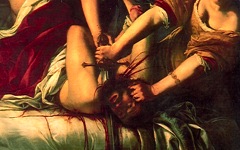
Artemisia Gentileschi’s Judith and Her Maidservant Slaying Holofernes
Notes:
1. Garrard, Artemisia Gentileschi: The Image of the Female Hero in Italian Baroque Art (Princeton: Princeton University Press) 1989, p. 365
Publication Date: 20 Apr 2010
© Simon Abrahams. All articles on this site are the copyright of Simon Abrahams. If you wish to use copyrighted material from this site in print or other media for purposes that go beyond 'fair use', you must obtain permission from the copyright owner. Other websites may link to this page without permission (in fact, please do) but may not reproduce the material on their own site.