Cranach’s Judith and Holofernes
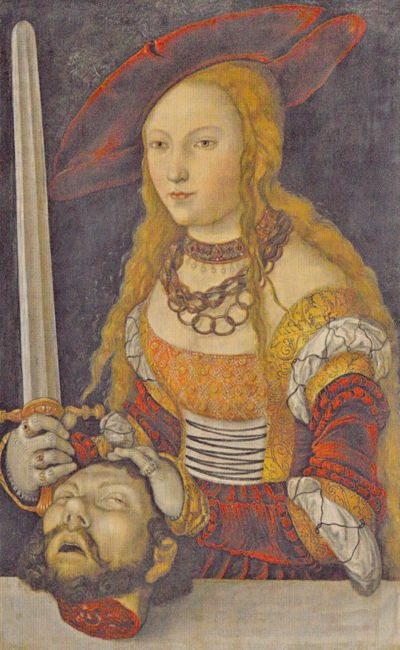
Cranach, Judith and Holofernes (c.1530) Oil on panel. Kunsthistorisches Museum, Vienna.
Click image to enlarge.
In this workshop copy of Judith and Holofernes by Cranach Judith brandishes her sword, the weapon with which she executed Holofernes' head. The obvious pride she has in the tool is at slight odds with the story. It is not the weapon with which Judith killed the general that is so important but the location (bedroom) and their relationship (sexual), neither of which is suggested.
On the underlying level, though, the tool she used is more important. She as the "artist" takes as much pride in her "paintbrush", the symbol of Cranach's craft, as in her "painting", the head of Holofernes beneath her hand. As in many other masterpieces explained under the theme Artist and Art Judith as the artist displays her masterpiece, Holofernes' head, two levels of reality fused into one.
Click next thumbnail to continue
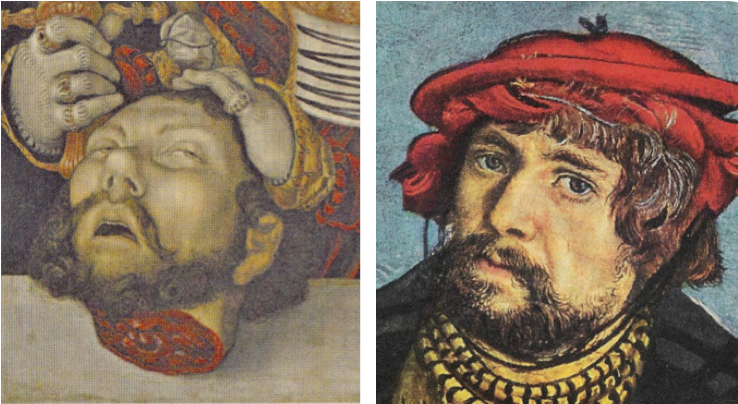
Left: Detail of Cranach's Judith and Holofernes
Right: Detail of Cranach's Self-Portrait from The Holy Kinship
Click image to enlarge.
Judith as Cranach's alter ego is one half of his androgynous mind with Holofernes, her opponent and unwanted lover, as the other. This may be why Holofernes' facial features bear a slight resemblance to Cranach's own: high cheekbones, rings under the eyes and a similar pattern to the mustache.
Click next thumbnail to continue

Left: Detail of Cranach's Judith and Holofernes
Right: Detail of engraving after lost self-portrait by Titian
Click image to enlarge.
Judith's gold chain, too, probably refers to the gold chains that emperors awarded their most important artists (left). Titian was particularly proud of his and used it in his self-portraits as a symbol of royal recognition and artistic supremacy (right). The tradition continued with Rubens and Van Dyck while Manet in the nineteenth century used the red rosette of the Legion d'Honneur for the same purpose.1
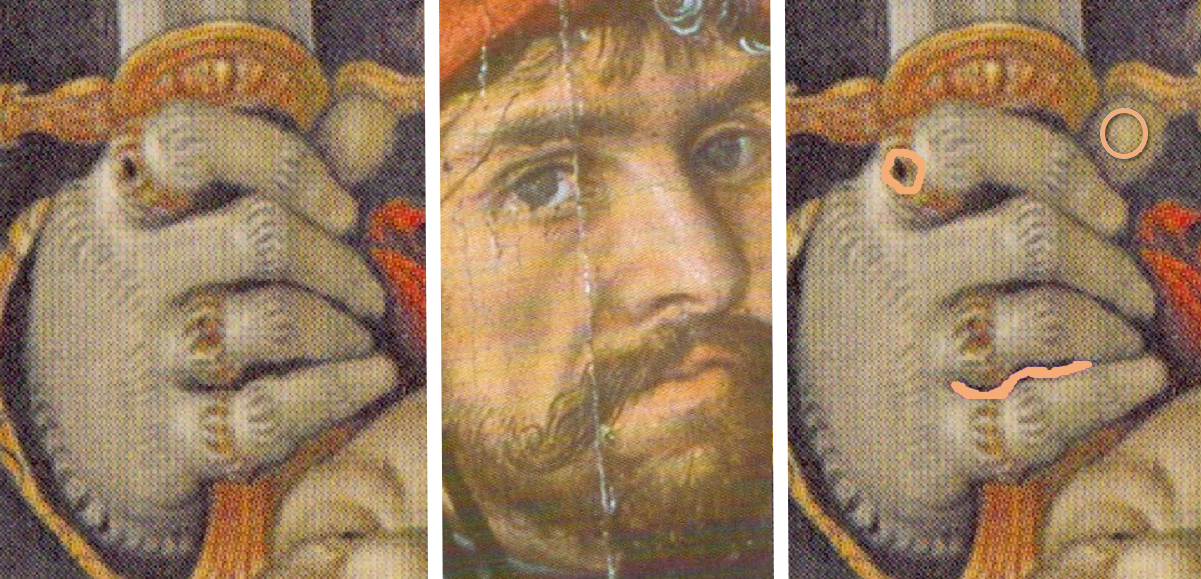
Left: Detail of Cranach's Judith and Holofernes
Center: Detail of Cranach's Self-Portrait from Beheading of St. John the Baptist
Right: Diagram showing three of Cranach's facial features echoed in Judith's gloved hand
Click image to enlarge.
This last suggestion will be met with scorn in some quarters but it is time that art historians woke up to how artists form seemingly unrelated objects into their own facial features. Often, as in some examples under Veiled Faces, the entire face is recognizable; in others, only one or two features. Here, Cranach has shaped the gap between two of Judith's fingers into the distinctive line of his mouth with the jewel in the ring as one eye and the round end of the thumb as the other. By fusing Judith's hand with his head, Cranach symbolizes the union of craft and conception with a giant "paintbrush" extending upwards out of his mind.
For a contemporary take on this painting, see Morimura's Mother (Judith 1).
More Works by Cranach the Elder
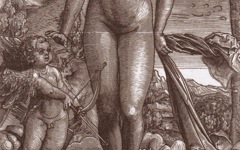
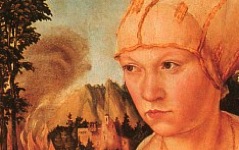
What can one learn from the single fragment of a larger painting? A lot, if you look.
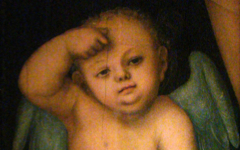
Cranach’s Cupid (c.1530)
Notes:
1. See Manet's The Suicide as one of possible many examples.
Publication Date: 31 Dec 2010
© Simon Abrahams. All articles on this site are the copyright of Simon Abrahams. If you wish to use copyrighted material from this site in print or other media for purposes that go beyond 'fair use', you must obtain permission from the copyright owner. Other websites may link to this page without permission (in fact, please do) but may not reproduce the material on their own site.