Delacroix’s Arab with His Steed or Turk Leading His Horse (c. 1832-3)

Delacroix, Arab with His Steed or A Turk Leading His Horse (c. 1832-3) Watercolor on white wove paper. Greville Winthrop Collection, Harvard
Click image to enlarge.
If a major artist from France, Spain, or Italy places a horse horizontally across the picture plane, it may well suggest an easel which in Romance languages derives from horse. In French, for Delacroix, chevalet. That suggests that the Arab is Delacroix's imagination of himself on the other side of his easel. The viewer is, as it were, inside "the canvas" watching the artist "paint" the horse in the mirror of his mind. The reflection of "Delacroix", his arm extended, "paints" it.
Click next thumbnail to continue
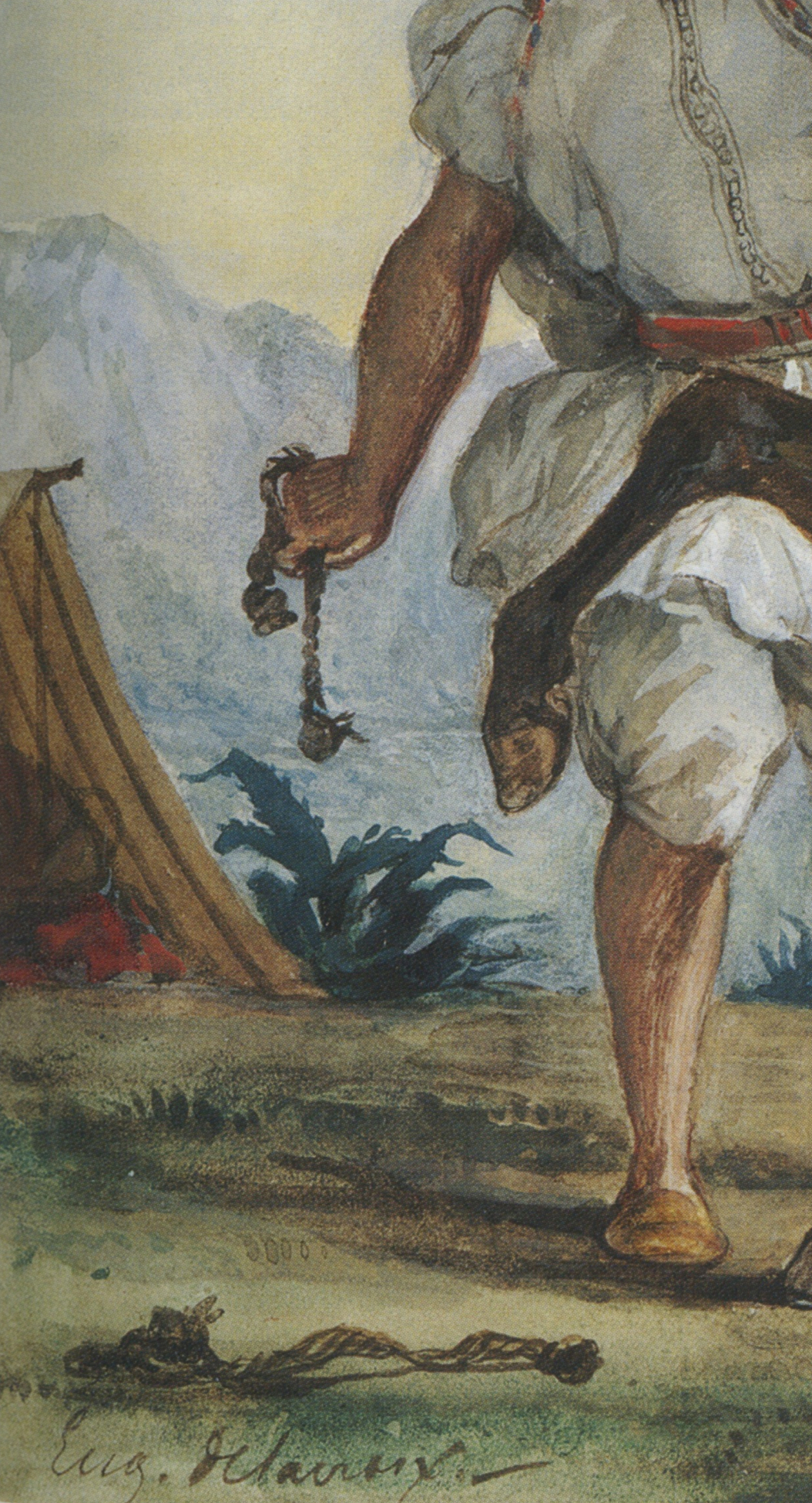
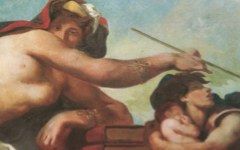
Detail of Delacroix's Arab with His Steed
Click image to enlarge.
The Arab's turban, however suitable for the scene, refers back to those worn by artists for hundreds of years to keep paint off their hair. Van Eyck and Rembrandt, among others, wear them in self-portraits.
This turbaned groom, though, also holds a piece of rope like the one above the artist's signature which, at the very bottom of this detail, is drawn in the same dark brown ink. Its duplication reinforces its metaphoric representation as Delacroix's "paintbrush."
Click next thumbnail to continue
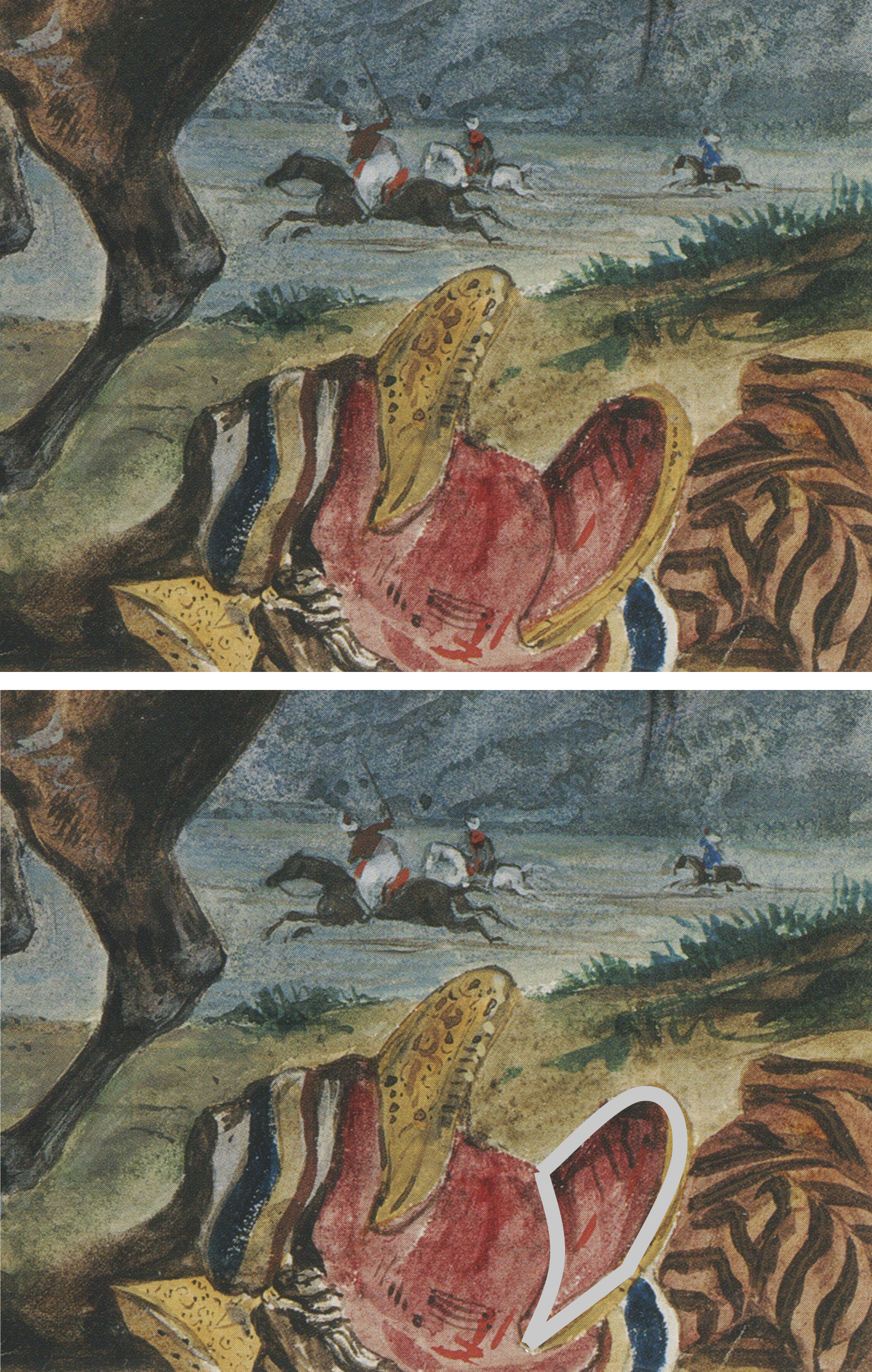
Top: Detail of Delacroix's Arab with His Steed
Bottom: Diagram of image above
Click image to enlarge.
The discarded saddle is portrayed as a still-life in the right-hand corner which, as one specialist noted, is characteristic of Delacroix in that it "establishes contact with the viewer." Yet there is almost always a signature twist within the still-life. The back of the saddle forms a large D for Delacroix while some parallel lines within it may have been intended as an E for Eugène, as in other watercolors.
Click next thumbnail to continue

Delacroix, A Turk Leading His Horse or Arab with Steed (c. 1832-3) Watercolor on white wove paper. Greville Winthrop Collection, Harvard
Click image to enlarge.
In this beautiful drawing Delacroix has fused the actions of his craft with his memory of Morocco, implying that the groom's attempt to restrain the frisky horse is an allegory of his own creative struggle to fix the fleeting image in his mind on paper.
___________
Elsewhere, EPPH has revealed how horses by Velazquez, Delacroix and Manet also signify easels in the "studio of their mind".
More Works by Delacroix
Learn how an artist's sketches and unfinished drawings help explicate a painting
Delacroix’s Two Women at the Well (1832)
Notes:
Publication Date: 04 Aug 2012
© Simon Abrahams. All articles on this site are the copyright of Simon Abrahams. If you wish to use copyrighted material from this site in print or other media for purposes that go beyond 'fair use', you must obtain permission from the copyright owner. Other websites may link to this page without permission (in fact, please do) but may not reproduce the material on their own site.