Dürer’s Portrait of Philip Melanchthon (1526)
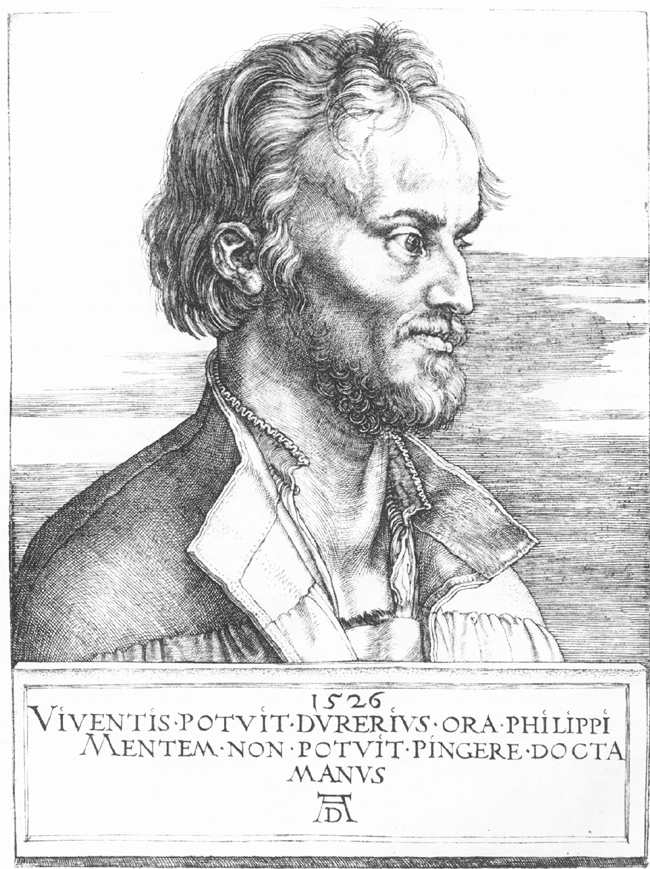
Dürer, Portrait of Philip Melanchthon (1526) Engraving on paper
Click image to enlarge.
Durer’s Portrait of Philip Melanchthon, a well-known religious reformer and theologian, is notable for the manner in which the artist treats the eyes, each of which has something odd about it. One eye is large, bright and clear; the other mostly unseen, the tip of its eyelash just visible above the clouds.
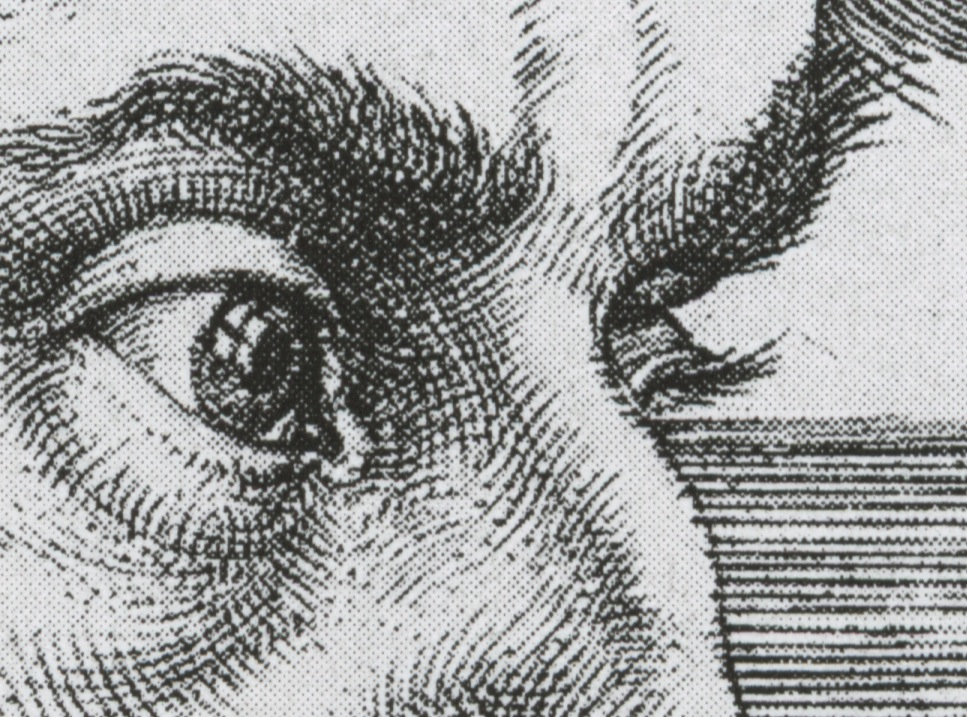
Detail of Dürer's Portrait of Philip Melanchthon
Click image to enlarge.
This contrast between a large eye and an unseen one is made more mysterious by how the top-most cloud disappears behind the far eye, a juxtaposition between cloud and eye that is highly suggestive. It is as though the eyelash is actively drawing lines, a kind of optical burin.

Top: Detail of lower edge of Dürer's 1500 Self-Portrait
Bottom: Detail of Dürer's Portrait of Philip Melanchthon
Click image to enlarge.
It is also tellingly similar to a small detail in Dürer's 1500 Self-portrait which Joseph Leo Koerner drew attention to (top)1. At the very lower edge where the image meets the frame some hairs of fur on Durer's sleeve peer like "eyelashes" from the bottom of the painting. They are so close to the edge that they are often cropped in reproduction. Koerner did not make the link between the sleeve and an eye but, to my mind, the sleeve in resembling eyelashes and the curve of an eye links Dürer's unseen hand with his eye just as the far eye in Melanchthon's portrait suggests a hand at work engraving the clouds.
Click next thumbnail to continue

Detail of Dürer's Portrait of Philip Melanchthon
Click image to enlarge.
To make matters more complex, the reflection of a window in the near eye counters the figure’s supposed location “out-of-doors.” One nineteenth-century art historian complained that the presence of the window's reflection "verges on the ridiculous" as the clouds demonstrate that he is out of doors.2 It is always safer to assume, though, that our thinking is ridiculous, not the artist's. As so often in art, this portrait makes clear - to those willing to see - that it is not a record of reality like an early photograph. It does not depict the sitter in our illusory world and should not be thought of as such.
Click next thumbnail to continue
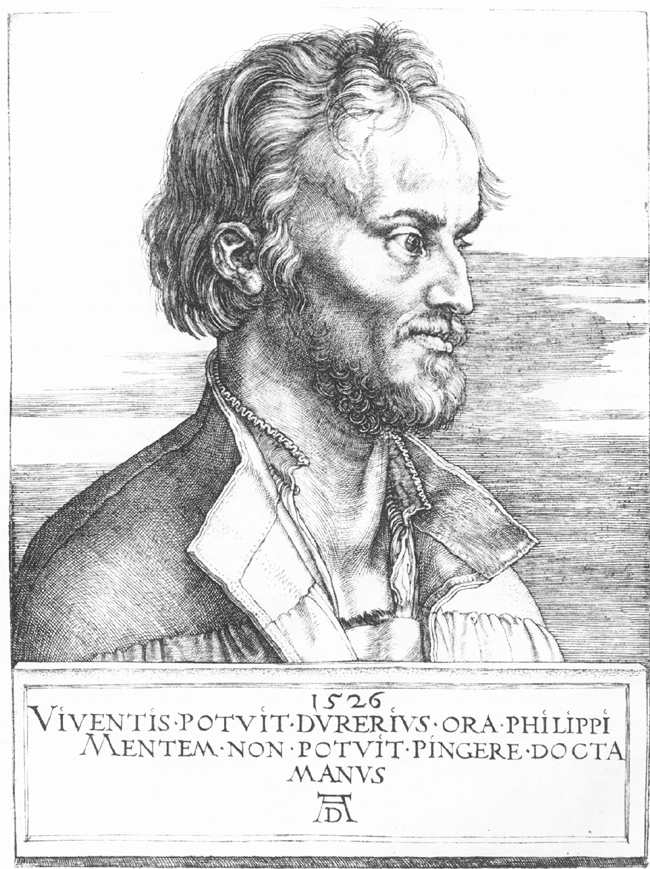
Dürer, Portrait of Philip Melanchthon (1526)
Click image to enlarge.
Dürer suggests that this theologian is a poet and his alter ego. His near eye looking inwards sees clearly, while the far eye looking outwards creates an illusion. Insight and out-sight are different forms of perception: a painter uses the latter alone, an artist both.
More Works by Dürer
See how artists continually think on another level beyond the narrative
Dürer’s Rape of Europa and Other Studies (1494-5)
Notes:
1. Koerner, The Moment of Self-Portraiture in German Renaissance Art (University of Chicago Press) 1993, p.141
2. S. R. Koehler, Catalogue of the Exhibition of Albrecht Dürer's Engravings, Etchings and Drypoints, and most of the Woodcuts Executed from his Designs (Museum of Fine Arts, Boston) 1888, p. 101 cited in Walter L. Strauss ed., The Complete Engravings, Etchings and Drypoints of Albrecht Dürer (New York: Dover) 1972, p. 218
Publication Date: 02 Aug 2011
© Simon Abrahams. All articles on this site are the copyright of Simon Abrahams. If you wish to use copyrighted material from this site in print or other media for purposes that go beyond 'fair use', you must obtain permission from the copyright owner. Other websites may link to this page without permission (in fact, please do) but may not reproduce the material on their own site.