Holbein’s Jakob Meyer zum Hasen (1516)
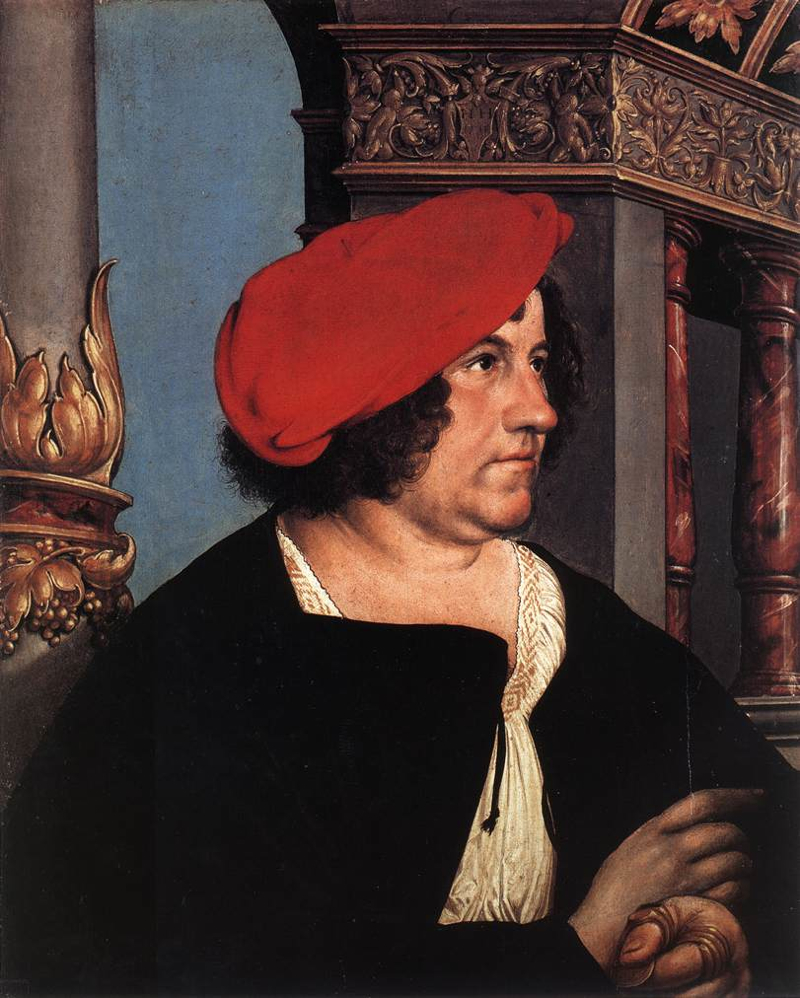
Holbein, Portrait of Jakob Meyer zum Hasen (1516) Oil on wood, Kunstmuseum, Basel
Click image to enlarge.
Many of the portraits shown on this site use what we call "face fusion", a combination of the artist's features with the sitters', to convey that the sitter is an alter ego of the artist. In this 1516 portrait Holbein did use some of his own features in Jakob Meyer's face (for example, the short diagonal eyebrow on the left) but he did not rely on that method alone to convey his message.1
Click next thumbnail to continue

Detail of Holbein's Portrait of Jakob Meyer zum Hasen
Click image to enlarge.
Look at the hands in the lower right corner. One holds tight to a coin between thumb and forefinger. Together they echo how an artist’s thumb strains to hold the rounded shape of a flat palette, often angled downwards like the coin. The other hand (heavily restored) is oddly relaxed but in facing inwards the hand suggests that it might even belong to Holbein himself outside the picture. The finger, on the poetic level, is "a brush". And in pointing at its own figure it signifies that the artist paints himself or an alter ego. Besides, in other pictures from the same year, two signboards for a school, the young Holbein conveyed a similar idea.
Pay attention to hands because they are often symbolize the artist's craft.
More Works by Holbein
Why would a great master when copying a portrait by an earlier master change the features of the portrait sitter?

Ingres’ Copy of Holbein’s Henry VIII

Notes:
1. For more on Face Fusion, see Portraiture
Publication Date: 05 Mar 2011
© Simon Abrahams. All articles on this site are the copyright of Simon Abrahams. If you wish to use copyrighted material from this site in print or other media for purposes that go beyond 'fair use', you must obtain permission from the copyright owner. Other websites may link to this page without permission (in fact, please do) but may not reproduce the material on their own site.