Manet’s Tragic Actor (1865-6) Part 2
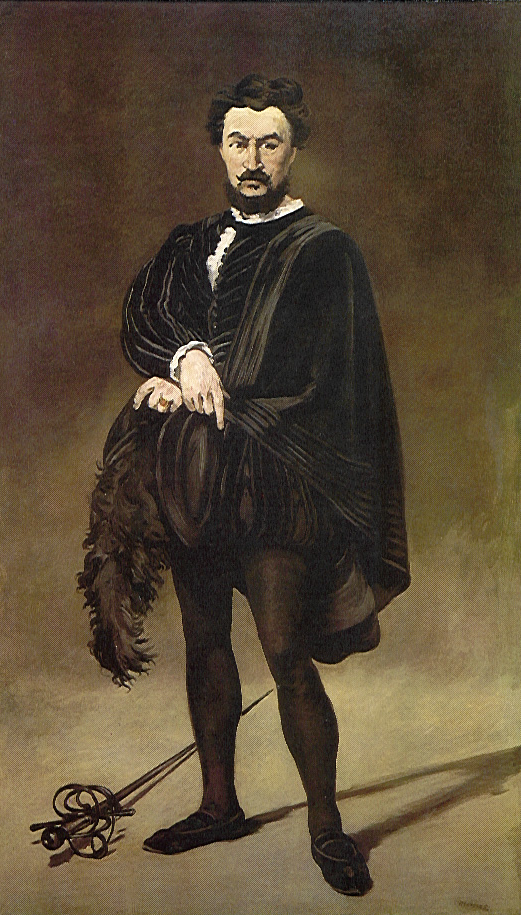
Manet, The Tragic Actor (1865-6) Oil on canvas. National Gallery of Art, Washington DC.
Click image to enlarge.
In Part One of The Tragic Actor I showed how the figure's pose is linked to Goya and in a separate entry on Velazquez's Pablo de Vallodolid to that actor too, an alter ego as well. There are two Spanish masters in one French actor who happened to be an artist too. With the sword as his brush Manet painted the figure, then left the sword pointing inwards on the surface of the canvas as its shadow suggests.
Click next thumbnail to continue

L: Manet, The Tragic Actor
R: Raimondi, Portrait of Raphael (Engraving)
Click image to enlarge.
Although devoted to Velazquez Manet declared his (and the canon's) dependence on other great masters too by inserting links to more than just Velazquez and Goya. Here, the cloak over his shoulder, his glance to the right in a bare room with few objects only related to art, links him to the figure of Raphael in Marcantonio Raimondi's little known print of the Italian master in his studio.1 This has never been noted even though Manet's first Salon submission, The Absinthe Drinker, is even more dependent on this print.
Click next thumbnail to continue
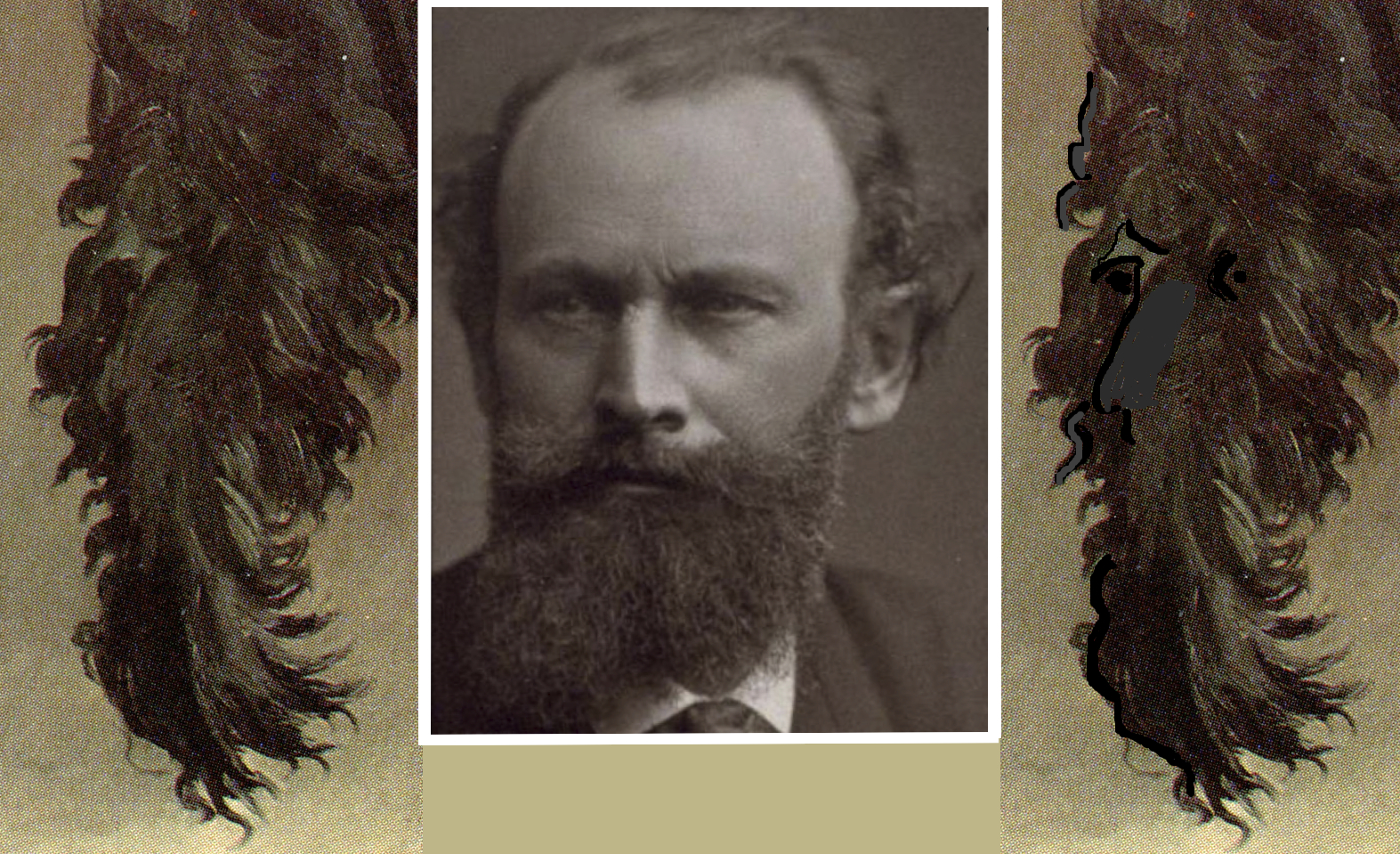
L: Detail of Manet's Tragic Actor (1865-6)
C: Photo detail of Edouard Manet, c.1860's.
R: Diagram of the Tragic Actor's detail at left
Click image to enlarge.
In the plumed hat the features of Manet's face and unkempt hair are faintly suggested. [Click on image to enlarge.] There are disconnected features all over but the main image appears to suggest Manet's head turned to the left. His far eye and eyelid are delineated (perhaps a frown too), along with the contour of his nose, the silhouette of his moustache on the far side, his beard below and the left-hand side of his near eye too. The feathers at far left might even depict his features' shadow on "a wall".2
Click next thumbnail to continue
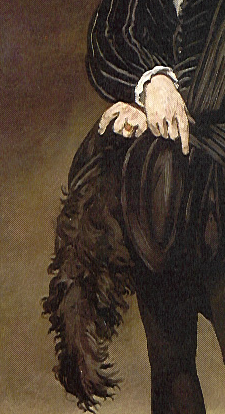
Detail of Manet's Tragic Actor
Click image to enlarge.
Out of Manet's proto-cubist head, illustrating his fertile imagination, emerge the hands of an "artist" whose figure is based on the great masters. The sword, a phallic object, is the principal accessory. To indicate, though, his own androgyny, he added a vaginal shape to the cloak below his hands which are themselves symbols of his manual craft. The mandorla-shape, even used in images of the Virgin in the Renaissance, is placed next to and above his feathery "face" thereby implying that the painting's conception took place in his mind.
More Works by Manet

Notes:
1. The shoulder is a significant body part for an artist because figures posed to look over their shoulder are commonly self-referential as I explained in Over the Shoulder Poses. The Tragic Actor's pose may well refer to Poussin as well as he too used this print by Raphael, and the cloak over the shoulder, for his own 1650 self-portrait.
2. The hodge-podge of facial features suggested in the feathers is not as unusual as it may now appear. Similar metamorphoses have, for example, been identified in Albrecht Dürer's St. Jerome in the Wilderness (1496). Visual metamorphosis has been a feature of Western art for many centuries as I demonstrate in works listed under the theme. More Cubist-like versions will be shown later.
Publication Date: 14 Jan 2013
© Simon Abrahams. All articles on this site are the copyright of Simon Abrahams. If you wish to use copyrighted material from this site in print or other media for purposes that go beyond 'fair use', you must obtain permission from the copyright owner. Other websites may link to this page without permission (in fact, please do) but may not reproduce the material on their own site.