Manet’s View of the Universal Exhibition (1867)
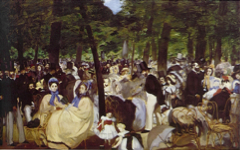
In 1867 Paris held the equivalent of a World's Fair. It was known as The Universal Exhibition and created such excitement that Manet was inspired to create a lasting view of the event. Or did he? Once again, initial expectations are mistaken and, as always, it is worth keeping in mind the criticisms of the painting by both his contemporaries and modern scholars.
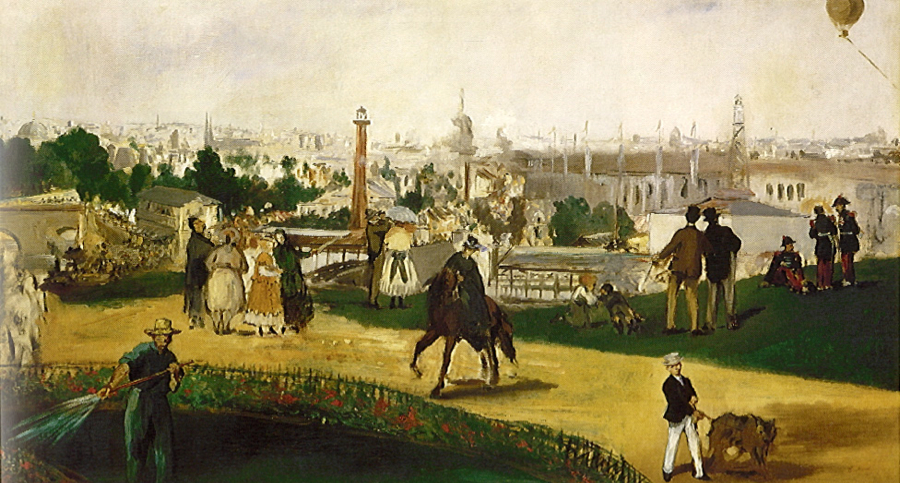
Manet, View of the Universal Exhibition (1867) Oil on canvas. Nasjonalgalleriet, Oslo, Norway
Click image to enlarge.
The most common complaint is that Manet has merged the background with the foreground thereby making it look as though the Seine has disappeared. In reality, it runs between the Trocadero and the distant view. Another critical comment is that Manet has "flattened" the background to concentrate the viewer's attention on painting's essential characteristics. As you will see, the observation is correct but not the conclusion.
Click next thumbnail to continue
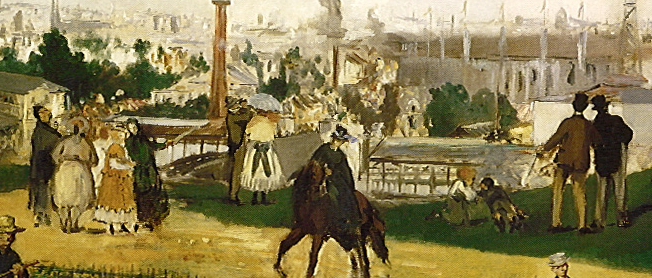
Detail of Manet's View of the Universal Exhibition
Click image to enlarge.
Manet's painting puns on the art world's understanding of Exhibition. The foreground figures are in a "gallery" or "studio" admiring the painting by Manet in the background (left). It looks flat because paintings are flat. And, no doubt, Manet dreamt of a Universal Exhibition for his paintings in any event; it signals the appearance of a great master.
Click next thumbnail to continue

Manet, View of the Universal Exhibition (1867)
Click image to enlarge.
As in other works by Manet, the subject of his imaginary painting has fused with the studio space.1 That is why the Seine has disappeared; it was not in "his painting" to begin with.
Separately, on another level, the circular garden represents a portion of the artist's eyeball which the gardener rakes to encourage its fertility. This conveys, as in examples by Goya, that the scene takes place in Manet's eye. (See "Behind Goya's Eyes" and the last frame on The Meadows of San Isidro.)
Click next thumbnail to continue

Manet, The Horsewoman (1865)
Click image to enlarge.
Manet had painted a similar but simpler composition two years earlier. The horsewoman at left turns away from her "canvas" in a pose characteristic of an artist. She holds her whip as a "paintbrush" and the background is her "painting". Yet even though the background looks unfinished, Manet signed the canvas. Why? Manet's "painting" may be finished but the rider's is not. It is in the process of creation.
In a further twist the rider shares Manet's red hair, a symbol of the androgyny of Manet's mind.
More Works by Manet
Notes:
Publication Date: 18 Jan 2011
© Simon Abrahams. All articles on this site are the copyright of Simon Abrahams. If you wish to use copyrighted material from this site in print or other media for purposes that go beyond 'fair use', you must obtain permission from the copyright owner. Other websites may link to this page without permission (in fact, please do) but may not reproduce the material on their own site.