Michelangelo’s Sistine Ceiling 1: The Flood
This is the first in a series of brief posts explaining the Creation panels of the Sistine ceiling in unusual ways. The images seen conventionally depict the events of Genesis but they can also be viewed as representations of mental images inside Michelangelo's mind, compositions so masterful that he could reasonably have thought, as we know he often did, that God had helped him. The short explanations highlight key features clarifying each panel so that readers can begin to see them as Michelangelo and his few peers might have.
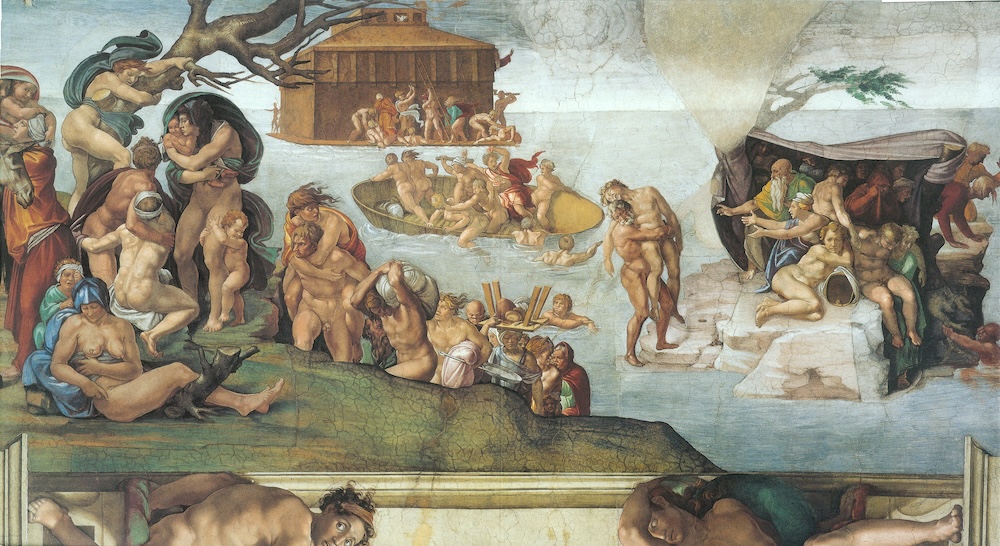
Michelangelo, The Flood (c. 1508-10)
Click image to enlarge.
The first scene painted was The Flood which barely recalls the biblical story. The only animal appears as a donkey's head and many of the figures seem saved even though all mankind, except Noah's family, perished. Even if the waters rise further, the depiction defies narrative expectations. All changes, though, on realizing that the ark in the distance resembles the Sistine chapel itself which is built like a fortress.
Click next thumbnail to continue
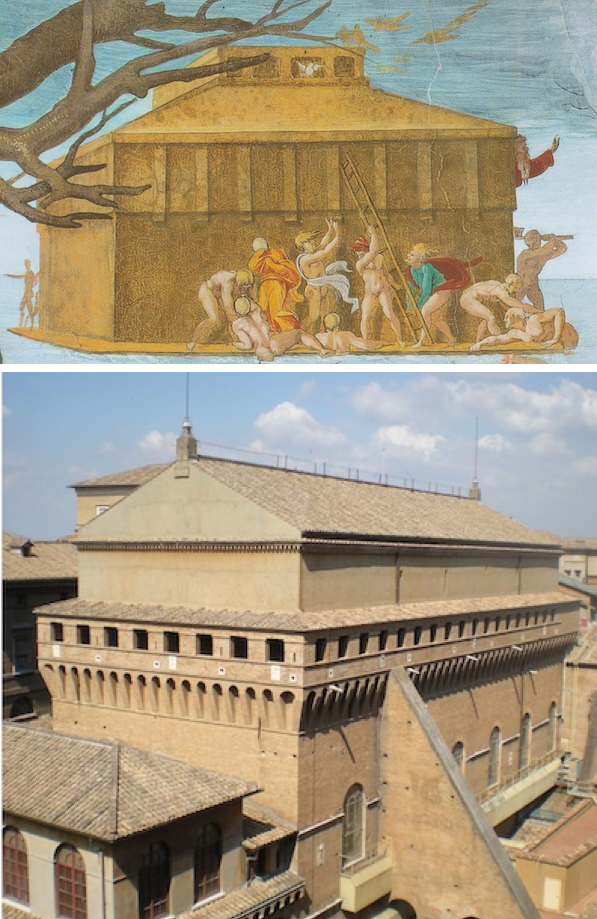
Above: The Flood, detail.
Below: Photograph of the Sistine Chapel exterior.
Click image to enlarge.
With repetitive vertical strips high on the walls below square openings, the ark-as-chapel is different enough not to have been recognized publicly yet close enough to have been perceived by other artists. This was the first step in Michelangelo's self-representational enterprise in that, on starting to paint the chapel, he painted "the chapel", outside in.
Click next thumbnail to continue
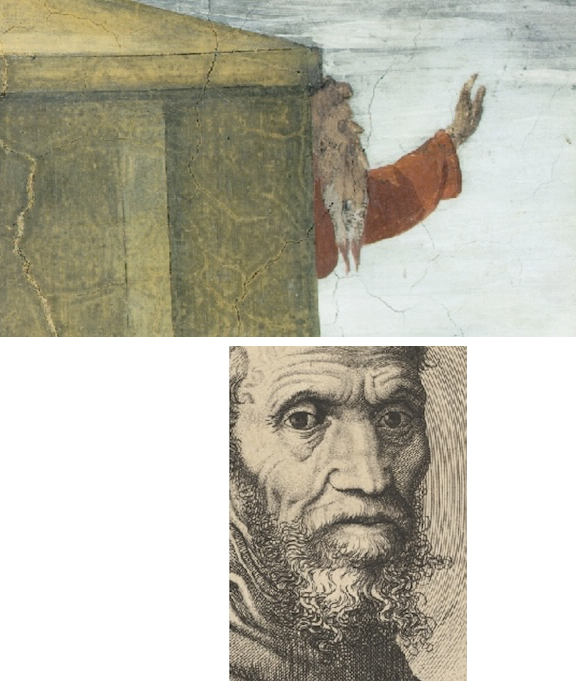
Above: The Flood, detail
Below: Portrait of Michelangelo, engraved by Giorgio Ghisi, detail
Click image to enlarge.
Meanwhile, Noah’s extended arm makes him resemble both God in an act of Creation and an artist “painting” the “sky”.1 He even sports a bi-forked beard, an iconic feature of Michelangelo present in most portraits.2 Vasari described the sculptor as a prophet, and Michelangelo repeatedly depicted himself in the guise of a saint3 which suggests that Noah here is Michelangelo's alter ego. In addition, both he and Noah felt the divine worked through them.
If so, a beautiful paradox follows: Noah is “painting” the interior of the chapel outside the ark, as Michelangelo painted its outside inside. It depicts a duality which he is
forever dwelling upon in his poetry when he speaks of how he appears outside or “fuori” and what he would be within or “dentro”.
Click next thumbnail to continue
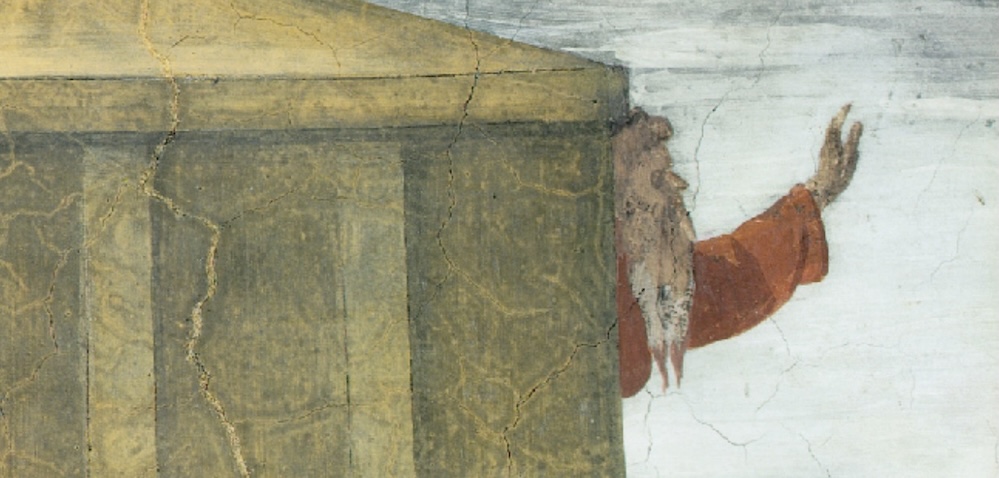
The Flood, detail
Click image to enlarge.
The artist also worked at the same level Noah does in the image, at the top of the walls, and like Noah again used his fingers to paint parts of the ceiling. These inversions of inside and outside are critical to the meaning of the entire ceiling which will be explained further in posts to follow.
More Works by Michelangelo
Michelangelo's strange scene of a battle is not what it seems
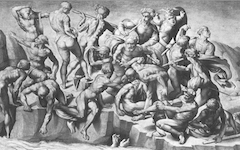
Michelangelo’s Battle of Cascina (1504)
Notes:
1. William Wallace noticed a similar gesture “drawing” the image itself in Michelangelo’s Seated Woman (British Museum). Wallace, “Instruction and Originality in Michelangelo’s Drawings” in The Craft of Art: Originality and Industry in the Italian Renaissance and Baroque Workshop, ed. A. Ladis and C. Wood, Athens and London, 1995, pp. 120-121; See also Poses of Painting.
2. J. T. Paoletti, “Michelangelo’s Masks”, Art Bulletin, 74, 1992, p. 428, n. 14.
3. Paul Barolsky, Michelangelo’s Nose: A Myth and its Maker (University Park: The Pennsylvania State University Press) 1990, pp. 37-55
4. ibid., p.20.
Publication Date: 30 Jul 2026
© Simon Abrahams. All articles on this site are the copyright of Simon Abrahams. If you wish to use copyrighted material from this site in print or other media for purposes that go beyond 'fair use', you must obtain permission from the copyright owner. Other websites may link to this page without permission (in fact, please do) but may not reproduce the material on their own site.