Picasso’s The Kitchen (1948)
In 1948 Picasso painted a linear image of the kitchen he shared with Francoise Gilot. It has always been called The Kitchen. The style Picasso used in it had originated a few years earlier when he was illustrating Pierre Reverdy's poem, The Song of the Dead. (See entry on Picasso's Ps.) Although Gilot has claimed that the canvas depicts the "walls, table, door, stove, cabinets and even a growing plant reduced to mere vertical arrows"1 of their kitchen, it hardly resembles one. It looks more like the memorial sculpture Picasso had designed thirty years earlier for Guillaume Apollinaire, the French-Polish poet and one of his closest friends. That is why commentary on this painting tends to waver between between calling it a kitchen or a second memorial for Apollinaire. Does this image really depict a kitchen or is it only called The Kitchen because Picasso may have said so? Pamela H. Smith has noted that many ingredients used in the kitchen have also been used in art studios since before the Renaissance.
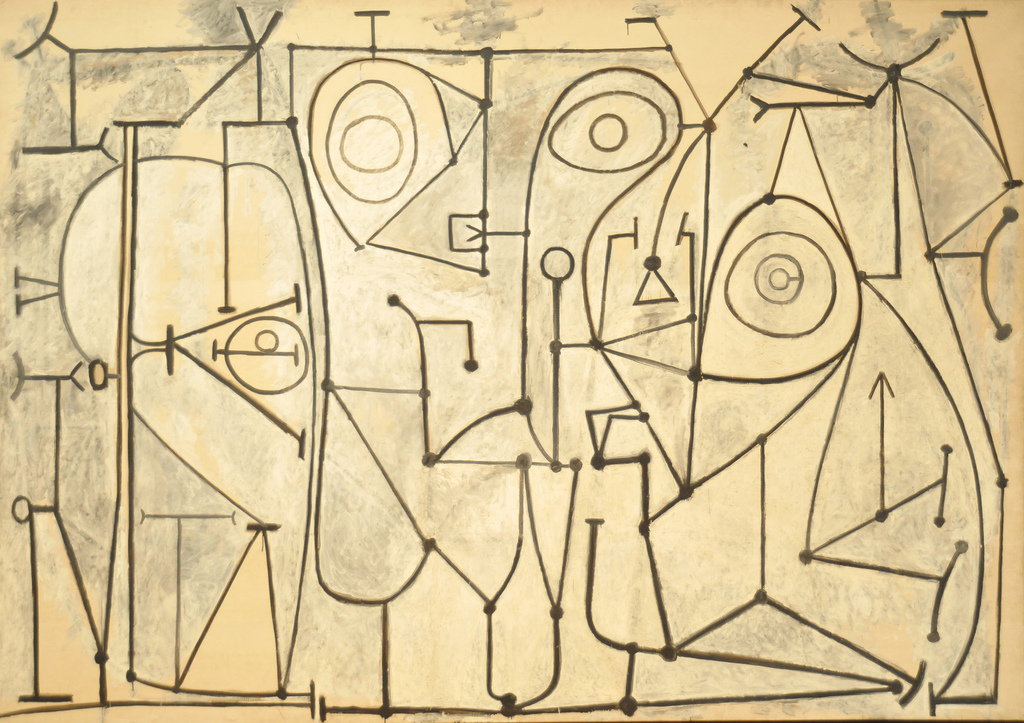
Picasso, The Kitchen (1948)
Click image to enlarge.
Smith's examples include a recipe for goat glue sounding like food preparation; beer which could be used for gilding; flour and water for glue; the dough of bread was used both as an eraser and cleaner on drawings etc. etc. So, which is it? Picasso identifying with a poet or an allegory about art based on a kitchen? What no-one has noticed, though, is Picasso's self-portrait at left.

Left: Diagram of self-portrait in Picasso's The Kitchen
Right: Picasso, Self-portrait (1921), inverted
Click image to enlarge.
Compare the diagram to a 1921 self-portrait and Picasso's bull-nose becomes apparent. And just as we revealed that Poussin in The Ordination placed an N for Nicolas in the eye of Christ, the initial of his first name, so Picasso placed a P in his.
Click next thumbnail to continue
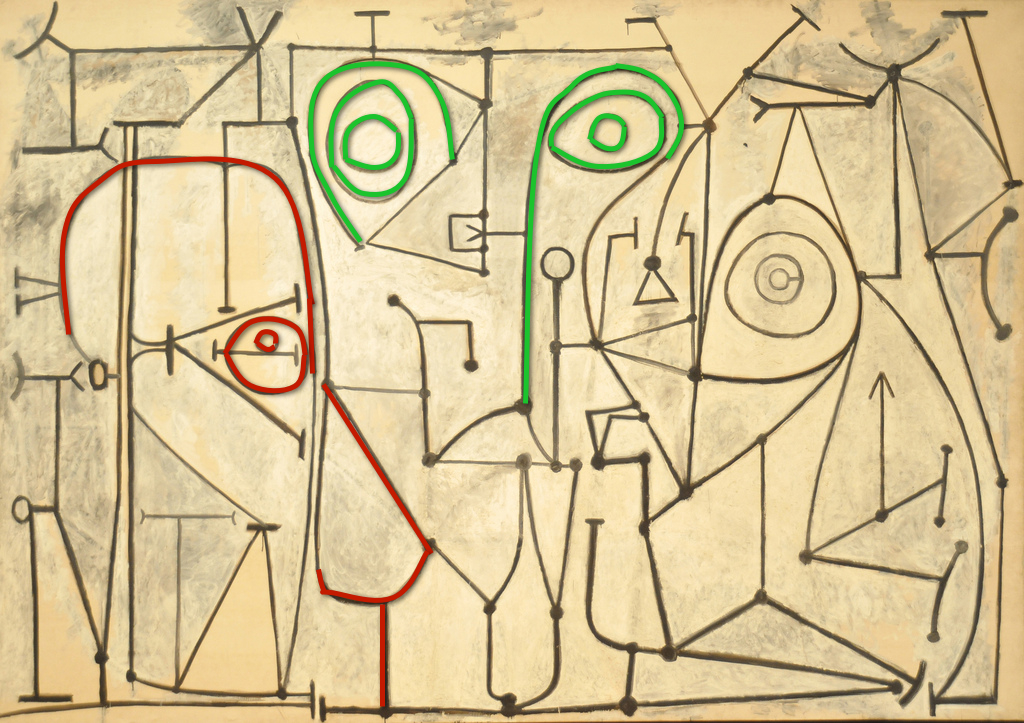
Diagram of self-portrait and a second portrait n Picasso's The Kitchen
Click image to enlarge.
Besides there is a second portrait in the center looking out at us, eyes and nose only.
Click next thumbnail to continue
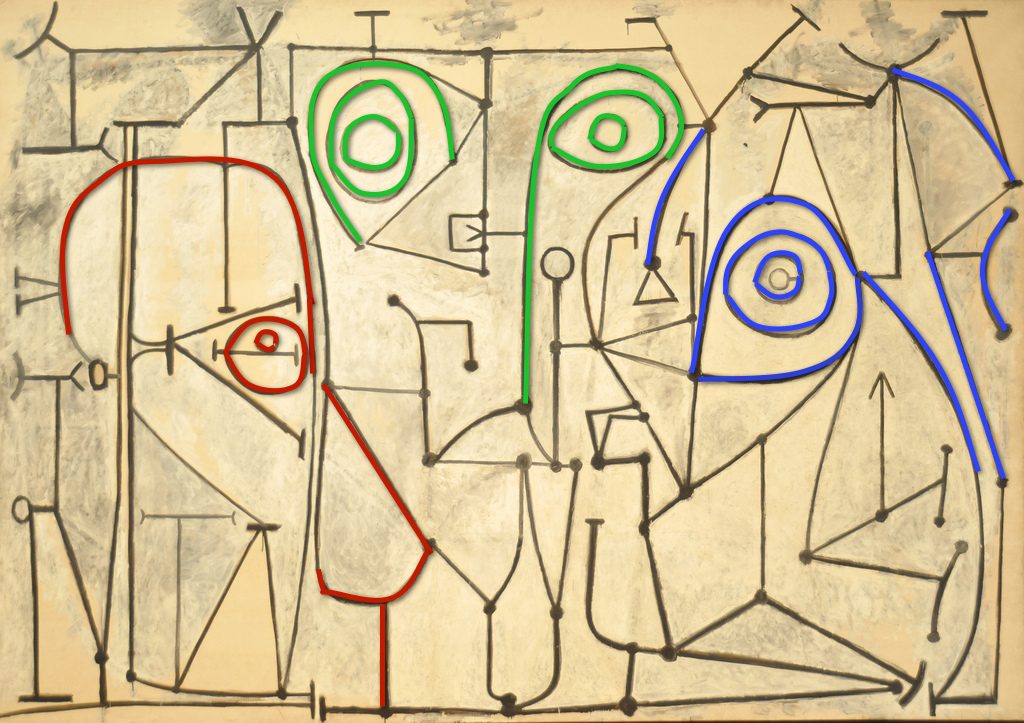
Diagram of self-portrait and two other portraits n Picasso's The Kitchen
Click image to enlarge.
A third head on the right completes the triple portrait. The identity of the last two heads, however, remains unknown. Nevertheless, given the composition's lack of resemblance to a kitchen or Apollinaire, there is only one thing certain: more research is needed.
For other hidden portraits see the theme: Veiled Faces and works by Leonardo, Cezanne, Balthus and others.
More Works by Picasso
The magic of visual illusion was not an invention of the Surrealists; it has been an integral part of art for centuries.
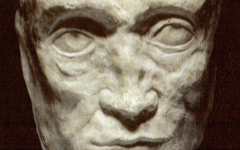
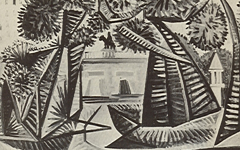
Velazquez’s Portrait of Luis de Góngora (1622)...and Picasso’s.
Notes:
Publication Date: 04 May 2011
© Simon Abrahams. All articles on this site are the copyright of Simon Abrahams. If you wish to use copyrighted material from this site in print or other media for purposes that go beyond 'fair use', you must obtain permission from the copyright owner. Other websites may link to this page without permission (in fact, please do) but may not reproduce the material on their own site.