Picasso’s Women on the Beach (1947)
It's so easy to accept what you initially see; it needs no effort. Creative perception, on the other hand, requires perserverance to re-imagine the visual data in a different way. Major artists take time to consider the art of their peers, and what they plan for their own. Their illusions, though, must not only fit consistently into their own past oeuvre but within art's traditions too.

Picasso, Women on the Beach (1947) Lithograph on paper.
Click image to enlarge.
This lithograph by Picasso is titled Women on the Beach because of the horizon line and some similar scenes of bathers. However, that line is oddly short. Beware. The Spanish master, like other major artists, almost always makes two images in one (see other examples by Picasso).
Click next thumbnail to continue
Click image to enlarge.
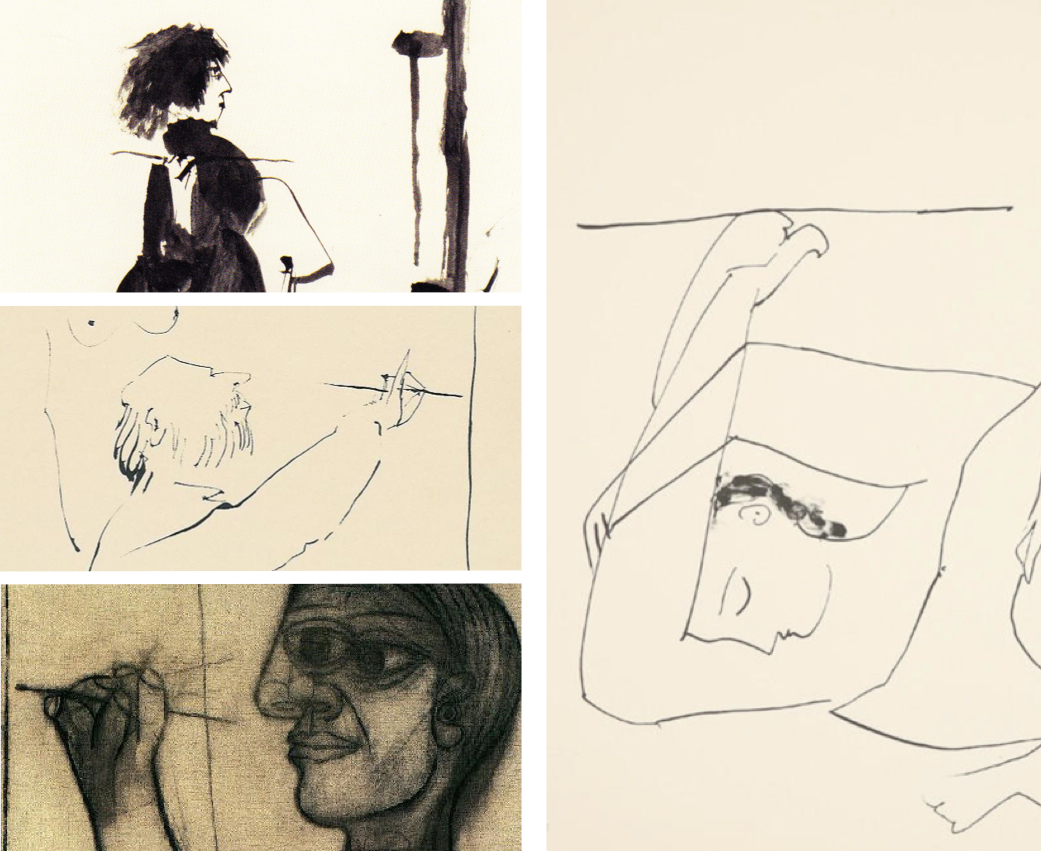
His studio scenes sometimes include a painter holding a brush horizontally, as in the examples (far left). Thus, the horizon line in Women on the Beach can also be read as an artist's tool which makes the sleeping woman an "artist" (right). She not only touches the "horizon line" but has two right hands. A cursory viewer might think Picasso corrected the hand without erasing his first attempt. Not so. The two are intended to indicate the dual meaning of the short horizon. Artists often leave hints for the perceptive viewer; this is one of them.
Click next thumbnail to continue
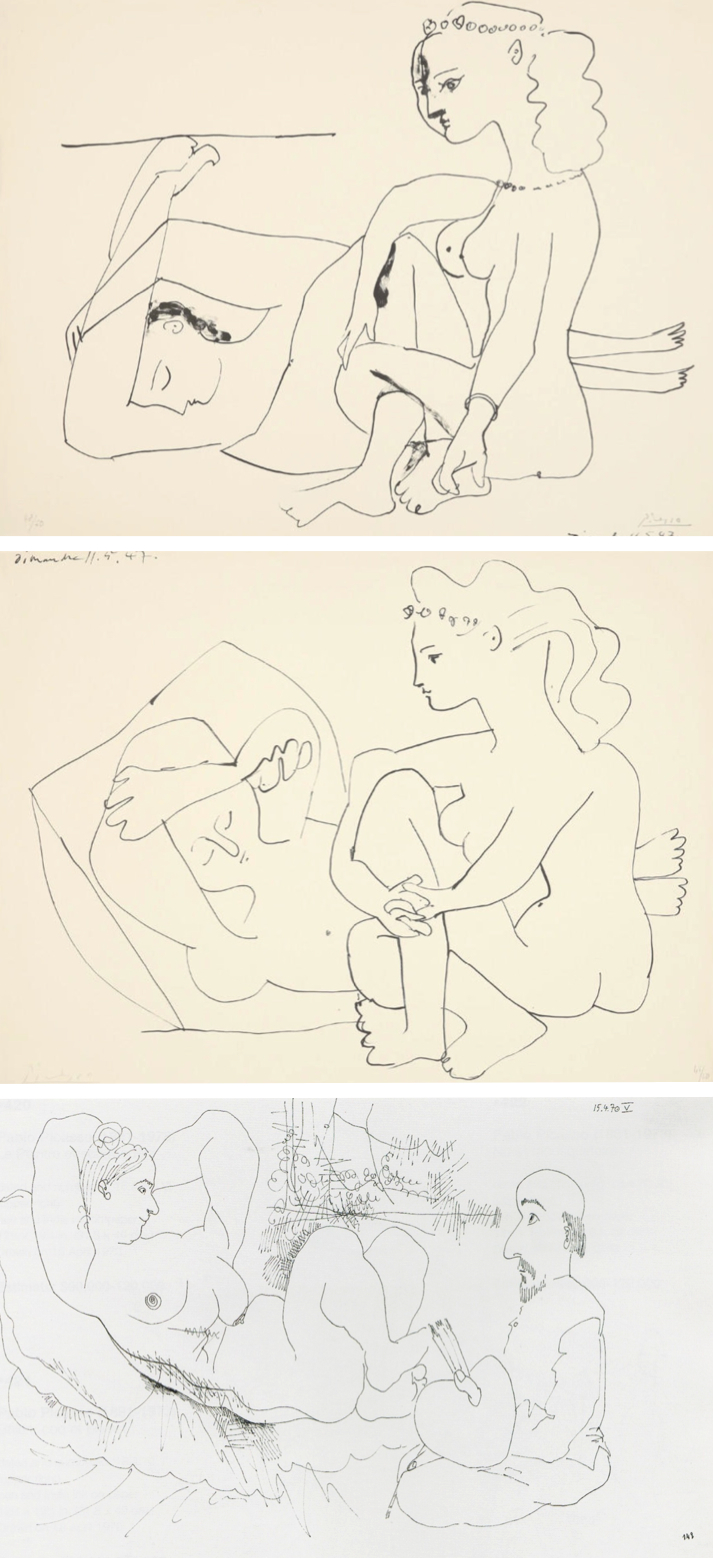
Top: Picasso, Women on the Beach (1947)
Center: Picasso, Young nude women resting (1947) Lithograph
Bottom: Picasso, The Painter and His Model.15.4.70.V. (1970) Pen and ink on paper.
Click image to enlarge.
If we look at another print in the series (below center), the horizon is gone, but the same nude rests her head on a rectangular pillow resembling a canvas angled on an invisible easel. Her head is painted on it. This makes the other woman an "artist" too: the real or primary artist, a pattern in keeping with art's long tradition of reclining nudes. For comparable examples, see EPPH's interpretations of Manet's Olympia (1863), or Titian's Venuses and, of course, within Picasso's oeuvre too (bottom image).1 There are hundreds of similar examples.
This means that the seated nudes in both scenes from 1947 (top and center) are also androgynous: "Picasso" painting or imagining his fertile imagination as a nubile woman. One dreams (on the left) while a contemplative one examines "her" handiwork (on the right). Two artists in one work because, as ever, even a painted artist must paint herself.
More Works by Picasso
Notes:
1. See also Picasso's Nude with Man and Bird (1971).
Publication Date: 27 Oct 2014
© Simon Abrahams. All articles on this site are the copyright of Simon Abrahams. If you wish to use copyrighted material from this site in print or other media for purposes that go beyond 'fair use', you must obtain permission from the copyright owner. Other websites may link to this page without permission (in fact, please do) but may not reproduce the material on their own site.