Raphael’s Sistine Madonna, Part 2

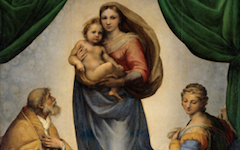
Raphael, Sistine Madonna (1512) Gemäldegalerie, Dresden
Click image to enlarge.
In Part 1 of this entry on Raphael's 1512 masterpiece, the Sistine Madonna, we saw how the curtains help indicate that the Virgin and Child, floating above the saints, are "a painting" within the painting behind the curtain. The saints are the "artists". However, on posting it, I saw something new: a visual illusion critical to the picture's meaning. It's not totally unexpected, though, because a similar illusion has already been seen in a painting by Poussin, one of Raphael's many admirers.
Click next thumbnail to continue
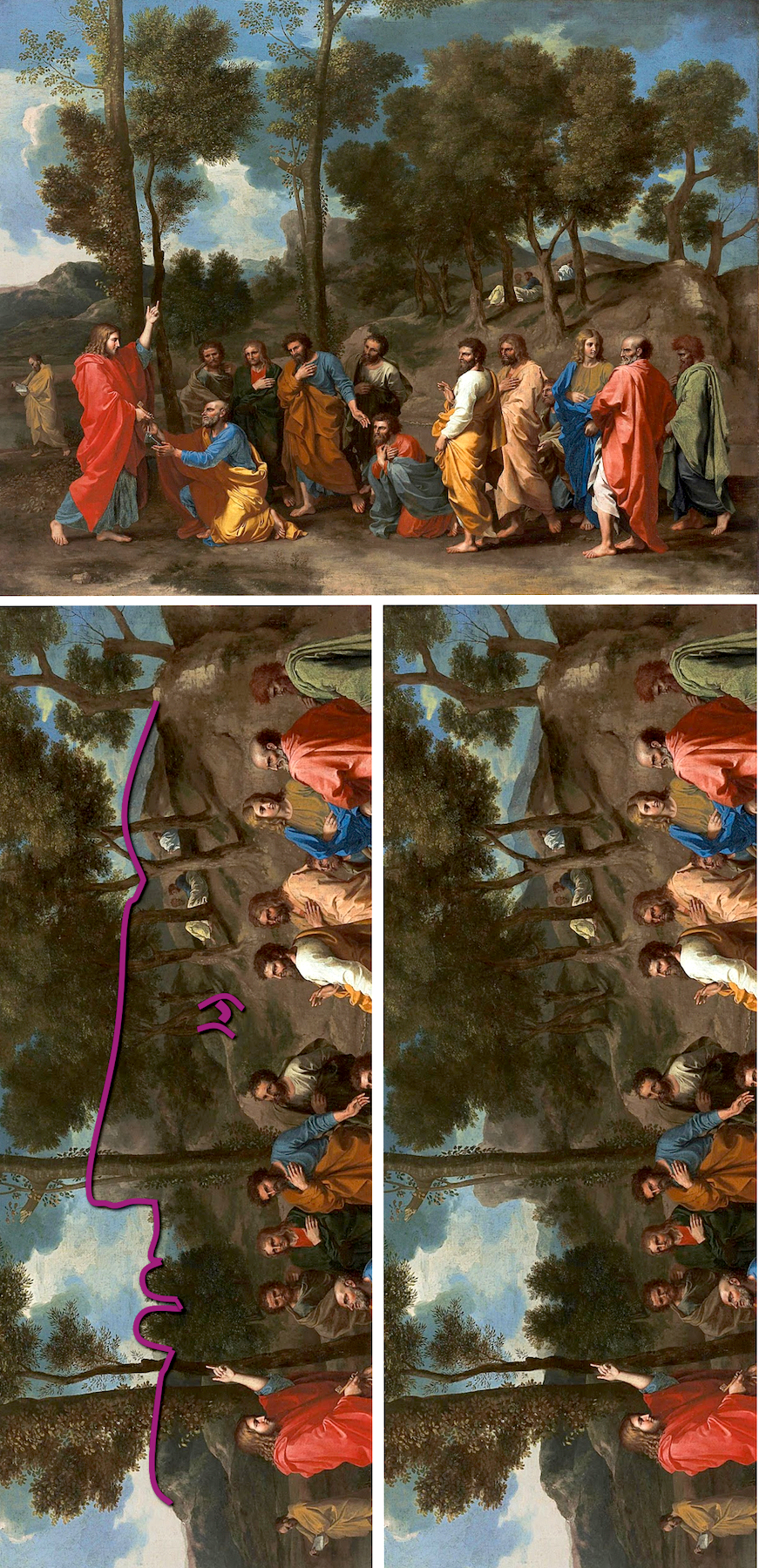
Top: Poussin, Ordination (1640's)
Bottom: Detail and diagram of above
Click image to enlarge.
In Poussin's Ordination from the 1640's (top) I have shown how a profile of Christ's head can be seen on the horizon when the canvas is turned 45° to the left (below, left and right).
Click next thumbnail to continue
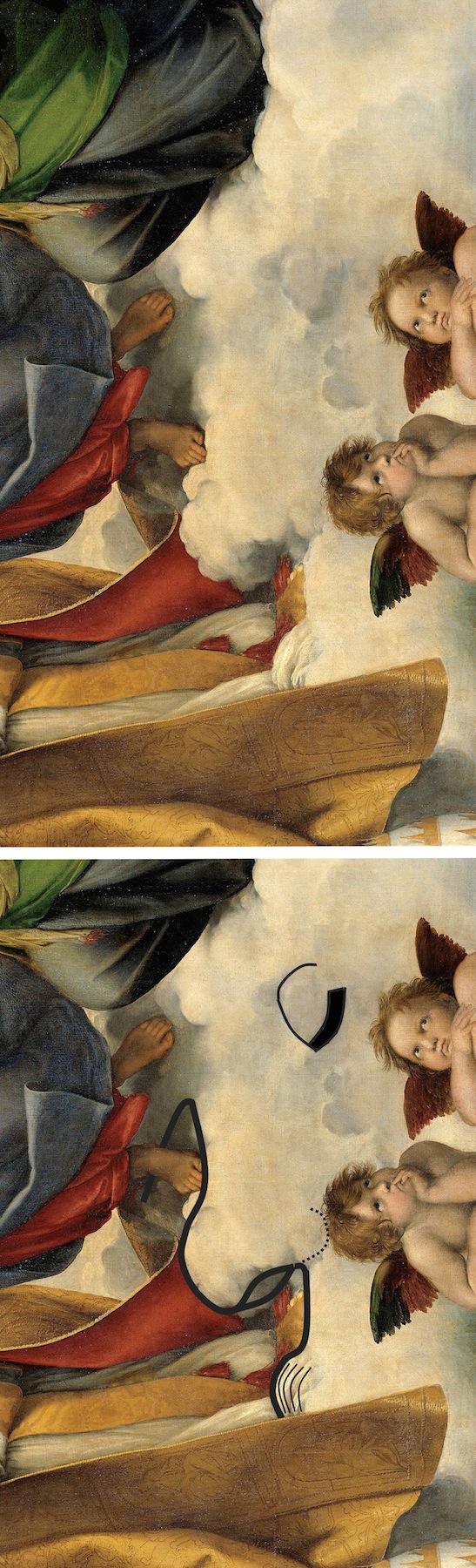
Detail and diagram, each rotated, of Raphael's Sistine Madonna
Click image to enlarge.
Turn the Sistine Madonna too and a male profile becomes visible in the clouds (left, with diagram below). It appears to be the pope's with a pronounced tip to the nose and his bushy moustache as its defining features. So, just as Poussin's profile depicts his principal alter ego in the composition, so does Raphael's, the Pope "painting" the Virgin and Child, which was Raphael's signature subject. Each of these elusive heads, Raphael's and Poussin's, represents "the creative source" of the composition. They are the core of the artist's imagination which then produces the realistic scene above the profile in the Raphael or inside it in the Poussin. Mimetic scenes in art generally depict the external world because within us, according to art and neurologists, mental images are seen from multiple angles. [See post on "Cubism Explained"]. Raphael and his peers, before Freud, Picasso and neuroscience, used clouds to suggest the metamorphic world of the imagination, as smoke can too. However while tobacco smoke conveys an artist's inspiration through intoxication, clouds represent a border space between heaven (the interior world) and earth (external). It is a transitional area, liminal like dawn or dusk, where the artistic mind is inspired.
More Works by Raphael
Notes:
Publication Date: 16 Apr 2014
© Simon Abrahams. All articles on this site are the copyright of Simon Abrahams. If you wish to use copyrighted material from this site in print or other media for purposes that go beyond 'fair use', you must obtain permission from the copyright owner. Other websites may link to this page without permission (in fact, please do) but may not reproduce the material on their own site.