Rembrandt’s Portrait of a Young Woman (1632)

Rembrandt, Portrait of a Young Woman in a Black Cap, detail (1632)
Click image to enlarge.
This portrait, A Young Woman in a Black Cap, was acquired (stolen?) by Hermann Goering during WWII and, after a succession of owners, sold again at Sotheby's in 2009. Once thought to have been painted by a follower of Rembrandt, the Rembrandt Research Group now gives full authorship, after its recent cleaning, to the master himself.
Click next thumbnail to continue
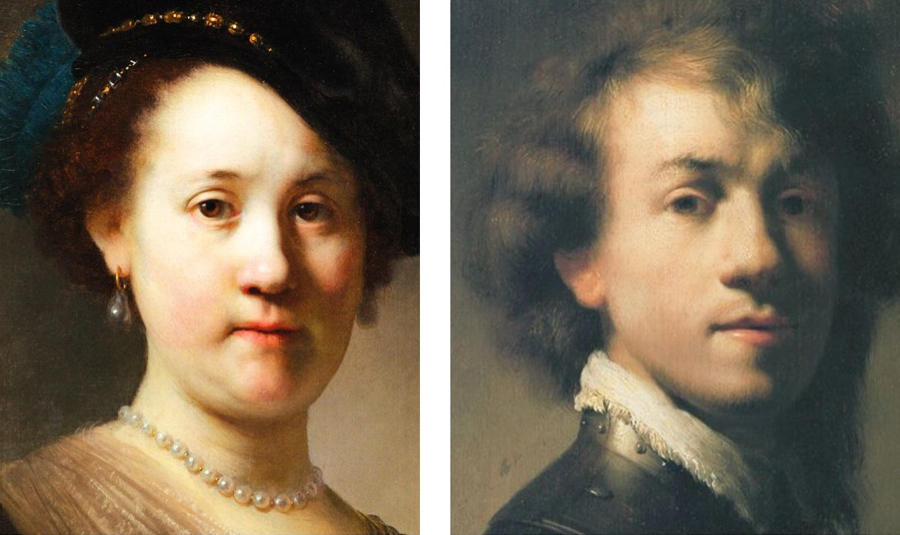
Left: Detail of Rembrandt's Portrait of a Young Woman (1632)
Right: Detail of Rembrandt's Self-Portrait in a Gorget (c.1629)
Click image to enlarge.
Most significantly, for our purposes, the sitter was once thought to depict Rembrandt's sister. She certainly resembles him. Indeed, so many portraits by great masters were once thought to be "self-portraits", or related to the artist, that resistance to the idea that every painter paints himself is somewhat baffling. How else can one explain how so many portrait sitters resemble the artist?
Click next thumbnail to continue
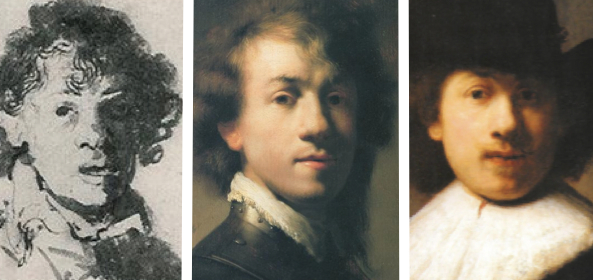
Left: Rembrandt, Self-portrait with an Open Mouth, detail (c.1629)
Center: Rembrandt, Self-portrait in a Gorget, detail (c.1629)
Right: Rembrandt, Self-portrait, detail (1632)
Click image to enlarge.
It is worth noting that Rembrandt's forehead in three self-portraits, each made shortly before this portrait, is divided diagonally into light and shade, leaving one eye lit, the other dark. While appearing natural, the diagonal division of the forehead poetically conveys two forms of artistic vision: those of exterior reality and insight.
Click next thumbnail to continue

Rembrandt, Portrait of a Young Woman in a Black Cap, detail
Click image to enlarge.
Perhaps Rembrandt thought that one eye in bright light, the other in deep shade, on this woman would not be flattering or the lighting too harsh. However, he still conveyed the same meaning by placing the cap, not the shadow, at the same angle, a formal link that artists familiar with Rembrandt's visual poetry would have recognized. Half her "mind" is bathed in light, the other in darkness. As so many artists have done, Rembrandt turned this sitter (if she existed) into his feminine self, a fertile self, and a creative symbol of his mind. The artist and sitter, like the artist and artwork, have become one.
More Works by Rembrandt
See how Rembrandt concisely expresses the underlying idea of art in a Roman myth

Rembrandt’s Lucretia (1666)

Notes:
Publication Date: 03 Jun 2011
© Simon Abrahams. All articles on this site are the copyright of Simon Abrahams. If you wish to use copyrighted material from this site in print or other media for purposes that go beyond 'fair use', you must obtain permission from the copyright owner. Other websites may link to this page without permission (in fact, please do) but may not reproduce the material on their own site.