Picasso’s Swords and Knives
Weapons as symbols for an artist’s brush are the single most overlooked characteristic of Western art. The world’s museums are full of masterpieces in which ‘artists’ are secretly at work ‘painting’ their subjects in scenes of battle, warfare and murder. In fact, so successfully have artists hidden their underlying theme on art that scarcely any of them have ever been recognized.1 In Chinese art, however, battle is a known allegory of art. One 17th century treatise on painting titled The Battle Array of the Brush notes that “the paper is the battlefield, the brush is sword and lance.”2
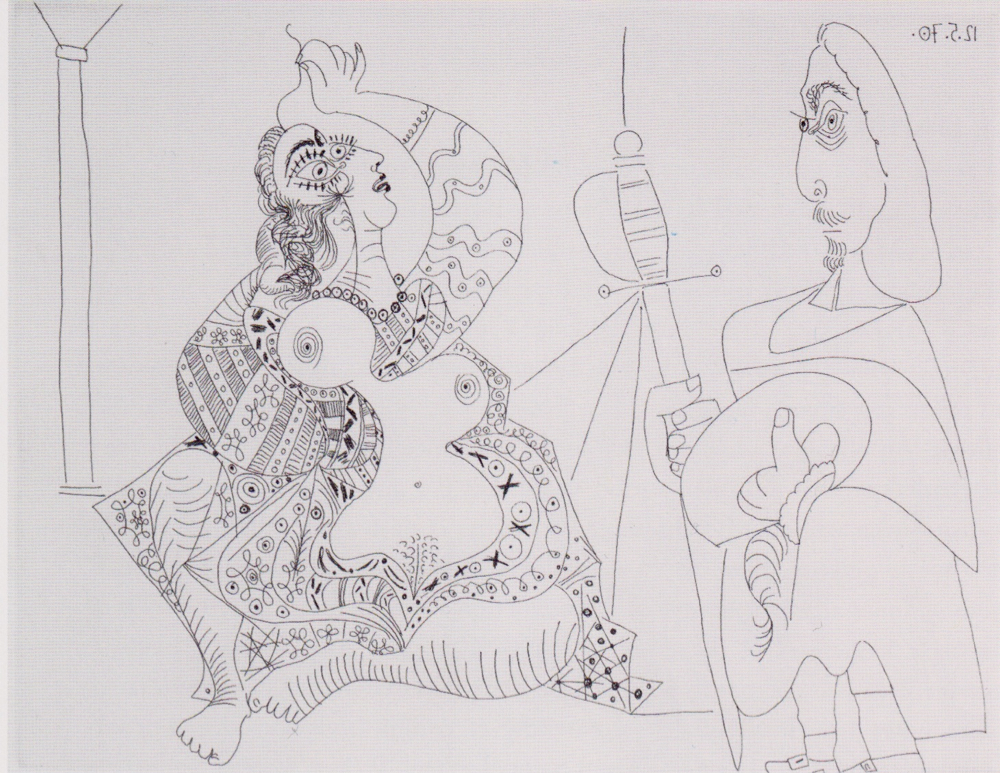
Picasso, Series 156, No. 47 (1970)
Click image to enlarge.
We have shown elsewhere how two other images by Picasso, a Bullfight Scene and an etching of Three Actors, both use swords as visual metaphors for the artist's brush or etching needle. At left, the artist in the alter ego of a musketeer faces his model while holding the metaphorical equivalents of sword and brush. Note how the hat held in his near hand resembles the shape of a palette with the artist's extended thumb echoing how his thumb would penetrate the palette-hole.
Click next thumbnail to continue
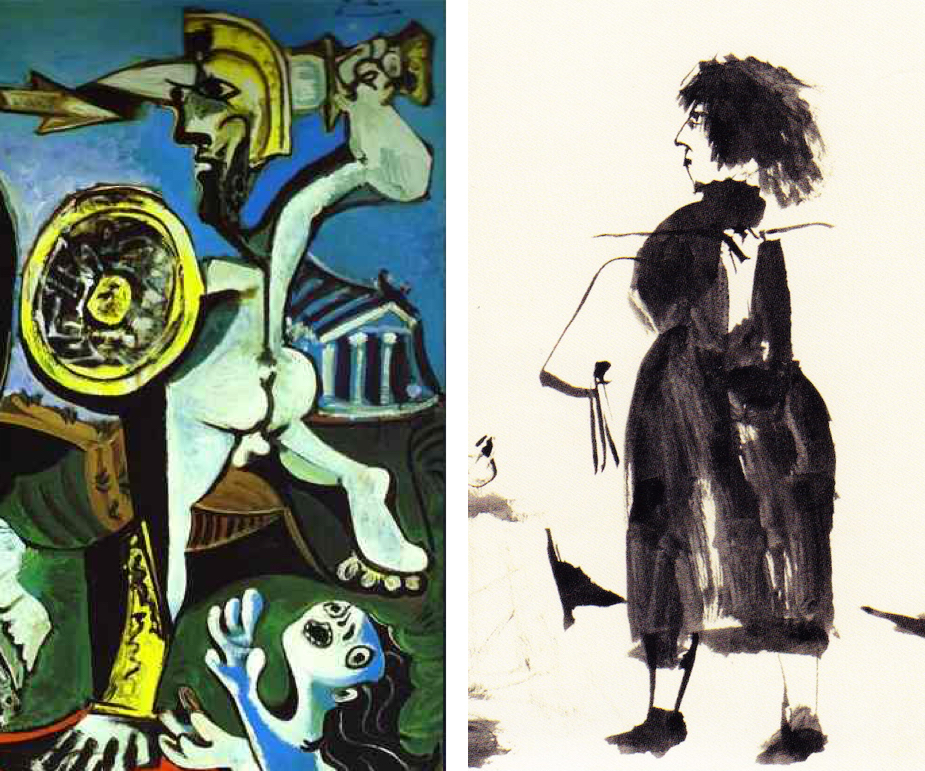
Left: Picasso, Rape of the Sabines, detail (1962-3)
Right: Picasso, In the Studio of the Female Painter, detail inverted (1954)
Click image to enlarge.
If one compares the pose of Picasso's soldier in The Rape of the Sabines (left) to that of his female painter in the studio (right), it becomes apparent - to those who know that every painter paints himself - that he must have thought of the Roman soldier as an artist. One specialist on Picasso was struck by this similarity without being able to recognize that the soldier is indeed an alter ego and that the sword is his "brush".3
Click next thumbnail to continue
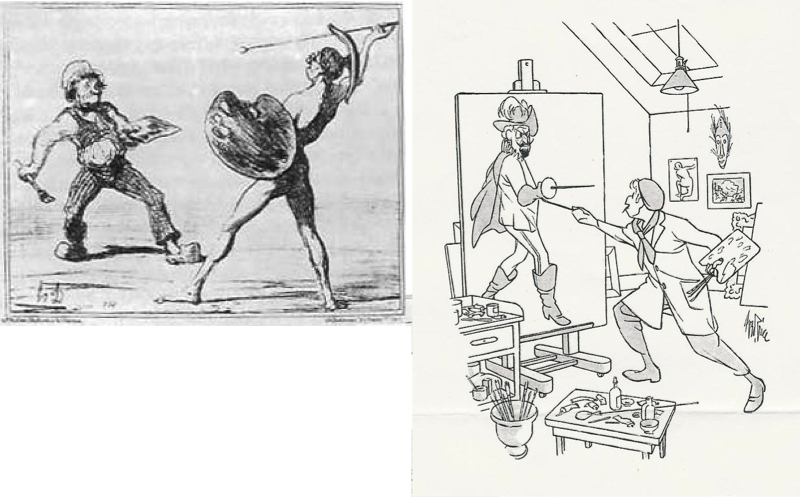
Left: Daumier, The Battle of the Schools (1855)
Right: ???, Cartoon from The New Yorker
Click image to enlarge.
It is, besides, a not uncommon pose in popular illustrations of artists as can be seen (far left) in Daumier's nineteenth-century Battle of the Schools. Meanwhile the New Yorker cartoon (right) demonstrates that graphic illustrators continue to be instinctively aware of the link between swords and paintbrushes even if art historians are not.
Click next thumbnail to continue
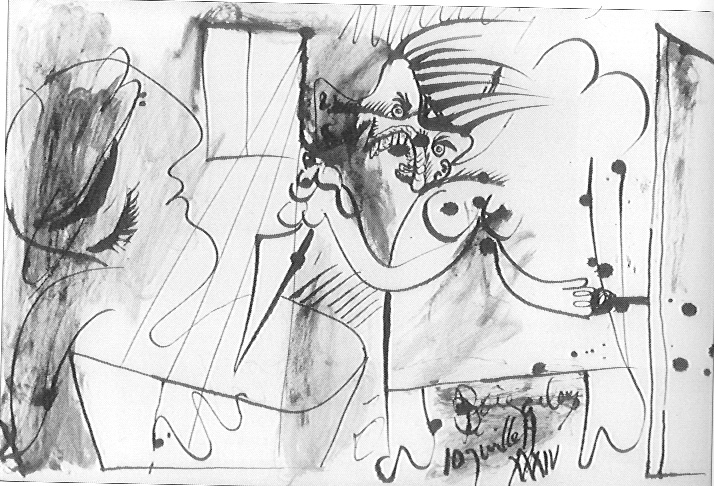
Picasso, Murder (1934)
Click image to enlarge.
One last example of the knife/brush theme in Picasso's work is this drawing, Murder. It is normally thought to represent Picasso's feelings towards Dora Maar, a woman with whom he was soon to separate. However, while the attacker does represent Picasso and the woman Dora, it is not about murder. The knife is Picasso's own pen with Dora at left as his "artwork". That is why ink blots are splattered over the page, marks that without the allegory make little sense. The scene, as so often in art, depicts its own creation, in this case the artist "executing" his art.
More Works by Picasso
Learn to recognize the letters of Picasso's signature, a key to many of his works
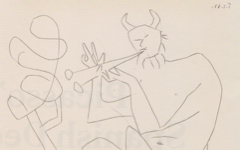
Picasso’s Faun Flutist (1947)
Notes:
1. A rare exception is Perry Chapman who has noted that in treatises and allegories on painting ‘armor and battle are frequently associated with the artist and the Art of Painting.’ See Chapman, The Image of the Artist: Roles and Guises in Rembrandt’s Self-Portraits, PhD diss. (Princeton University), 1983, p.115
2. Images of the Mind: Selections from the Edward L. Elliott Family and John B. Elliott Collections of Chinese Calligraphy and Painting at The Art Museum, Princeton University (Princeton University) 1984, p. 183
3. Karen Kleinfelder, The Artist, His Model, Her Image, His Gaze: Picasso’s Pursuit of the Model (University of Chicago Press) 1993, p. 101; Swords are loaded with various kinds of symbolism so there is more to their meaning in artworks than as mere tools. One leading psychoanalyst believed that knives, swords and weapons in dreams and literature "always represent the ego’s defense against being overpowered by the unconscious" which means that, like a paintbrush, they impose logic on chaos. See Neumann, The Origins and History of Consciousness, trans. R.F.C. Hull (Princeton University Press) 1954, p.317
Publication Date: 12 Jan 2011
© Simon Abrahams. All articles on this site are the copyright of Simon Abrahams. If you wish to use copyrighted material from this site in print or other media for purposes that go beyond 'fair use', you must obtain permission from the copyright owner. Other websites may link to this page without permission (in fact, please do) but may not reproduce the material on their own site.