Titian’s St. John the Evangelist (c.1540-50)
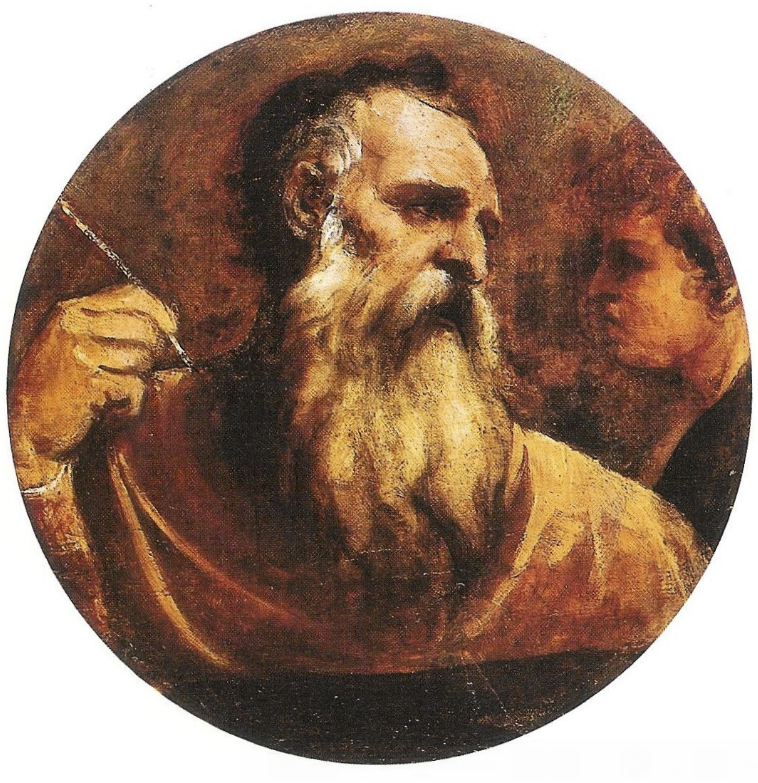
Titian, Self-portrait as St. Matthew the Evangelist. (1540s) Oil on canvas. Planned for the ceiling of Santo Spirito in Isola now in Santa Maria della Salute, Venice
Click image to enlarge.
Large numbers of Titian's paintings have been thought to include his self-portrait as someone else. The list was first compiled in the 1930's and has since generated much discussion over its accuracy.1 No early self-portraits survive so we are left to make comparisons with later self-portraits, often with the head turned, making identification more difficult. Nevertheless the fact that there have been so many candidates supports our contention that Titian practised face fusion, especially in portraiture. The tondo at left depicting St. Matthew was for a church ceiling but is a fairly accurate self-portrait. As an Evangelist, he holds a quill in place of brush.
Click next thumbnail to continue

Left: Detail of Titian's Self-portrait as Matthew (1540's); Right: Titian, Detail of Self-portrait (early 1550's)
Click image to enlarge.
A comparison with a "real" self-portrait from the next decade makes that self-evident.
Click next thumbnail to continue
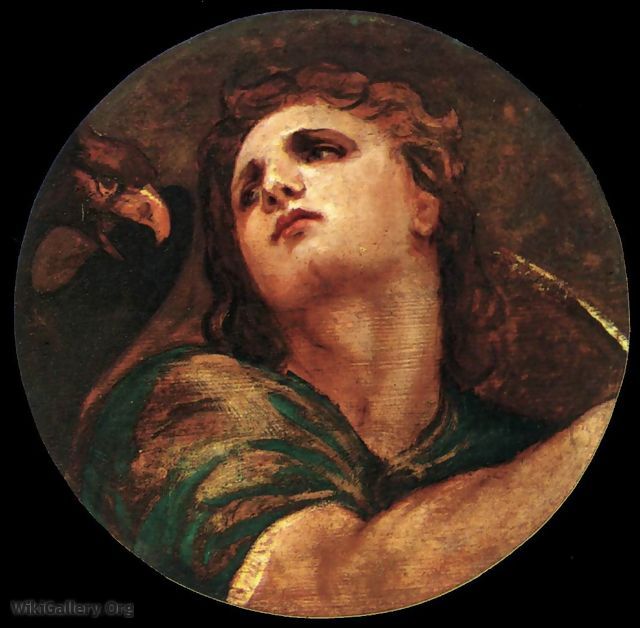
Titian, St. John the Evangelist (1540s) Oil on canvas. Planned for the ceiling of Santo Spirito in Isola now in Santa Maria della Salute, Venice
Click image to enlarge.
Another tondo from the same series shows St. John the Evangelist holding a quill again as an artist would a brush. It is almost as if John, sitting at a drafting table, looks up from the mirror in which he is drawing his own features just off to one side. That's why his hand is near the edge. [See Pointing at the Edge.] Mirrors then were always circular and concave, providing the kind of exaggerated perspective seen here. We are consequently placed in an impossible position inside the mirror.
See conclusion below
In these circular tondos Titian conveys that he, as a great master, has access to the divine, not as the Church's external God-in-the-sky but as an expression of the internal divine within himself and within us all. That self is not the personal, individual self we normally speak of but the Self with an upper-case S we all share, our common human essence. It has also been argued that tondos like these recall the church oculi (circular openings) in the upper tiers of Renaissance tombs, often containing an image of the Virgin, and are thus liminal passageways between our world and the divine.2 That must be correct because circles in art are common symbols for the eye as well which like all forms of oculi (in domes and walls as well) bridge inside and outside. And here, through the artist's eye, we look inwards and upwards.
More Works by Titian
Notes:
1. Zbynek Smetana, Titian’s Mirror: Self-Portrait and Self-Image in the Late Works, PhD. Diss. (Rutgers University, NJ) 1997, pp. 44-5
2. ibid., pp. 55-6
Publication Date: 13 Jun 2014
© Simon Abrahams. All articles on this site are the copyright of Simon Abrahams. If you wish to use copyrighted material from this site in print or other media for purposes that go beyond 'fair use', you must obtain permission from the copyright owner. Other websites may link to this page without permission (in fact, please do) but may not reproduce the material on their own site.