Anthropomorphic Landscapes
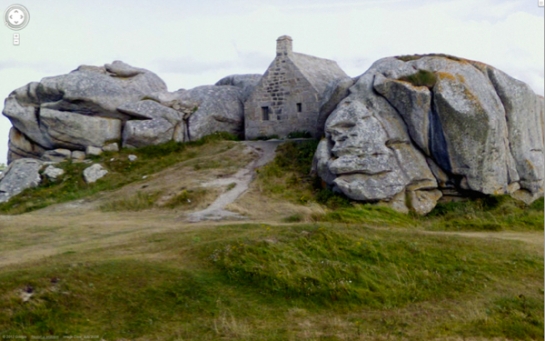
Jon Rafman, 853 Ménez Ham, Kerlouan, Finistere, France (2009) Archival print on paper
Visual metamorphosis. It's my term to describe a compositional method long used by major artists but virtually unknown to the art world except in a few rare cases. The only major exceptions I can immediately think of are Martin Schöngauer, Albrecht Dürer and Gustave Courbet three centuries apart.1 Both created images in which rocks take on living forms. Given how commonly real rocks suggest living forms (see above) it is quite remarkable how rarely it has been recognized in art. If you look under the theme at left, Visual Metamorphosis, you'll find additional examples by artists such as Francis Bacon, Balthus, Paul Cézanne, Lucas Cranach the Elder and Leonardo to name just a few. I plan to add many more.
Perhaps the most surprising unseen rock-face in the group is Lucas Cranach's example in his Martyrdom of St. Barbara, a large painting hanging prominently in New York's Metropolitan Museum. How people familiar with the painting have never seen the large face staring out of it (it even has lips and a row of teeth) is beyond me but they have not. It is confirmation, perhaps, that you only see what you know.
As for the photograph above, nominally by Jon Rafman, it has an interesting story behind it. In 2007, as many know, Google sent out an army of hybrid electric automobiles, each one bearing nine cameras on a single pole. Armed with a GPS and three laser range scanners, this fleet of cars began an endless quest to photograph every highway and byway in the free world. A year after Google Street View was launched, Jon started to collect images from the site never intended for public consumption. The one above was collected in Finistère, France. Others in the series The Nine Eyes of Google Street View will soon be exhibited at the Saatchi Gallery, London.
1. A minor sixteenth-century artist known only by his nickname Herri met de Bles is the only other recognized example I can remember. Felix Thürlemann, “L’aquarelle de Dürer (fenedier klawsen): La double mimesis dans l’analyse picturale d’un lieu géographique”, Revue de l’Art 137, Sept. 2002, pp. 9-18; Michel Weemans, “Herri met de Bles’s Sleeping Peddler: An Exegetical and Anthropomorphic Landscape”, Art Bulletin 88, Sept. 2006, pp. 459-81; Weemans, “Herri Met De Bles’s Way to Calvary: A Silenic Landscape”, Art History 32, April 2009, pp. 307-31
The EPPH Blog features issues and commentary.



Reader Comments