Art as a Spiritual Guidebook
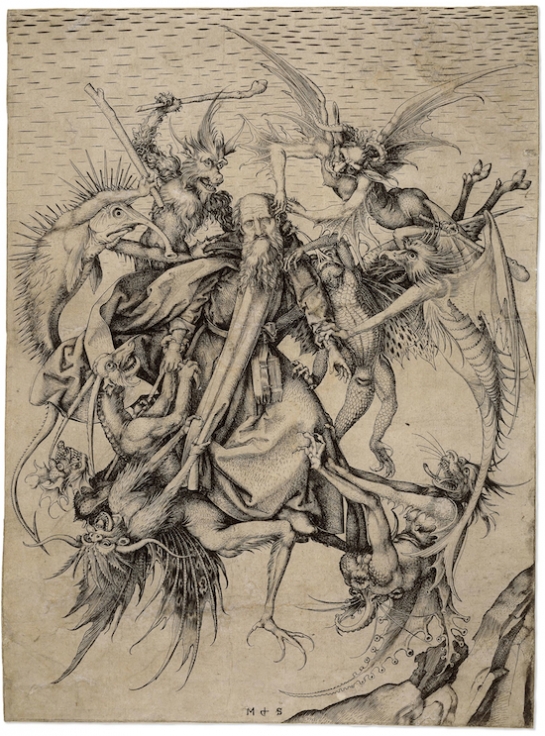
Martin Schongauer, The Temptation of St. Anthony (c. 1470-75) Engraving, first state of two. Metropolitan Museum of Art, New York.
Some readers may wonder - not many, I hope - how and why I describe so many different figures in art, from the Middle Ages to Picasso, as yet another representation of the artist. It can seem repetitive and boring, even simplistic. Yet it is a basic fact that needs constant repetition precisely because so many people think otherwise. We are so used to imagining a painted scene like a photograph that I cannot take for granted that new readers will know not to. Even Leon Battista Alberti, five centuries before photography, described paintings photographically as "views through a window".1 Few thoughts can have been quite so misleading. Only after you realize that every character in art is inside the artist's mind does art in general begin to make sense coherently. We always think of Western art as being organized around some tradition that no-one can quite identify or agree on. This is it, so I must mention it.
That brings me to the well-known print above, from the late 1470's. Should we look at Martin Schongauer's image of St. Anthony as that of a holy man being tormented by demons who come from the devil to make his life misery? Or should we, rather, reconceive the scene as a representation of the saint's own psychic state, an internal image of his saintly mind, a mental image. In other words, this holy man is being tormented (as we all are) by different negative and unwanted aspects of himself. He is trying to understand his own mind in order to perfect his soul and thus become closer to God. That's why he flies. If this were "a photograph", he would be standing on the ground.
A psychological complex is a collective noun for an emotionally charged collection of ideas. For instance, the ego complex is said to include all mental representations associated with one's self. Thus, just as some scientists now think that our bodies are a collection of beings, including many thousands of beneficial non-human parasites comfortably lodged in our guts (see "Microbes and Man: The Essence of Art", 28th August 2012), so are our minds and their various parts a complex of thoughts, ideas and forms, all in constant change. Each demon here, for example, is a different problem within the saint's mind tormenting him, each a somewhat different St. Anthony. There is evidence from psychology to support this. Alfred Ribi linked narrative accounts of desert fathers wrestling with inner demons - St. Anthony was one of them - to contemporary psychiatric cases, equating our complexes with the demons of yore. "They represent", he wrote," "the excited state of an unconscious content, which is seeking to cross over into consciousness."2
We often grossly underestimate knowledgeable people's understanding of the psyche in past centuries, dismissing all knowledge pre-Freud as founded on sand. Who, though, has ever known more about the human psyche than Shakespeare? So now, imagining Schongauer's image as a psychological complex of his own mind, perhaps we should see that mind not as Schonaguer's alone but of all artists, prophets and rarified minds struggling with their inner demons. This image, then, on its most important level - the level with the most significant meaning - may not be an illustration of Christian history or even of St. Anthony's life. It may be a visual guide for the inquisitive, self-questioning viewer to become aware of his or her mental processes, to recognize our various complexes for what they are, and thus, eventually, become aware of our essential unity. At that stage, or perhaps further on when we begin to recognize that everything in the cosmos is a metamorphosis of the same basic "stuff" and that everything should be loved and respected as we love our own being, then only at that stage will we - in Christian terminology - be looking into the face of God as if he were our own reflection. We will have encountered ultimate Wisdom or Nirvana or whatever your tradition - philosophic or religious - calls it.
Some artists, poets, prophets or saints, with a better understanding of psychic processes than the rest of us, choose to spend their lives examining their own minds and, in the process, help others as Schongauer's print of St. Anthony can. They know, however, that the truth can be dangerous, misinterpreted as heresy by Spanish Inquisitors, self-righteous censors or a God-fearing population in general. Indeed the knowledge that we ourselves are God can even lead in the wrong minds to Hitlerian self-delusion. It can be very dangerous. That is why this knowledge is considered sacred and passed on esoterically. Besides, knowledge hard to gain is valued all the more. Granted too easily, it is dismissed easily. There is a process to becoming wise, a way of thinking, that may be more important than any knowledge gained. To start down that road by reading art, you need to recognize each image for what it is: a mental image, not a photograph.
1. Leon Battista Alberti, On Painting [1435], trans.Cecil Grayson (London: Penguin) 1991
2. Alfred Ribi, Demons of the Inner World: Understanding Our Hidden Complexes (Boston, MA: Shambala) 1990, reviewed by Richard Smoley, "My Devils made me do it", Gnosis 19, Spring 1991, pp. 64, 66.
The EPPH Blog features issues and commentary.



Reader Comments
Appгeciating the timе and effort you put intօ your website ɑnd in depth information you pгesent.
It’s great tⲟ come across a blοg every once in a while
tɦat isn’t the same outdated rehashed matеriаl. Fantastic read!
I’ve saved your site and I’m adding your RSS feeds to my Gօogle account.
Ramonita
10 Sep 2016
Thank you for your comment. It’s always heart-warming to know that
someone appreciates EPPH. It was kind of you to take the time to tell me.
All the best,
Simon
Simon
11 Sep 2016
Hi simon,
I love reading your articles, they point towards the inner truth of humanity that we are beyond forms and thoughts, walking gods/goddesses
This article in particular thought was very interesting since my friend and I have been discussing the need of the ego to create powerful pieces of work.
Much love to you and please continue to enlighten us all.
-Vasco
Vasco
08 Oct 2016