Artists and Creation-Centred Spirituality
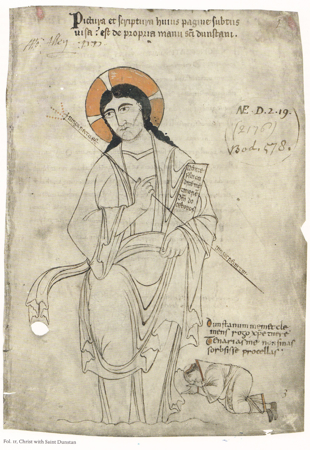
Christ with St. Dunstan from St. Dunstan's Classbook, c.950
Conventional art scholarship is far too eager to believe that artists illustrated the orthodox, didactic beliefs of their patrons. The idea that Michelangelo was told what to paint in the Sistine Chapel is both common in art scholarship and mad. Yet there is a reason why such misinformation has spread so far: art historians know too much about mainstream theology and too little about the popular undercurrents that were either called heresy or subsumed (and hidden) within the larger Church despite vast differences. They are not alone. Matthew Fox complains that Roman theology has so dominated the history of Christianity in Europe that many students of Christian history are totally unaware that “it was the Celtic and Irish traditions that evangelized much of Northern Europe, even as far south as central Italy. Over 220 parish churches and hundreds of smaller churches, chapels and shrines in Italy are dedicated to Irish saints to this day.”
The difference is critical as Fox explains in Passion for Creation, his fascinating commentaries on the sermons of Meister Eckhart, the German mystic. In describing the vast influence that the Celtic mystical tradition has had on poets Fox emphasizes how the Celtic religion was profoundly nature-oriented and how feminine deities and feminine animals both played prominent parts in it. The Celtic spiritual tradition “was a bastard child in Christian spirituality in the West…St. Patrick’s creed was not redemption-oriented [like the Roman Church]… but creation-centered.”
“The chief law-giver of the Celtic tradition”, which began around 1900 BC, “was the poet of the tribe, and it was taken for granted that all members could participate in common folk celebrations and creativity. This Celtic tradition, which strongly influenced Francis of Assisi and Abelard and which gave the West William Blake and W.B. Yeats, identified salvation with being an artist, a healer, and a whole-maker. William Blake said so like this:
“A Poet, a Painter, a Musician, an Architect: The Man or Woman who is not one of these is not a Christian.” 1
Renaissance artists, therefore, did not have to follow the tired, didactic beliefs of their patrons and the Church because there was, and always has been, within Christianity far more vibrant alternatives.
1. Matthew Fox, Passion for Creation: The Earth-Honoring Spirituality of Meister Eckhart (Rochester, VT: Inner Traditions) 1991, pp.31-3
Posted 07 Aug 2010:
The EPPH Blog features issues and commentary.



Reader Comments