Coins, tablets and Dürer
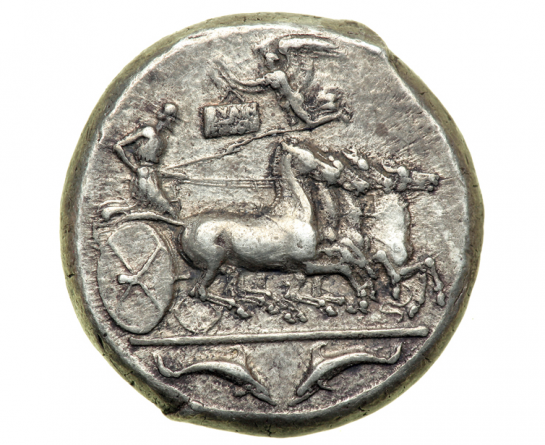
Sicily, Syracuse, c. 410 BC. AR Tetradrachm (17.43 g). Signed by Euainetos and Eumenos.
Coins draw groans. Walk into a roomful of coins in a museum and even the most ardent art lovers hurry through in the hope of finding some painting or sculpture on the other side. Nevertheless the designs on coins are one of the glories of Greek art in antiquity. Talented artists designed the dies, the best of whom sometimes left their name or mark on the work. One such example from Syracuse in Sicily, dated c.410 BC, is signed unusually on both sides by two different artists. Euainetos designed and then signed the obverse of this coin, Eumenos did the same on the reverse. The image above, the side that caught my attention, is by Euainetos. His scene is divided into two parts, above and below the horizontal line. We are interested in the scene above. A one-man chariot drawn by four horses, known as a quadriga, gallops towards the right while Nike, goddess of victory, flies in the opposite direction holding a tablet. Although it is a very familiar scene in Greek numismatics with numerous variations, Euainetos brought a dynamism and sensitivity to the motif that cannot be found in the work of lesser artists. Traditionally in such scenes Nike flies in holding a laurel wreath to crown either the rider as the victor or the horses. In Euainetos' example she holds a tablet instead with Euainetos' own name on it as though she were coming to crown the artist.
Albrecht Dürer, of course, used a very similar tablet in the sixteenth century to indicate his own authorship, sometimes placing the tablet in a position by which we understand the protagonist, Christ or St. Jerome perhaps, to be an alter ego of the artist. Here in Euainetos' example a Greek artist seems to be suggesting something very similar, that the artist should be identified with the winner announced as a great visual poet by Nike with or without her laurel wreath.
It is most unlikely that Dürer would have seen this coin or even one like it. The two artists would have come up with their ideas independently. However, the coincidence does demonstrate, I think, that there is something common to the creative mind, regardless of time or place, that we lesser mortals have trouble imagining. And so we deny it.
The EPPH Blog features issues and commentary.



Reader Comments