Creativity in Science and the Arts
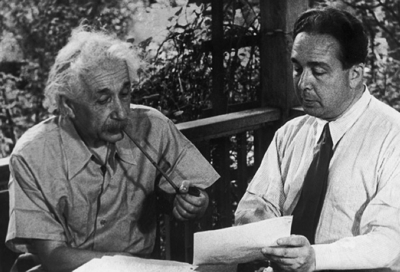
Albert Einstein with Leo Szilard
Today we tend to think that creative people find employment in the arts while those whose minds are capable of rigorous logic are more suited to science. It is, of course, entirely wrong as many may sense without knowing exactly why. The average scientist, indeed the vast majority of scientists, do what they are told to, confirm the experiments of others and apply logic to the problems they are given. They are not creative and have no need to be creative. The creators come up with an idea somewhat mystically, from inside their subconscious, and then must spend years proving it to be true logically to the outside world. Logic alone creates nothing.
In the arts the situation is very similar although abstraction and the new media in "contemporary art" confuse the issue. Until abstraction broke free of representational imagery the average painter, indeed the vast majority of painters, just painted what they saw in front of them or illustrated someone else's narrative, like scenes from scripture for instance. They were quite happy not being creative and their images are shallow. Truly creative painters, those who merit the term artist or poet, have always been a small minority who, despite having had to paint a scene on commission, really depicted something else for those with similar perception. The underlying scene, often with esoteric meaning, comes mostly from their subconscious yet shows the way forward for those in search of wisdom, beauty and inner peace. It can be found in work by leading contemporary artists as well. Creativity in the "arts", thought to be universal, is rarer than many think.
This all is prologue to the words of Leo Szilard, the brilliant physicist and biologist (above right), who understood the difference clearly, at least in science, because he had experienced it himself and saw it in the work of Einstein and others.
‘The creative scientist has much in common with the artist and the poet. Logical thinking and an analytical ability are necessary attributes to a scientist, but they are far from sufficient for creative work. Those insights in science that have led to a breakthrough were not logically derived from pre-existing knowledge: The creative processes on which the progress of science is based operate on the level of the subconscious.”1
1. Cited in Antonio Damasio, Descartes’ Error: Emotion, Reason, and the Human Brain (New York: Avon Books) 1994, p. 189
Posted 24 Nov 2012: Contemporary ArtTheoryVisual Perception
The EPPH Blog features issues and commentary.



Reader Comments