Did even St Paul follow the Inner Tradition?
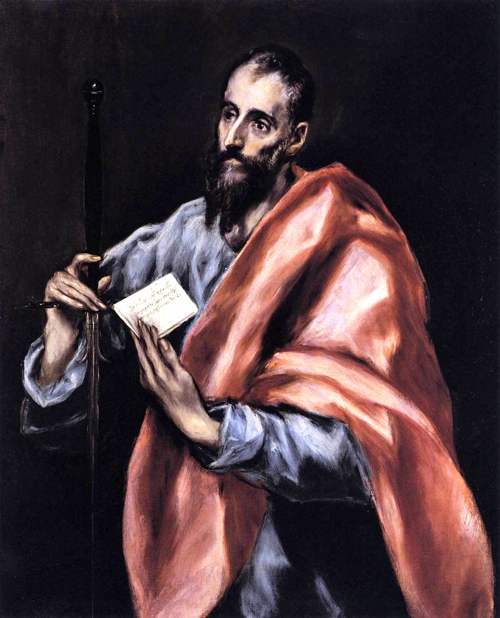
El Greco, St. Paul the Apostle (c.1612) Oil on canvas. Museo del Greco, Toledo
Theology and theological studies are so focussed on the Establishment Churches who appeal to the masses, that followers of the Inner Tradition are often ignored or have their testimony skewed to support what they did not say. Esoteric (ie., secret and inner-focussed) by nature, their ideas are often disparaged as out-of-the-mainstream which is precisely the point. Esotericists must follow their path alone by making sense of their own minds. They take nothing on faith other than that God and the Good (etymologically close), along with Wisdom and its identical twin, Truth, are everywhere, in everything and never change. Everything else changes, not them, which means, in essence, that Plato's Wisdom is the same as Christ's, Buddha's, Dante's, Dürer's and Shakespeare's. And all four - Good, God, Wisdom, Truth - are interchangeable terms for the same thing.
For those skeptical about how many people in prior centuries followed this Tradition, I plan to publish various telling examples. We start with St. Paul, the first real leader of the Church, who wrote a letter to the Galatians telling them that everyone needs to follow their own spiritual path. No-one can do it for them.
"….But let every man prove his own work, and then he shall have rejoiced in himself alone, and not in another. For every man shall bear his own burden."1
This contradicts the Establishment view peddled to the masses for centuries that Christ's crucifixion saved all mankind, that he did our work for us. Christ's crucifixion was instead an example of how we ourselves must suffer internally before we can achieve spiritual transformation. Christ is not, in essence, an historical figure but a mythical Everyman and Everywoman whom Christians should imitate.
Paul continues a little further on:
"And as many as walk according to this rule, peace be on them…. From henceforth let no man trouble me: for I bear in my body the marks of the Lord Jesus."2
How much more clearly could St. Paul say that he had discovered Christ within himself? He can now see himself spiritually transformed into God, which is to say that the divine essence in himself, in all humanity and in all nature was now apparent to him. He could see the Good in himself and in everything.
P.S. In the interests of full disclosure I am a completely secular Jew unable to even imagine (for myself) a spiritual life. I do, though, recognize its many psychological and social benefits. My real interest is in Western art which is so based on the wisdom of the Inner Tradition that art cannot be understood without it.
1. St. Paul's Epistle to the Galatians (King James' Version, "Authorised Version", Cambridge Edition) 6:4.
2. ibid, 6:16-17.
Posted 09 Aug 2013:
The EPPH Blog features issues and commentary.



Reader Comments
Who is the author of this article, and has he written others?
LILLIAN DELEVORYAS
12 Aug 2013
The answer to your question is me, Simon Abrahams, and you can find my articles here at EPPH. Hope you enjoy them.
Simon
12 Aug 2013