Do you know what it means to come home?
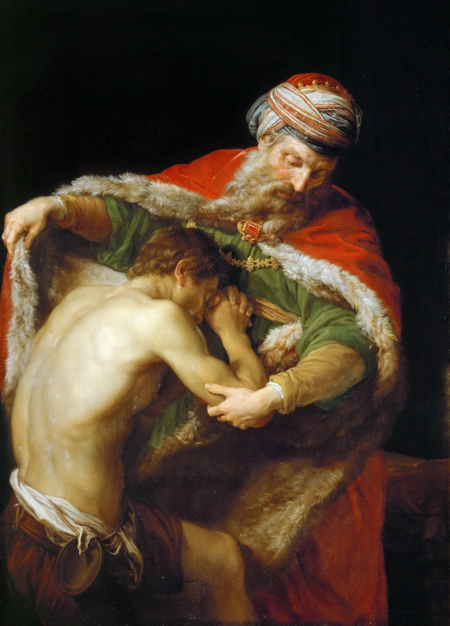
Pompeo Batoni, The Prodigal Son (1773) Oil on canvas. Kunsthistorisches Museum, Vienna.
Think differently. The old ways are often dull and didactic. Take, for instance, paintings and prints that seem to illustrate Bible stories. Why treat them as a narrative when mystical Christians, among whom must be counted many great Western artists, would not have thought of them as superficial stories of good and bad. One of the very few great masters who was also a great poet was William Blake and the title of one of his most famous works, The Marriage of Heaven and Hell, makes instantly clear that he did not read the Bible narratively.
Here is a simple example: The Prodigal Son. It is one of Jesus' best known parables about a younger son who when old enough asked his father for his share of the estate. He then left home and squandered it all. Returning home penniless and hungry, he saw the error of his ways and begged his father for forgiveness. The old man put on his finest robes and a swell party which enraged the older brother because he, like a good son, had remained dutiful. The father explains that because young Bobby has in a sense returned from the dead, a celebration was in order. In the words of the Bible: "He was lost and now is found." This, we are told by both Establishment churches and Wikipedia, is a story of redemption. Redemption? Act bad, do evil, ask for forgiveness and you will be forgiven. Is that what Christ meant? Even from the father's and brother's point-of-view, the apparent lesson is hardly profound: be forgiving. One must remember that it is Jesus talking and this is a parable.
Jesus explained why he spoke in parables as I often note. "Therefore speak I to them in parables: because they seeing, see not; and hearing, they hear not, neither do they understand." Point being: most people aren't intelligent or advanced enough to understand what I have to teach them. They would misunderstand me. So, to prevent them from getting the wrong end of the stick, I speak in parables. So, what does Jesus mean in the Prodigal Son?
I'm sure there are a number of ways of interpreting this - and I have no rank from which to speak - but it seems to me that the most obvious meaning from Jesus' esoteric point-of-view is that you can go out into the world and achieve great things or blow everything, like the Prodigal Son did. We all have to lead our lives. Even mystical people do that. However, don't get lost there. It is only when you come "home" and look inwards that you will find the way to God. God is inside you, ie "at home". The father is the Father. The "dead" are those on the outside, living their lives without thought of the spirit. Look inwards and you will start to experience life properly. You will have been "reborn".
So, next time you look at Dürer's engraving of the Prodigal Son or Rembrandt's painting or even Pompeo Batoni's (above), remember that. Batoni specialized in portraits of eighteenth century aristocrats and is not generally considered very profound. Yet there is no doubt in my mind when I look at his painting above that he has portrayed the Prodigal Son back home as looking inward. And does the father not resemble "God" who, incidentally, is wearing a turban? That almost certainly makes him a "painter" as well and, thus, Batoni's God. [See my explanation of turban symbolism] So, if you like that take on the story, I encourage you to take other "narratives" in art with a grain of salt as well. Think differently. The great ones are almost certainly painted so that the ordinary viewer, on seeing, will not see. Neither will they understand.
The EPPH Blog features issues and commentary.



Reader Comments