Drawings as Ideas in the Mind
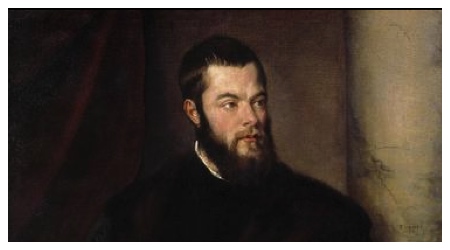
Titian, Portrait of Benedetto Varchi (1540) oil on canvas. Kunsthistorisches Museum, Vienna
Concepto, concetto, esemplo, modello. Michael Cole and Mary Pardo, writing about the studio in the Italian Renaissance, have pointed out that the terms artists then used for a working drawing, what we today might call a sketch or study, were the same words used to describe an idea in the mind. The poet Benedetto Varchi, in a 1540 portrait by Titian above, made that exact point in writing on art. Cole and Pardo thus conclude that "with Varchi, as with Vasari and others, it was possible to understand drawing explicitly as a record of mental activity."1
The idea then, expressed time and again on EPPH, that scenes in great art are not what they seem but are instead depictions of the artist's mind in action, finds support on three fronts: in the words artists then used, in the explanation of a knowledgeable Italian poet of the period and in the work of today's scholars.
Cole and Pardo explain how, even though the word studio was not yet used in its modern sense, Renaissance artists had private rooms in which to retreat away from their busy workshops in order to think and develop new compositions. They add that in "the countless, early modern images of scholars at work: the studio is also a vision, or a materialization, of the learned person's well-furnished mind." That idea, though, permeates art well beyond the images of scholars they refer to. Artists, as I try to show, imagined their studio as their mind.
1. Michael Cole and Mary Pardo, "Origins of the Studio" in Inventions of the Studio, Renaissance to Romanticism, eds. Cole and Pardo (University of North Carolina Press) 2005, pp. 1-35, esp. pp. 7, 27.
The EPPH Blog features issues and commentary.



Reader Comments