Dürer’s Portrait of Philip Melanchthon (1526)
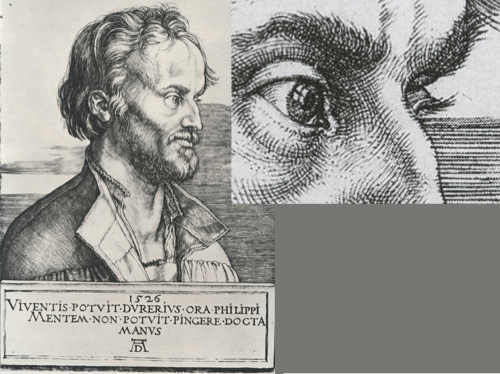
Left: Dürer, Portrait of Philip Melanchthon (1526)
Right inset: Detail
Durer’s 1526 Portrait of Philip Melanchthon is notable for the manner in which the artist treats the eyes. One eye is large, bright and clear; the other mostly unseen, the tip of its eyelash just visible above the clouds. This contrast between a large eye and an unseen one is made more mysterious by the way the top-most cloud disappears behind the far eye, a juxtaposition between cloud and eye that is highly suggestive. It is as though the far eyelash is an active instrument, a kind of optical burin, engraving each line behind it. The near eye, in contrast, makes nonsense of the figure’s location “out-of-doors”. It contains the reflection of a window affirming that the sitter is, contrary to appearances, indoors. As always in art, this portrait is not an early photograph, does not depict the sitter in our illusory world and should not be thought of as such.
Dürer suggests that this well-known theologian and religious reformer is a poet and his alter ego. His near eye looking inwards sees clearly, while the far eye looking outwards creates an illusion. Insight and out-sight are different forms of perception: a painter uses the latter alone, an artist both.
To see the complete entry, click here.
Posted 02 Aug 2011: DurerPortraitureVisual Perception
The EPPH Blog features issues and commentary.



Reader Comments