Face It! Anthea is Parmigianino
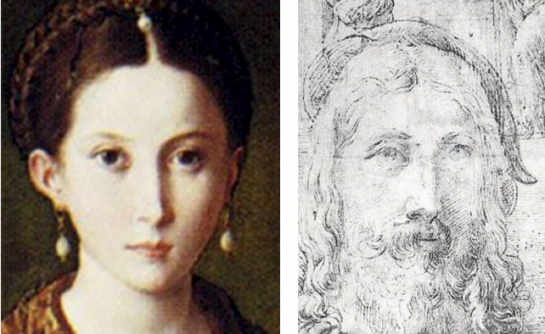
Parmigianino, Detail of Anthea (left); Parmigianino, Detail of Self-Portrait (right)
Fifteen years ago a computer scientist named Lillian Schwartz published her discovery that the proportions of the Mona Lisa’s face matched those of Leonardo in his famous Self-Portrait almost exactly, too exactly to be coincidence.1 Art historians with a sense of humor howled with laughter while others spewed venom on the scientist. As reported in the Gazette des Beaux-Arts, one prominent expert remarked: “Art history will survive this crap.”2 He may be right about that but his reputation won’t.
One of the most striking features of human progress is that the largest strides are made by contributions from outside a field of expertise and not from within it. Those inside are too constrained by the prevailing paradigm and peer review to think “outside the box.” Only those whose minds are free to think the unthinkable can recognize the inconsistency of a conventional approach.
Over the past few years we have published hundreds of examples showing how portraits by well-known artists are too similar to the artist’s own self-portrait to be an accurate likeness of the sitter. The most striking are the five portraits of Napoleon by different artists and the long series of British monarchs all of whom resemble the artist.
One notable comparison not yet published is particularly close to Schwartz’s discovery about the Mona Lisa. Parmigianino painted a young woman known today as Anthea in 1527 but, like the Mona Lisa, no-one really knows her true name or who commissioned the portrait. Elizabeth Cropper points out that Anthea wears the costume of a courtesan and may be an idealized portrait of a certain type rather than a specific person.3 The Frick, Collection, during a temporary loan of Anthea, noted that the identity of a sitter in the Renaissance was of secondary importance and added that “It is significant in this regard that Parmigianino employed versions of Anthea’s face in several very different works.” What they do not note – and what is plainly obvious above – is that Anthea’s face also resembles Parmigianino’s. Thus they are wrong. He did not use Anthea’s face in other figures but used his own in both Anthea’s and the others. Like hundreds of artists, before and since, Parmigianino used his features to construct other faces because they all, in one way or another, are aspects of himself.
Thank you, Lillian Schwartz. You deserve a medal, both for your contribution to art history and the disgraceful way you were treated.
1. Lillian Schwartz,“The Art Historian’s Computer”, Scientific American 272, April 1995, pp. 106-11.
2. S. J. Freedberg cited in “La Chronique des Arts”, supplement to Gazette des Beaux-Arts 109, May-June 1987, p. 15
3. From a lecture by Elizabeth Cropper on Anthea at the Frick, Spring 2008
Posted 26 Sep 2010: ParmagianinoPortraitureVisual Perception
The EPPH Blog features issues and commentary.



Reader Comments