Focus on Great Art. Don’t waste time!
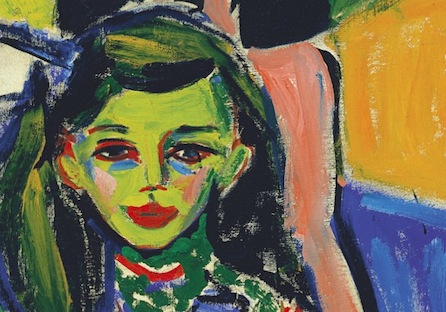
E. L. Kirchner, Fränzi in front of a Carved Chair (1910)
Oil on canvas.Thyssen-Bornemisza Museum, Madrid.
One of the most important features of EPPH is that all the content is based on certain underlying ideas, some quite novel. Eight of the most important are listed on the Principles page. I have just realized, though, that another of particular importance is missing from the list. This is it:
Great artists when young are heavily influenced by earlier great artists and very little by the minor art of their own day.
Ever since I began working independently I have been guided by this idea; thus, I rarely look at ordinary art in any century but focus exclusively on work by the major names. This saves me a vast amount of time that more conventional students in academia cannot escape. Evidence in support can be found in art itself and in literature, even sometimes in the words of the painters and sculptors themselves.
The German Expressionist, Ernst Ludwig Kirchner, wrote in his travel diary in 1926:
“….as I was going through the museums again and looking at my old favorites by Rembrandt, Cranach, Dürer, the Dutch masters….I perceive much more deeply and more truly the influence they had on my own development. No modern artist could ever have given me what these old masters have given me; I have never had the sense of sharing a common natural world with any of them the way I have with these masters….I have yet to find any modern artist whose style is so directly formed by experience and constant work as is so clearly the case with Rembrandt, [and] also with Dürer, etc.”1
So study the diamonds in art and don’t waste time on the duds.
1. Peter Springer, Hand and Head: Ernst Ludwig Kirchner's "Self-portrait as a Soldier" (Berkely: University of California Press) 2002, p. 111
Posted 25 Oct 2013: Theory
The EPPH Blog features issues and commentary.



Reader Comments
Is it, as you say, there
is a art “Canon” similar to that proposed by Bloom for literature…
Gustavo von Bischoffshausen
27 Oct 2013
Yes, Gustavo. Absolutely. It does not mean that every artist who should theoretically be part of the canon has been recognized or that some artists (very few, probably) may have been included in the canon when they should not have been. Nevertheless, there is a unified project known today as ART that has been practised by like minds for many, many centuries. It was originally part of mankind’s search for inner wisdom, truth, God (call it what you will) and is still valid in today’s secular world as the vast increase recently in secular spirituality demonstrates.
Simon
28 Oct 2013