How and Why Artists Steal
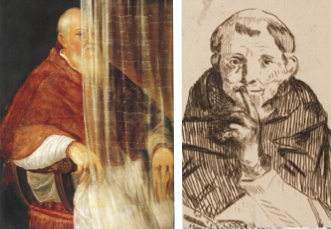
Left: Titian, Portrait of Cardinal Archinto (1558)
Right: Manet, Silentium, detail (1862/3)
“It’s not always good to have ideas. Some people have a gift for coming up with ideas. But for those that don’t it is a real struggle. Oddly,” Paul Arden writes in his latest guide for creative wannabes, “the people who struggle most are often the ones who become the most successful. Having too many ideas is not always a good thing. It’s too easy to move on to the next one, and the next one. If you don’t have many ideas, you have to make those you do have work for you.”1
……..and that’s what I do here, of course. I demonstrate that a few meaningful and profound ideas have been used over and over again. All artists steal their ideas from earlier art or – to put it more precisely – they learn through both life and art that these ideas are the ones that really matter. That is why they translate and adapt them for their own era and culture and then hide their meaning, as did their predecessors, behind a veil of apparent normality. They keep silent, too, to let the newly enlightened viewer achieve true aesthetic satisfaction through the use of their own - and the artist's - unconventional perception.
1. Arden, Whatever You Think Think the Opposite (Penguin Books) 2006, p. 92
Posted 03 Mar 2012: ManetTitianTheoryVisual Perception
The EPPH Blog features issues and commentary.



Reader Comments