Blindness Lets People See
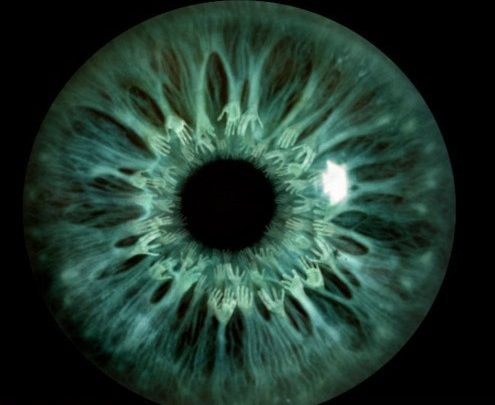
"The blind can see" sounds like a biblical myth but it is true. The blind and the visually impaired can see visual art for what it is, at least the idea of it, while the sighted generally cannot. In paintings and sculptures over many centuries, artists have composed mental images uniting the world outside with the world inside. Art is a construction based on external sensory input and internal wisdom and imagination. Those with visual impairment can understand this easily because they know that they render images in similar ways. The sighted majority do too; they just don't know it because it's too quick and easy for them. Vision (known somewhat inaccurately as external vision) happens so instantaneously and sub-consciously that we think it objective. Those who cannot see will generally not make that mistake as Andrea Bocelli, the Italian tenor blind since age twelve, has recently explained.
Reflections on the Sense of Touch
by Andrea Boccelli
"The word image is a word that the visually impaired use in their daily speech too, because it doesn't necessarily have to be connected with sight. The result of the processing of a sequence of information, it is in fact the cognitive interpretation of a given space. Eyesight is the triumph of simultaneity and synthesis. It offers an overall view, possibly even with a pinch of deception, but its benefit is immediate, while touch (assisted by hearing) offers a selection of pieces of a puzzle which need to be put together again. And the resulting image, far from being served on a plate, is a product of physical and mental exploration.
The tactile image has the advantage that it can't be thrust upon you. On the contrary, you put it together as the result of an extraordinarily absorbing adventure that you experience very much in the first person. Sightless perception forces you to play a lead role, establishing an inescapable relationship between subject and object. [my comment: as in art]
Immanuel Kant defined the hands as "a perceptible expression of the mind." Observing with your hands is a complex, sophisticated experience which involves the interplay of many different dimensions: not only volume in space but also the thickness, temperature and tension of the material, its softness or its roughness, its porousness… You get your hands dirty, both metaphorically and otherwise. You accept a chemical exchange that feeds pertinent information into irrational channels. The result is an intimate form of communication with the outside world, a knowledge which, while maybe not 'precise', is nevertheless deeply capable of grasping the aesthetic value of things. Potentially, the visually impaired have a more elaborate key to access images, they have imagination: an inspired, 'artistic' rapport with the world of objects, and possibly even a less hypocritical approach because they accept what people with sight find hard to admit, namely that there's no such thing as objective reality, that we see only what we want to see. The mind contemplates the tactile image like a poem rather than like a picture or a photograph. [my comment: he does not know, of course, that a picture, ie. 'art', is not "photographic" when seen by the few like us. It is instead a visual poem. He is still correct, though, on how the masses view a picture.] The eyes tend to take hold of an object, to swallow it whole, whereas touch establishes a relationship with it: it's prepared for you to get burnt or to shiver, to get excited or to feel tenderness.
The skin, the largest organ in the human body…, intimately linked to the spiritual and the erotic, is a primary gateway for communication with the world. The coordinates that it's capable of transmitting to the mind can be cultivated, trained and perfected in their accuracy. And in addition to all of that, they're assisted by another miraculous gateway, the sense of hearing. This, because listening is also understanding "the other", it's a sump of information for mapping space, it's a vehicle of material and spiritual knowledge. It is possible to hear an object's vibrations, to perceive its impact with the surrounding air, to grasp its intimate resonance….
Sight is a wonderful gift. What's given and what's taken away is written in the book of fate and we can only gratefully welcome the tools that our time on this earth offers us, whatever they may be. But I also think that we need to learn to cultivate them so that they can blossom and express their full potential.
The visually impaired can also recognize an object's value, intensely, deeply. They, too, can enjoy the beauty and harmony of a work of art. In this case, the use of the word 'impaired' is just one of the many circumlocutions that reek of hypocrisy… The tactile image is simply a 'different way' of looking at things."1
1. In Touch with the Past, ed. James M. Bradburne (Florence: Palazzo Strozzi) 2013, pp. 4-5
Posted 02 Oct 2013: Insight / OutsightPointing / TouchTheoryVisual Perception
The EPPH Blog features issues and commentary.



Reader Comments