The Error of Art History
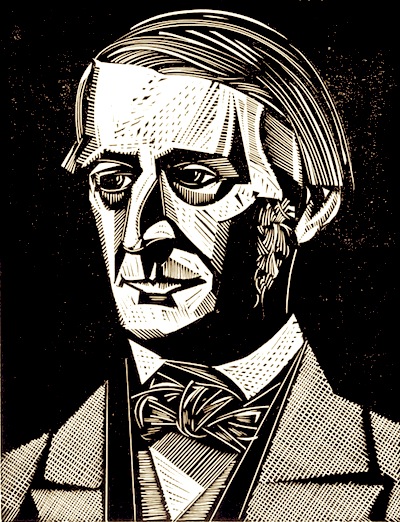
Anon. woodcut of Ralph Waldo Emerson
Yesterday I wrote about how some errors make the world interesting and beautiful. This one does not.
Read the Journals of Ralph Waldo Emerson, who rarely saw great art, and you will learn about it on every page because the truths he knew are those of poetic painters too. The biggest mistake made since the Renaissance is the idea of art as external, by which I mean literal or narrative, as though the scene took place. Most viewers are unaware that poets depict their inner self, not their outer view, and that Leonardo's Mona Lisa is no more a portrait of an actual sitter than God resembles an old man. That brings us to Christ. Jesus' life, though reflecting his actual teachings, is largely myth: an allegorical telling of his spiritual development as a guide for all of us. Christ demonstrates man's potential. So, sadly, what Emerson described in the mid-nineteenth century remains true today:
"I regret one thing omitted in my late Course of Lectures; that I did not state with distinctness and conspicuously the great error of modern Society in respect to religion & say, You can never come to any peace or power until you put your whole reliance in the moral constitution of man & not at all in historical Christianity. The Belief in Christianity that now prevails is the Unbelief of men. They will have Christ for a Lord & not for a brother. Christ preaches the greatness of Man but we hear only the greatness of Christ."1
And not only is historical Christianity the great error of Church and Society; it has become the Error of Art History.
1. Emerson, Selected Journals 1820-1842, ed Lawrence Rosenwald (New York: Library of America) 2010, p. 580
The EPPH Blog features issues and commentary.



Reader Comments