Interpretation and Art
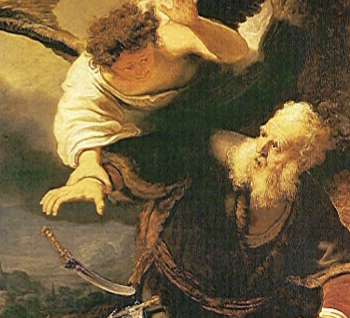
Rembrandt, Detail of Angel Halting Abraham's Sacrifice
Gnosticism was a word coined in the seventeenth century to encompass those early Christian traditions that did not take Jesus’ words at face value and were often deemed heretical by the establishment Church. Many early Christians searched for gnosis, or Wisdom, which was just another way of saying that they were searching for God. This idea that God is Wisdom has been completely lost in the exoteric tradition of the Catholic and Protestant Churches. Fortunately, the so-called Gnostic gospels found at Nag Hammadi in 1945 make God as Wisdom a central focus of Jesus’ collected sayings.
The Gospel of Thomas, one of the best known, makes this clear from the beginning. It starts:
“These are the hidden sayings that the living Jesus spoke and Judas Thomas the Twin recorded: “And he said, “Whosoever discovers the interpretation of these sayings will not taste death.”
Interpretation is all. Do not accept doctrinal explanation of Jesus’ story (it has been inextricably twisted into a knot of nonsensical beliefs) but interpret Jesus’ words for yourself. Interpretation is the key to Wisdom, just as it is in art. The reference to immortality above is, of course, metaphoric: those who succeed will have been “re-born” and found a Truth for all time.
It seems to me that artists, including seemingly secular minds like Picasso’s or Cindy Sherman’s or Basquiat’s, have some kind of access to mankind’s core-Wisdom in ways that we ordinary people do not. They found it in art and they perpetuate it through art. If we can interpret their works “correctly”, we also can advance towards gnosis. That is why they create. I can’t say I myself have got very far [I’m not very spiritual] but everything I write about here I learnt through art, most importantly the Inner Tradition. My knowledge is infinitely greater than it was; not sure about the Wisdom part. What keeps me going is that each time I discover a work’s hidden meaning, I'm floating on air and, for significant masterpieces, sometimes sky-high. That is my satisfaction.
To appreciate the power of interpretation, you must accept that most people described as “artists” are nothing of the kind. No child can be an artist. “Artists” are those who have interpreted past art for themselves and then carved their own, original route within the path called “Art.” They have a message and a calling, even if poorly articulated. Sunday painters copying a landscape, however well crafted, are still only painters, not artists. An artist is a poet. The finished work of an artist can guide an interested viewer towards gnosis just like the gospels can and on the same condition:
“Whosoever discovers the interpretation of (art) will not taste death.”
It must be the same with literature and music and perhaps even film.
Posted 04 Dec 2011: BasquiatPicassoInner TraditionReligion
The EPPH Blog features issues and commentary.



Reader Comments