Is Beauty Truthful?
"Beauty is truth, truth beauty,—that is all
Ye know on earth, and all ye need to know.” John Keats
Does the last couplet of John Keats’ Ode on a Grecian Urn make sense? If the lines, undisputedly beautiful, are illogical, how can they also be true? Literary critics have tried to explain but fail to agree. Perhaps, given that Keats’ subject is visual beauty, a painted pot, it might be useful to think about how canonical visual art, which is also meta-referential, conveys truth.
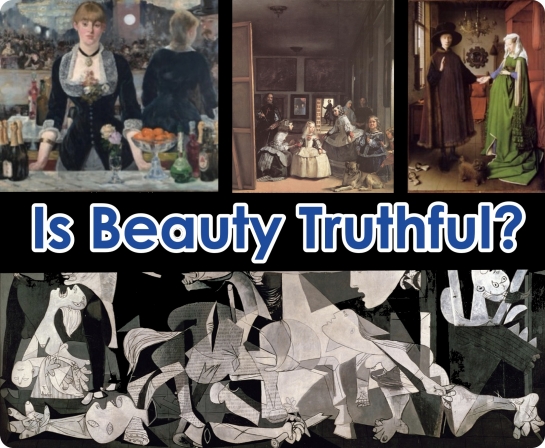
EPPH has long proposed that both great artists and poets convey the universal philosophy of mankind which remains true for all human beings, everywhere, at any time. It was once known as Perennial Philosophy or, in the Renaissance as the prisca theologia, but it is present in different forms in every major philosophical and spiritual tradition worldwide. However, the great masterpieces, despite their truth, often seem as mysterious as Keats’ lines while remaining widely admired. Well-known examples are Michelangelo's Sistine ceiling, Velazquez’s Las Meninas, Manet’s A Bar at the Folies-Bérgère, and even Picasso’s Guernica.
The perceptual stumbling block is that, contrary to common sense and majority opinion, those scenes do not represent the exterior world as through a window. They are always, as EPPH shows in over six hundred examples, an interior view of the artist’s own mind, as in a psychic mirror. That is why they seem illogical and indecipherable. Once that is grasped, they all make sense and convey a far greater truth about our common human mind than can be found through conventional vision. Their beauty is a sign of their universal truth because the human mind has not changed in millennia. Keats clearly knew that.
To read more about the underlying truth, see the recently published article, “The Unseen Truth of God in Early Modern Art”. It may change your views on all types of art.
The EPPH Blog features issues and commentary.



Reader Comments