Keith Haring’s Secret Knowledge
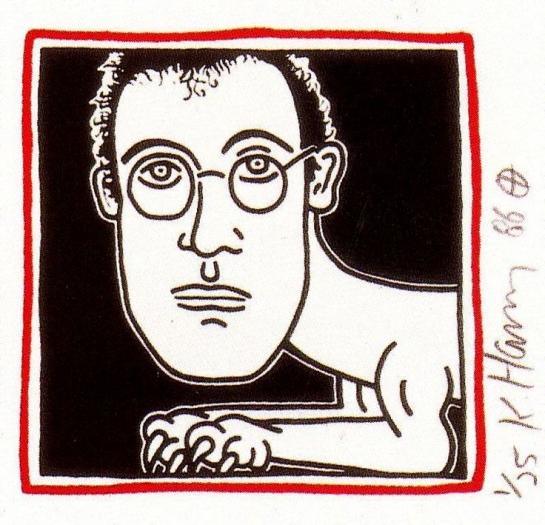
Keith Haring, Self-portrait (1986) Lithograph on paper.
EPPH has already shown how at least 7 major artists depicted themselves as lions (see below). There are more to come but many are by Old Masters and are quite subtle. Here’s an obvious example, an actual self-portrait, by an artist who was all the rage in 1980’s New York, Keith Haring. Why would a downtown artist, once considered a graffiti artist, make himself a lion? What else could it be but his secret knowledge of art history? It’s not just that Haring must have known, as most do not, that Leonardo’s leonine name was a very important factor in his art but he was also aware that paws and claws are used by artists to signify their craft. Note how his lion’s toenails point downwards like pencils to touch the edge of the image, yet another nugget of secret knowledge. A hand or tool positioned by the frame traditionally symbolizes the artist’s hand actively creating the image. His paws are also directly below his circular-framed eyes thereby linking vision with craft. Like all significant artists, Haring was not just a good designer; he was poetic and understood past art.
Correction: He is a sphinx which is part-lion. See comments below.
Artists currently shown on EPPH in leonine self-representations include Leonardo, Perugino, Lorenzo Lotto, Albrecht Dürer, Lucas Cranach the Elder, George Stubbs and Delacroix.
The EPPH Blog features issues and commentary.



Reader Comments
He’s painted himself as a sphinx, not a lion. Mysterious, enigmatic, unknowable.
Keith Haring Foundation
09 Jan 2014
We all make mistakes. You are right, of course, but I’m not sure in terms of Haring’s meaning if there is much difference between a lion and a sphinx. The Greek sphinx had the body and legs of a lioness which is all we see other than his face. It does add the issue of mystery and, perhaps, secret knowledge too.
Your comment also made me notice that he looks over his shoulder while sphinxes tend to look straight ahead (not always). Once again, I believe it’s another of element of his closely-held knowledge, that many figures looking over their shoulder represent the artist looking at himself in a mirror while painting to one side. I’m going to add a theme on that because it comes up time and again.
Many thanks for the correction,
Simon
Simon
10 Jan 2014
We jump under his skin and remember Alexander The great’s head tilt to the left- the secret to how he understood Beaucephalus and tamed his unruly easel- and the world, was by OBSERVATION.look at those eyes. Sphinx, lion, the principle is the same. It is interesting for me to see that the tradition of art is so alive despite the art world being ruled by common cretinism.
.
Sven Theunissen
26 Jan 2014
Spoken like an artist!
Simon
26 Jan 2014
Keith Haring marks his eyes different one from another. See how one eye lid is raised above his glasses’ rim, the other exists in the circle. That right eye is so poetic. While the left eye looks at the self, mirror image, ego, the right eye’s pupil is at the edge, the limit, having identified one’s true nature-seen into one’s brain (talent/imagination/worth). I think this is what raised awareness is. I think this is what rules the art world. I laughed out loud at Sven’s cretinism comment. Also, notice how Haring echos or emphasizes the bent raised eyelid with the eyebrow. I notice this is common in Haring’s work. Emphasized curves like the shoulder of his Sphinx/lion. It’s an echo mark, a ripple, a motion indication. It’s his desire to move, bend, change his world, probable. I want to examine more of his work. Great post!
Adam R Brown
22 Jan 2016
Adam, you’re absolutely correct. Very insightful additions that I, for one, hadn’t noticed.
Simon
22 Jan 2016