Michelangelo’s Battle with Stone
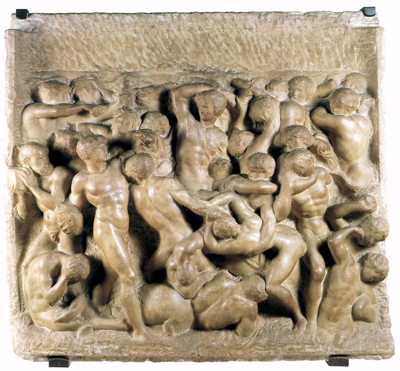
Michelangelo, Battle of the Lapiths and Centaurs (c.1492)
One of Michelangelo’s earliest sculptures, Battle of the Lapiths and Centaurs, depicts a battle scene in which stones are hurled between the combatants. Barolsky noted that the choice of stones as a weapon was not specified by the classical poets and was therefore Michelangelo’s preference based on his favorite medium: stone. The sculpture further resembles the description of a battle-relief by the Greek sculptor, Phidias, in which he was said to have included his self-portrait as ‘a bald old man holding up a great stone with both hands.’ He appears at the left in Michelangelo’s sculpture and would appear to represent Michelangelo himself in the ‘likeness’ of Phidias, one great sculptor as a synonym for the other.‘Phidias’ holds a stone crafted from stone, thus blending reality with imagination in a battle that is on its principal level an allegory of creative struggle in the artist's mind. Barolsky has written how in the life-story Michelangelo created for himself: ‘he is in a sense one of his own sculptures, which are metaphors of the self......Michelangelo’s creation of himself is the central motive of his work.”
We have just published the third essay in the series Sight Unseen: An Introduction to the unseen side of art. It explains how the above interpretation makes sense of another great mystery in Michelangelo studies: why a scene of archers shooting arrows at a target includes no bows!
Posted 25 Aug 2011: Artist as Another ArtistMichelangelo
The EPPH Blog features issues and commentary.



Reader Comments