Microbes & Man: The Essence of Art
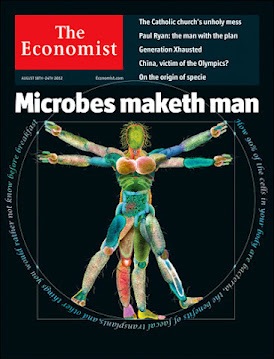
Cover of The Economist, August 18th - 24th 2012
Who we are, or rather who each artist was, is crucial to our understanding of art in ways that the literature on art rarely, if ever, addresses. Yet once the concept every painter paints himself is seen as central to understanding the artist’s intention, so will this question. Superficially the motto adopted by artists seems to suggest that their biography is even more central to understanding art than before. That would be wrong, though, on both the facts and theory. Not only have the lives of most artists long since been forgotten but their art, like that from ancient Egypt and Greece, is rarely less powerful for that. Even Picasso’s art transcends his life but that is an argument for another day. For now and always, the only question that really matters in both this life and art is: Who are you? It is an ancient idea, as relevant today as 3,000 years ago, when it was engraved over the entrance to the Temple of Apollo at Delphi as Know thyself.
Who are you? Are you your name or just your body; your mind perhaps; or even your body and mind together? Will you still be your corpse? What happens when Ida’s organs are transplanted into John? Is John now “Ida” or “half-Ida”? What will happen with a face transplant? Some people especially artists, poets and those spiritually inclined have considered this question at length since antiquity. The rest of us, lazily imagining that we know the answer to such a “simple” question, go on our blessed way believing that “I’m me, of course, who else?” Besides as we often note: “I’m definitely not you. I’m an individual.” That answer, I literally learned from looking at art, is the fruit of ignorance and of the unexamined life.
Even science, as The Economist reported in its cover story this week, thinks there is a problem in human identity. For years scientists thought that each of us is a collection of 10 trillion cells which are, in turn, the products of 23,000 genes. Yet a new view of the body has rapidly gained acceptance among scientists in just the past few months alone. We are not just the products of genes, the new view argues, because inside “the nooks and crannies of every human being”, especially in the guts, live 100 trillion bacteria of several hundred species. These microbes living inside us contain 3 million non-human genes yet, unlike parasites, they contribute to the wellbeing of the whole microbiome of which the human “host” is just a single, if dominating, part. Not only do they provide us with 10% of our daily calories through breaking down plant carbohydrates that our bodies cannot do on their own but they do the same for mother’s milk. Mankind’s first food “contains carbohydrates called glycans which human enzymes cannot digest, but bacterial ones can.” So, on the physical level at least, each of us is a collection of 100 trillion living entities. You are all of them.
Major artists, like their poetic colleagues in literature and music, have long known that the individual life is a myth of our own making, the product of a breakdown in our psyche. The psyche has been trapped by the five senses into a mistaken identification with the product of sight, sound, touch, taste and smell. By focusing inwards and searching internally for an understanding of their own self, Western artists like Christian mystics have long recognized that the individual’s identity is part and parcel of a larger whole. In the very core of our being we are united with other humans and other life forms through a “divine” essence metaphorically described by poets as Truth or Wisdom and by prophets as God’s Kingdom. That kingdom was never in the sky but Man.
In the early Greek copies of the Bible, our psyche is always identified as Soul. Long ago (allegorically, in the Garden of Eden) mankind ate from the Tree of Knowledge of Good and Evil thereby descending into a bi-polar existence in which opposites predominate (good and evil, heaven and hell, object and subject, you and me etc.) The psyche now misidentifies the self as our own body and/or mind. Once the psyche becomes identified, it is very difficult for it to break out of the trap of its own beliefs, finding it virtually impossible to identify alternatives. Most of the time our misidentified psyche only perceives what our physical senses do. It narrows our view not only of ourselves but of the exterior world as well, limiting our potential. Until we escape from this trap, we cannot easily perceive reality so the only choice is to trust someone who has already found a way out. That, in essence, is the route of those following a Hindu Guru, a Buddhist Rinpoche or a leader among the Greek Orthodox monks on Mount Athos, the latter one of the few Christian institutions today still following the precepts of the early Church. The road to seeing reality through theosis or nirvana is a long one, requiring the student to sit still for extended periods of time to allow the mind to quiet itself and gain the attention of the soul. In time, if suited, the student makes progress but not everyone can do it, not even all the monks on Mt. Athos.
This larger view of who we are – that, in essence, we are all one - is very similar to both the philosophy of Plato and that of the original prophets of all the world’s major religions. It is the product of a search for self-knowledge in tune with the Kabbalah of Judaism and the Sufis of Islam. Even within Christendom many have looked inwards in this way including the early Church fathers, St. Francis and the Florentine magus and priest Marsilio Ficino. Many in the Middle Ages and Renaissance trusted in the mythic magician Hermes Trismegistus whose name and image is engraved on the floor of Siena Cathedral and at the entrance no less. Many poets have thought likewise too. The second half of the twentieth century saw the beginnings of a mass movement towards internal spirituality most visibly in the rise of Buddhism in Western culture and the popularity of many New Age paths. The Beatles, unaware that Christianity had suppressed its mystical strains and buried its scriptures, went eastwards in search of truth when, today, they would have found many similar alternatives closer to home.
Finally, whether or not you believe in the truth of a divine essence or the unity of all life forms, poetic painters and sculptors over the centuries certainly did. To understand their art, then, we must interpret art’s motto every painter paints himself correctly, not as a focus on their individual life but as a turn inwards, away from the exterior world and into their own minds where, in spiritual practice, they perceive a unity with all nature. By identifying with the artist, as their compositions encourage you to do, you too can change your views. At the very least such experience helps expose the depths of our own ignorance. Scientists given the latest news seem to be moving in a similar direction. The artists, of course, like poets and playwrights, had many ways of discovering this truth, as in the various traditions listed above, even if the most likely place for them to have acquired this knowledge was, as it was for me, in art itself. They could just have read the poetry of Christian Scripture too. That is why art, as John Keats tells us in his poem, is beautiful. It is beautiful because poems of substance express a profound Truth sensed even by those who do not clearly understand. Its wisdom is all ye know on earth because the so-called knowledge of the exterior world is limited and misleading and, thus, not knowledge at all. True knowledge is internal, as expressed in the phrases Know Thyself, Who are you? and Every Painter Paints Himself.
Of course, you don’t have to believe in a so-called divine essence. I’m not sure if I do because I’m certainly not spiritual. However, you must at the very least know about this in order to grasp that essence of art that few have ever seen and without which even great art, like the Mona Lisa for instance, can seem pedestrian.
The EPPH Blog features issues and commentary.



Reader Comments