Mondrian’s Esoteric Interests
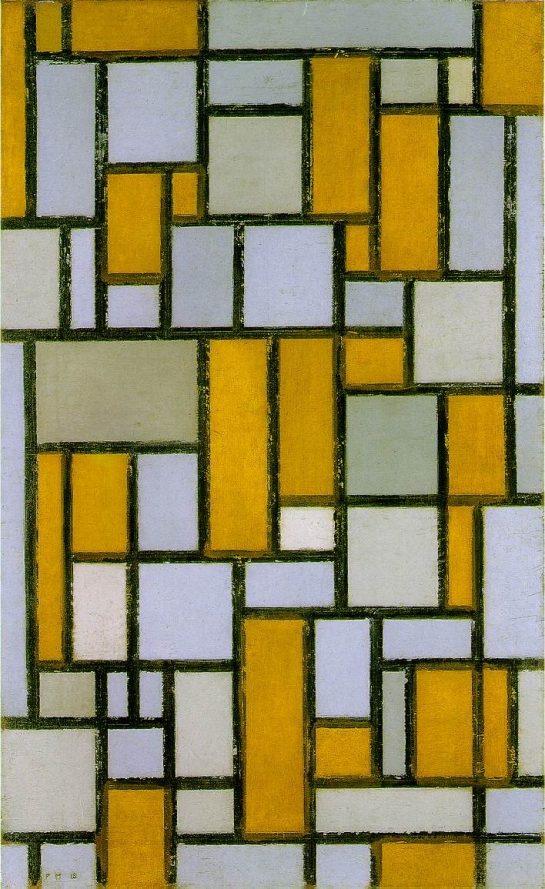
Mondrian, Composition with Gray and Light Brown (1918) Oil on canvas. Museum of Fine Arts, Houston, texas
The spiritual and esoteric knowledge passed down in Western art from one generation to the next seems to remain constant regardless of which spiritual path the artist is interested in. There are dozens of possibilities, some more likely in one age than another. Among the best-known of these esoteric traditions are Neoplatonism, Gnosticism, Alchemy, Rosicrucianism, Theosophy or, in a more orthodox vein, the teachings of St. Francis and St Theresa; Christ’s too though now denied by many Churches. Their goals are the same even if their path and verbal terminology differ. Unfortunately, specialists in art history not only tend to dismiss many of these interests as somewhat cranky but they emphasize their different methods and terminology rather than their common ground. [For an overview of the Inner Tradition, click here.]
Robert Storr, an exception, has noted how Max Beckmann and his very different contemporary, Piet Mondrian, shared an interest in the metaphysical which both wrote about. “Although in every respect his aesthetic opposite, Mondrian shared Beckmann’s metaphysical longings and his weakness for theosophical metaphor and jargon, but efforts at rescuing this paragon of the avant-garde [Mondrian] from the clammy embrace of late Symbolism and its table-tapping enthusiasts have required turning a blind eye to or simply lopping off the inconvenient aspects of Mondrian’s production in which Symbolist influence and his own esoteric impulse are most evident. Historians have imposed a tactful silence about the large body of [Mondrian’s] writings in which those ideas remained embedded long after he turned to pure abstraction.”1
This “tactful silence”, incidentally, is similar to that concerning Isaac Newton’s interest in esoterica and Einstein’s in mysticism. Though puzzled by the similarity of Beckmann’s and Mondrian’s interests Storr still cannot take their views seriously. He refers to their metaphysical “jargon” and links Mondrian to a common though absurd activity in late nineteenth-century life, a pastime made popular by the spirituality of the age, the calling-up of ghosts around a table. I have never been able to make much sense out of Mondrian’s entirely abstract art but I have no doubt given his serious written interest in Theosophy and its path to self-knowledge that the message and meaning in his art is linked to it.
My advice, for what it’s worth, is this. Take esoteric thought seriously wherever it occurs in the art or biography of an artist. It is the bedrock and lode-star of their calling.
1. Robert Storr, "The Beckmann Effect" in Beckmann (London: Tate Publishing) 2003, p. 12
Posted 20 Sep 2012: Inner TraditionReligion
The EPPH Blog features issues and commentary.



Reader Comments