Petrarch on Imitation
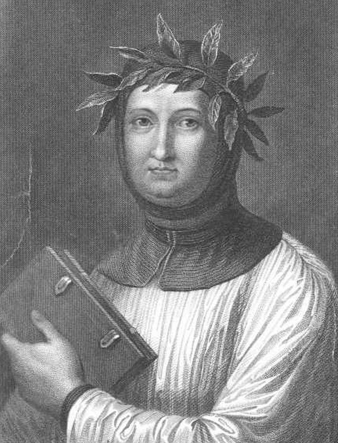
I have always doubted whether the poets and writers in an artist's social circle have any greater understanding of visual art than we have. They are, of course, deeply familiar with poetic techniques in writing but seem blind to them in art. Thus the ability of a good writer to transform a text into something similar but different is not a talent praised in portraiture. They think a painted head should be an accurate likeness. Why? That is a job, as Petrarch says of writers below, for an ape not a poet. Yet the comparison he uses - the similarity between a parent and child - is a particularly apt one for how artists have often fused their features with their sitter's.
Petrarch (1304-1374) lived in age unfamiliar with independent portraits. They had flourished for a few centuries in antiquity and then did not reappear again until the fifteenth century. Nevertheless many altarpieces included donor portraits and portraits of contemporaries as saints. This, then, is what Petrarch had to say about literary imitation with reference to painting:
“He who imitates must have a care that what he writes be similar, not identical, and that the similarity should not be of the kind that obtains between a portrait and a sitter, wherein the artist earns the more praise the greater the likeness, but rather of the kind that obtains between a son and his father. Here, though there may be a great difference between their individual features, a certain shadow (and as our parents called it, air) perceptible above all in the face and eyes produces that similarity that reminds us of the father as soon as we see the son, even though if the matter were put to measurement all parts would be found to be different; some hidden quality there has this power. So we too should take care that when one thing is like, many should be unlike, and that what is like should be hidden so as to be grasped only by the mind’s silent inquiry, intelligible rather than describable. We should therefore make use of another man’s inner quality and tone, but avoid his words. For the one kind of similarity is hidden and the other protrudes; the one creates poets, the other apes.”1
1. Petrarch, Familiari XXIII, 19 cited in Erik Inglis, Jean Fouquet and the Invention of France (Yale University Press) 2011, p. 51
Posted 29 Aug 2011: PortraitureTheory
The EPPH Blog features issues and commentary.



Reader Comments