Physiognomy and Every Painter….
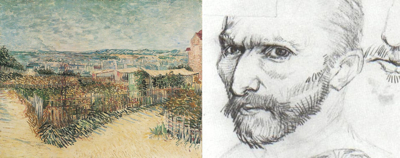
In the previous entry we saw how Degas’ beloved Little Dancer Aged Fourteen is partly modelled on the physiognomic ideas of Johann Caspar Lavater (1741-1801) and others. I mentioned this because Lavater also wrote: “Every painter paints more or less himself. As one is, so he paints.” His view is only partially supported by what we argue here (perhaps fortunately, considering his reputation) but few know that he was also a mystic and poet and may have come to his views on painting through knowledge of these other areas not physiognomy. He believed, like many mystics, that man is an imperfect copy of the divine and that therefore every creation is an imperfect copy of its creator. “Inner wholeness”, he wrote, “is the character of all nature. Just as all of nature is a silhouette of the infinite, eternal original spirit, so are all products of nature – the same silhouette reduced in infinite, multifarious ways, colored and shaded.” He went on to argue that “artists reflect the outlines of their face in their paintings, particularly their forehead and nose, and if these lines are angular, slack, or precise, then their paintings will be the same…..Artists reproduce the lines of their own physiognomy, lines that reflect their fundamental character, and thus reproduce themselves in their paintings.”1
While there is little evidence to suggest that an artist’s character is reflected in his art – indeed the reflection would not be universal if it were - we have already shown some examples (by Leonardo, Corot and, above, Van Gogh) in which Lavater is partially correct. The lines and contours of the artist’s face appear as significant parts of the overall composition but reproduced as something else, in these cases lines of the landscape. They do not, however, express the artist's character. He probably had too little opportunity to study art in depth to realize that artists often use the well-known idea metaphorically, not just literally, and in so doing express our universal humanity not each artist’s individual character as he believed. Nevertheless, Lavater’s use of the phrase indicates that the concept continued to be of compelling interest, at least to a mystic and poet, long after the Renaissance had ended.
1. John B. Lyon, “The Science of Sciences”: Replication and Reproduction in Lavater’s Physiognomies”, Eighteenth-Century Studies 40, Winter 2007, pp. 265-9
Posted 04 Feb 2012: DegasLeonardo da VinciVan GoghTheoryVisual Perception
The EPPH Blog features issues and commentary.



Reader Comments