Poetry from Libya’s Descent into Hell
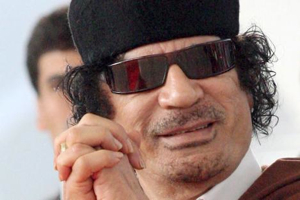
Brother Leader, Colonel Muammar Quaddafi
We spend so much time studying art here that hours reading literature are rare. So I was intrigued by the story of the New York Times reporters (one, a woman) captured by government troops in Libya and recently released. Their account in today’s paper is fascinating. Quaddaffi (who knew?) believes that Shakespeare was an Arab migrant to England known as Sheik Zubeir. However, beaten, fondled and violently maltreated by their ever-changing guards, culture was not on the minds of the reporters. “You have a beautiful head,” one guard told the photographer in a mix of English and Arabic. “I’m going to remove it and put it on mine. I’m going to cut it off.” Not until they arrived at the brigade headquarters of one of Quaddafi’s brutal sons near the Brother Leader’s hometown of Surt did they start to relax. An officer assured them that no-one would mistreat them again and they never were. They did, however, spend long days in a detention room, resembling, they thought, a double-wide trailer.
On the shelf of their new home was a German-Arab dictionary and three plays by Shakespeare. One prisoner finished Julius Ceasar, another started Othello. They joked that if they stayed there much longer, they could start performing them. However, what really struck them as they were finally released from Libya with the help of Turkish diplomats were the words of “an urbane Foreign Ministry official speaking idiomatic British English. As we sat in an office, he murmured two lines from Yeats:
“Those that I fight I do not hate,
Those that I guard I do not love.” "
Wow! I couldn’t do that, I thought, and impressed by the Libyan official’s ability to bring up the right lines at the right moment, I immediately googled them. His interpretation of what they meant was spot on; his timing perfect. The subject of the poem was fighting for an army he had no loyalty to. I have printed the full poem below but the site it came from, www.thebeckoning.com, is particularly interesting. They do in part for some poetry what www.everypainterpaintshimself.com does for art: fresh interpretations in everyday English of individual poems by a writer outside the academic system. For this poem, the website explains the details of the subject’s life and how, on meeting death, he must balance one against the other, life vs. death. Other readers have added depth to his interpretation, making it on the whole wider and more applicable to everyman. One reader made a deeper impression than the others with their details of the events surrounding World War I. Yes, Maggie Secara writes, these are all important points but “while the poem may be inspired by someone in particular, the poet's expression is always of his own internal state.” Right on, Maggie!
The Beckoning does not cover many poets and some poems are posted without interpretations but it’s an excellent idea for a website and if any reader knows of a larger site doing the same for literature what we do here for art, please let me know about them.
Here is Yeats’ poem written after the death of an Irish airman fighting for Britain:
An Irish Airman Foresees His Death
I know that I shall meet my fate
Somewhere among the clouds above;
Those that I fight I do not hate,
Those that I guard I do not love;
My country is Kiltartan Cross,
My countrymen Kiltartan's poor,
No likely end could bring them loss
Or leave them happier than before.
Nor law, nor duty bade me fight,
Nor public men, nor cheering crowds,
A lonely impulse of delight
Drove to this tumult in the clouds;
I balanced all, brought all to mind,
The years to come seemed waste of breath,
A waste of breath the years behind
In balance with this life, this death.
Posted 23 Mar 2011: Theory
The EPPH Blog features issues and commentary.



Reader Comments