Rembrandt’s “Weakness”
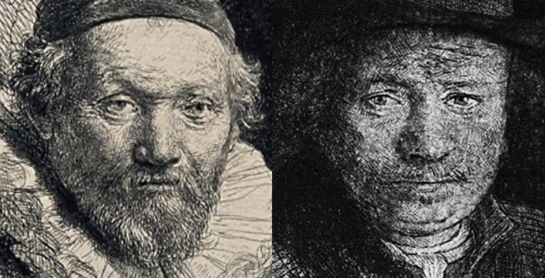
Left: Rembrandt, Portrait of Jan Uytenbogaert (1635)
Right: Rembrandt, Self-Portrait at a Window (1648)
Using short entries to explain art, we do not get much chance to quote the opinions of others striking the same chord. Hence this new segment called Quotations. Much of the time the quotes will point out a great master's "weakness", the type of comment that you should look out for too. Here's why.
Just as we explain how inconsistencies on the literal level help unearth the artist's intention, so observations in the literature about a great master's "mistakes" or "lack of talent" often indicate that the artist is doing something the expert cannot explain. Correct in their observations but unaware of the artist's true theme, their default explanation is: "he's not very good at that" or "she made a mistake".
Ernst van der Wetering provides an excellent example in portraiture.
"There is room for doubt...as to whether Rembrandt had a strong talent for capturing the likeness of those he portrayed. One reason for such doubt, among others, is suggested by some epigrammatic Latin verses written by Constantijn Huygens, occasioned by a portrait that Rembrandt had painted of one of his friends in 1632. In these verses he wittily mocked the inadequacy of the likeness in that portrait. This suspicion that Rembrandt's greatest strength did not lie in accurate portraiture is only exacerbated when one compares the authentic self-portraits with each other. The physiognomic differences between these portraits of Rembrandt are considerable. In cases where it is possible to compare a portrait painted by Rembrandt with portraits of the same model by other paintrers, one has the impression that the likeness produced by Rembrandt was the least accurate. This seems to be true, for instance, of his portrait of the famous Remonstrant preacher, Johannes Wtenbogaert, who was also portrayed by Michiel Jansz. Van Miereveld and by Jacob Adriaensz. Backer."1
Before assuming a major artist lacks skill in certain areas, it is always safer to wonder whether the creator's apparent weakness may instead be intentional.
1. Ernst van der Wetering, Rembrandt: Quest of a Genius (Amsterdam: The Rembrandt House Museum) 2006, p. 35
Posted 09 Oct 2010: RembrandtPortraiture
The EPPH Blog features issues and commentary.



Reader Comments