Art in Search of Self-Knowledge
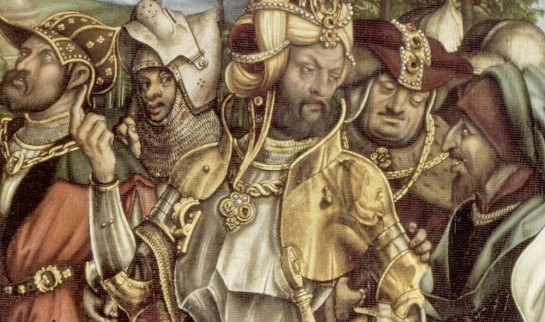
Hans Burgkmair, Crucifixion (1504), detail. Apex of the Basilikabild altarpiece. Oil on panel. Bayerische Staatsgemäldesammlungen, Staatsgalerie in der Katharinenkirche, Augsburg.
One of the great shibboleths of art history is that High Renaissance masters depicted the exterior world. Few, of course, doubt that landscapes and portraits represent exterior nature. EPPH, on the other hand, argues that all scenes in art are internal in the long millennia-old search for self-knowledge.1 While few but the thoughtful bother to try, this is a search that must repeat itself within each human life. No-one else can do it for you. Those that have told us how and what to look for include Socrates, Plato, Buddha, Moses, Jesus, the Gospels, the Kaballah, Chaucer, Dante, Shakespeare, Blake and innumerable other saints, poets, artists and philosophers. Einstein and great scientists have done so as well, and - believe it or not - some popular novels and Hollywood films. The latter are rarely recognized because the theme - as in art and parables - is under the surface and requires independent, metaphorical thought to tease out.
Conventional art historians, if they read EPPH, might dismiss the idea of self-knowledge as the unifying subject of art for a number of reasons, not least the vast amount of literature claiming otherwise. Besides, artists are thought to have been subject to the whims of patrons who generally followed Church dogma and were fully convinced that looking at art was, as the first modern art theorist also put it, like looking through a window. Even the intelligence and spiritual knowledge of great artists is sometimes belittled by those who study them on the basis that they were craftsmen not scholars.2 Besides, while the search for self-knowledge could possibly be true of a few artists, I have heard it said, it could not possibly be true of the many.
My heart sung then on reading Mitchell Merback’s recent article in the Art Bulletin analyzing a small detail of Hans Burgkmair's Crucifixion scene (detail above). It shows a soldier, said to be an alter ego of the artist, on the right-hand edge talking to the Good Centurion. His face is reflected differently in the officer's gold armour with a wide-eyed expression and no smile. Why? Discussing other images from the Renaissance of people looking in the mirror, Merback declares that the search for self-knowledge is indeed their subject and cites a writer from 1541:
“Man remains forever in his affairs and towards himself blind and a fool….Likewise if a monkey and an owl were to be looking at themselves in a mirror, the nature of animal or man is so blind that each creature, obsessed by self-love, does not know himself, does not see himself, and cannot do so.”3
Merback notes that contemporaries who were willing to think for themselves agreed.
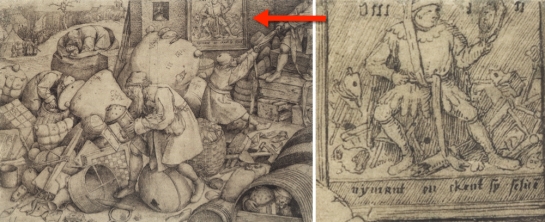
L: Breughel's Elck (c. 1558) Pen and brown ink. British Museum, London
R: Detail enlarged showing "Nobody" looking at himself in the mirror
He then shows a Breughel drawing from 1558 depicting a double for the artist stooping in the foreground in search of self-knowledge (above left). In the background is a poster of a fool called Nobody (ie. Everybody) looking at himself in the mirror (above right). Breughel inscribed underneath it: “Nobody recognizes himself.” As in all art, there is a double meaning (paradoxical here) which only makes sense to those aware of self-knowledge. Merback notes that this was quite common in certain circles in the Renaissance:
“The profound difficulty of seeing oneself for the sake of spiritual or moral improvement preoccupied a broad swath of sixteenth-century writers and artists [my italics] who understood it to be an anthropological as well as ethical problem.”4
In its breadth this is an important acknowledgement.
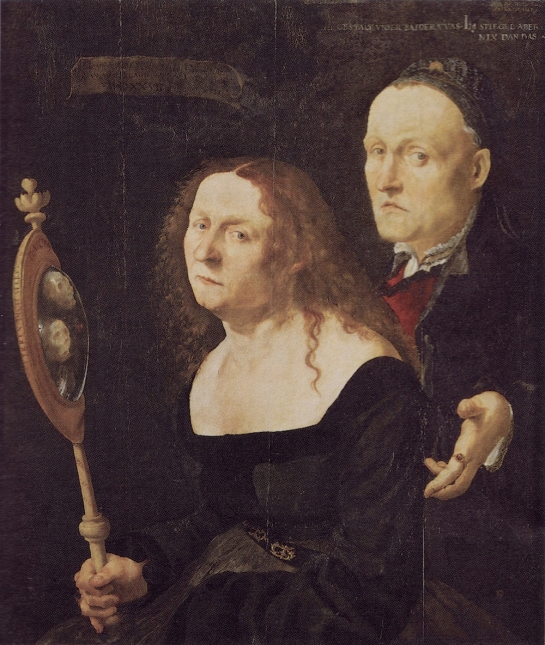
Lucas Furtenagel, Hans Burgkmair at the Age of 56 and Anna Burgkmair at the Age of 52 (1529) Oil on limewood panel. Kunsthistorisches Museum, Vienna
Another example is the 1529 double portrait (above) believed to have been composed by Hans Burgkmair. It depicts himself and his wife holding a mirror which has their own skulls reflected in it. On this one Merback cites another expert who claimed that “there is no doubt that we are being called to witness an act of self-recognition on the couple’s part and admonished to recognize ourselves in the process.”5 Even the inscription on the edge of the mirror tells us to recognize our true selves.6
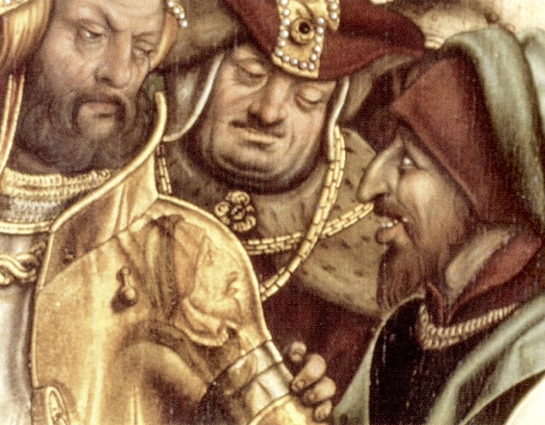
Detail of the soldier's face in the armour of the Good Centurion from Burgkmair's Crucifixion, the apex of the Basilikabild altarpiece. Oil on panel. Bayerische Staatsgemäldesammlungen, Staatsgalerie in der Katharinenkirche, Augsburg
Back then to the Crucifixion scene, the principal subject of Merback’s essay. He concludes that the Jewish-looking soldier is a paradoxical alter ego of the artist and that the reflection of his face in the gold shoulder-plate of the Good Centurion is “a moment of authorial self-recognition [his italics.]”7Gold, by the way, is a symbol of mental and spiritual purity, both of which occur in the attainment of true self-knowledge.
It is encouraging then that an expert like Merback, a specialist too, has recognized the importance of this subject in his area of specialization. Hopefully others will in theirs'. There are many reasons why self-knowledge is so important and the subject so universal in art as I have often explained. None, though, are quite so cogent as Socrates’ dictum that “an unexamined life is not worth living.” And as the sign said in the forecourt to the Temple of Apollo at Delphi, Know Thyself.
For a further discussion of this painting, see Hans Burgkmair's Archer in S. Croce in Gerusalemme (1504).
Notes
1. This is true even in the work of modern artists and contemporary masters. See any of the many examples on EPPH.
2. Jane Mayo Roos has written that Stéphane Mallarmé was “one of those rare writers willing to credit a visual artist with a degree of perceptiveness.” James Hall claims that “the idea that something as important as the direction of the lighting in a Renaissance portrait was determined by someone as socially insignificant as an artist seems anachronistic, to say the least.” And Marcia Hall believes that “the layman-painter (Michelangelo) could not be expected to have invented such a conceit as this. It is the kind of refinement [that] the theological advisers to the painter would have suggested or required.” Artists' supposed ignorance of theological matters is typical. Johann Konrad Eberlien noted: “It is not usual to attribute to Raphael a profound knowledge of theological matters.” Sources: Roos, “Manet and the Impressionist Moment” in Therese Dolan (ed.), Perspectives on Manet (Farnham, UK: Ashgate) 2012, p. 81; James Hall, “Spiritual or Sinister?”, Art Quarterly, Autumn 2008, p. 35; Marcia Hall, Michelangelo’s “Last Judgment” (Cambridge University Press) p. 26; Eberlein, “The Curtain in Raphael’s Sistine Madonna”, Art Bulletin 65, Mar. 1983, p.72.
3. Mitchell Merback, "Recognitions: Theme and Metatheme in Hans Burgkmair the Elder's Santa Croce in Gerusalemme of 1504", Art Bulletin 96, Sept. 2014, p. 303
4. ibid., p. 303
5. James Marrow, cited in Merback, op. cit., p. 304
6. The lotus leaf carved in wood above the mirror was an ancient symbol in Egypt for the pledge of continuity of birth and re-birth, the latter a traditional metaphor for the attainment of spiritual purity. In the East where it has been more widely used it symbolizes the attainment of mental and spiritual purity for both Hindus and Buddhists. The Penguin Dictionary of Symbols, ed. Jean Chevalier and Alain Gheerbrant (London: Penguin) 1996, pp. 616-8
7. I should add that a Christian artist is identifying here with the seemingly paradoxical stereotype of a Jew, with an effect somewhat like that of a Janus figure, opposites but united. Perhaps Burgkmair is suggesting that there was one original religion from which all stem, a position in line with the Renaissance philosopher Pico della Mirandola.
The EPPH Blog features issues and commentary.



Reader Comments