“Sir, rejoice with me, I have become God.”
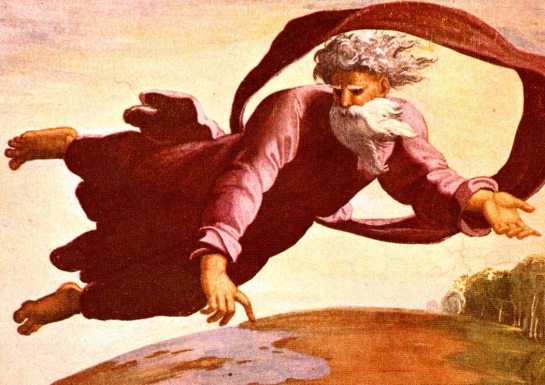
Raphael, God Separates the Land from the Waters
The Inner Tradition in Christianity, the idea that Scripture and Christ’s teachings are allegorical in nature, is so little known that its impact on art has not been properly addressed. Those following the tradition know that God, as described by Christ, can only be found inside oneself because heaven is just a poetic metaphor for a spiritual state-of-being. Art history has not fully recognized this even though artists, like poets, are far more likely to follow inner Christianity than its distant cousin. William Blake put the difference between the two types of Christians succinctly:
“Both read the Bible day & night,
But thou read’st black where I read white.”1
The gap is as jarring he claims. A nun writing to her eminent confessor around 1300 AD wrote "Sir, rejoice with me, I have become God” and she knew he would understand.2 Victor Hugo, both artist and poet much later, was just as clear: “The way to ascend unto God is to descend into one’s own self.”3 And St Paul writing to the Corinthians two millennia ago was equally explicit:
“Know ye not that ye are the temple of God, and that the spirit of God dwelleth in you?....; for the temple of God is holy, which temple ye are.”4
Your body, my body, is the temple within which God resides. If you find that difficult to believe, you’ll need to get over it; it is the foundation of great art. Dürer, after all, was not the only artist to portray himself as Christ. So did Mantegna, Titian, Michelangelo, Rembrandt and many others as I show under the theme, The Artist as Christ.
Artists, both secular and religious, tend to believe that deep within each of us is a spark of purity, perfection or divinity which once revealed, shines. It is not easy and very few attain it but the effort involved in making oneself a better human being, not like unto God but as him, has helped millions. Meister Eckhart, the fourteenth-century mystic, remarked: “I am converted into Him, not as a similar being but so that He makes me one with Himself.” [italics added.]5 To understand art, you must start to understand this.
1. William Blake, "The Everlasting Gospel, c. 1818" in Blake: Complete Poetry and Prose, ed. Geoffrey Keynes (London: The Nonesuch Press) 1939, p. 133
2. Sister Catherine to her confessor, Meister Eckhart, in a fourteenth-century pseudo-Eckhartian tract, Schwester Katrei, cited in Robert Lerner, The Heresy of the Free Spirit in the Later Middle Ages (University of Notre Dame Press) 1972, p. 218
3. D.T.Suzuki, An Introduction to Zen Buddhism, ed. C. Humphreys (London: Rider & Co.) 1969, p. 43
4. Corinthians I 3:17
5. Lerner, ibid., pp. 1-2
The EPPH Blog features issues and commentary.



Reader Comments