Still-lifes by Peale and Core [from the Archives]
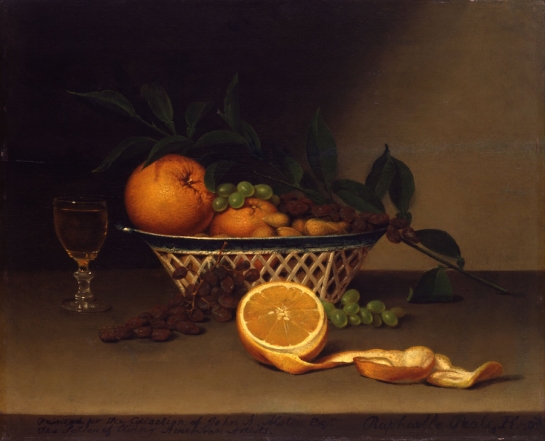
Raphaelle Peale, Still-life with Oranges (1818) Oil on wood. Toledo Museum of Art
Names are important in art. The American master Charles Willson Peale (1741-1827) had three sons who became painters: Rembrandt, Raphaelle [sic] and Titian. His fourth son was Rubens. Raphaelle is thought to be America’s first still-life painter who, on occasion, punned on his name as in the example above. The peel runs off to the right just like his signature below.
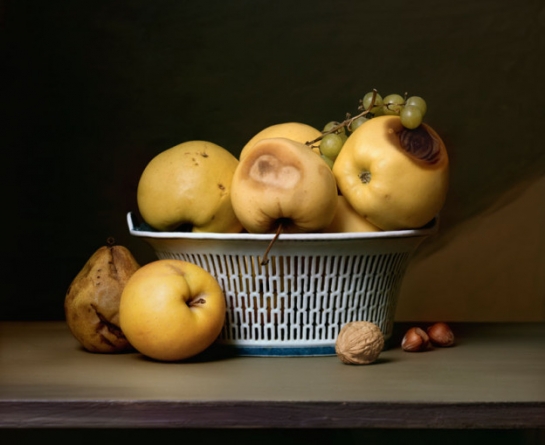
Sharon Core, Apples in a Porcelain Basket (2004) Color photograph
A contemporary photographer, Sharon Core (1965- ), is inspired by early American trompe l'oeil art. She is obviously not a great artist in our terms but she is poetic and understands part of their method which few do. Some of her works are direct copies of Raphaelle’s. Her prints, though photographs, resemble paintings and thus on another level are trompe l’oeil too like their source. And as importantly, her photographs when copies of Raphaelle's paintings are, so to speak, by both Peale and Core. She may not show any peel or core but, in her mind I imagine, there is a link. She does not copy Peale by chance.
Many artists know of this tradition; few scholars do though John Wilmerding who specializes in American art has written an excellent book on signature puns in his own field [ref1]. In part thanks to his insight I have discovered many more. François Boucher, the 18th century painter of Parisian society, risqué poses and roccoco, drew a nude literally drawing his own mouth. It must have been intentional because a mouth in French is la bouche (see entry). Thus such visual puns not only help confirm the artist's perspective but convey that the view is inside their mind, not outside. As long as you know that artists do this and have done so in great numbers ever since the Renaissance, they are relatively easy to recognize. Anyone can do it. You just have to know what to look for. A few of these pictorial puns, like Peale's, have been publicly recognized in the work of a single artist but not as part of a long-running artistic tradition in all Western cultures. The knowledge that this method to reference the painter is pervasive will empower your skill at interpreting art.
It is known, for instance, that Michelangelo used the archangel Michael to support God and his crew on the Sistine ceiling because he was the angelo Michael. Dürer whose name is derived from door used doors as self-referential thresholds between inner and outer reality because that is what artists do. They go back and forth between the two. Wilmerding has pointed out that the American artist Frederic Church put churches in his landscapes while Michael Fried noted even earlier that Courbet's Stonebreakers are bent under the weight of their labour because bent in French is courbé. Zhenya Gershman revealed on EPPH that Rembrandt's method of placing bright light next to murky darkness was in part inspired by his own name because, Rem in Dutch means obstruct (ie. shade) while brandt means light. He seems to have added the d to Rembrant, his original name, for that precise reason.
Picasso, also first revealed here, represented himself as the winged horse Pegasus (Pegaso in Spanish) and as a picador (Pica-sso) in his many images of the bullfight. However, I was particularly excited when I realized that the picador-link with his art is based on more than just sound as I will explain soon. I thought, though, that it would be useful here to give you some idea of how widely artists have used visual puns on their name by listing some that I have discovered along with some already known. You should always be aware of the artist's name and its possible puns because it is certain that dozens more have done likewise.
1. John Wilmerding, Signs of the Artist: Signatures and Self-Expression in American Paintings (Yale University Press) 2003
The EPPH Blog features issues and commentary.



Reader Comments