Van Gogh’s Crosses on The Road to Tarascon

Fig. 1 L: Van Gogh, Self-portrait (Summer, 1887) R: Photograph of J. P. Stricker, Van Gogh’s uncle
Vincent van Gogh’s uncle-by-marriage, J. P. Stricker, was an important catalyst in the formation of the painter’s world-view (fig. 1). A theologian and biblical scholar, Stricker did not believe in the literal, historical truth of Jesus’ life as recounted in the Gospels but, like many others, read it for its allegorical truth which is critical to understanding major art. No wonder Vincent wrote to his brother, Theo: “Do you know that J.P.S. is really a very clever man, in fact, an artist?”1 Stricker was not an artist in the common sense but thought like one, the best of whom, as shown on EPPH, have long had a common visual language to express the potential perfection of the individual. Jesus, in this ancient understanding, was a ‘son of God’ because everyone is, theoretically. 'a son of God'. God, or the essence of Creation, is in everyone, just as scientists now know that we are all made from stardust. Christ's life, read allegorically, illustrates a model for others to follow, just as the lives of Mohammed, Buddha and the saints do too. That path, leading to sustained happiness, is universally available, which is why Jesus is also a prophet and messenger of God in Islam. His torments symbolize the psychic troubles of everyone. However, by following his teachings and his example, the individual with their own innate powers of discrimination and wisdom can progress towards a state of inner stability like his. Everyone, though, must practice it on their own. This theme runs throughout Vincent’s oeuvre, as it does all the finest Western art whatever the subject matter, and, it seems likely, the finest Asian art too. So, as an art lover, keep this in mind at all times. It is the key to understanding.

Fig. 2 Van Gogh, The Painter on the Road to Tarascon (1888). Kulturhistorisches Museum Magdeburg.
Recently, I was struck by a detail in Vincent’s painting of himself carrying his easel and tools on the road to Tarascon, in sunny Provence (fig. 2). I have already interpreted the painting online, describing his figure as a pilgrim on the road of life attempting to improve himself by following the wisdom of past sages. There was no specific mention of Christ. There is, however, an intriguing design within the composition that helps show how the message just explained can be conveyed in a secular scene.
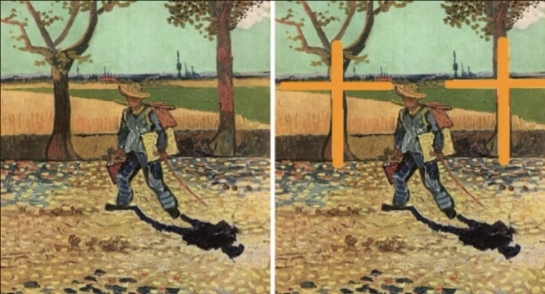
Fig. 3 Van Gogh, The Painter on the Road to Tarascon and diagram
Each tree trunk resembles the upright of a Cross with the horizontal bar formed, not by the horizon, but by two distant yellow wheat fields, just below it.2 The crosses with their yellow cross-bars are incredibly subtle, and easy to miss (fig. 3). Once seen, they are obvious. They represent the two thieves, the Good and Bad on either side of each of us. Vincent in the center thus takes Christ as his model on the Way of Life, on the journey to becoming Christ-like.
Vincent could have learnt this philosophy from Stricker; from looking at art alone; from reading scripture and patristic literature; or from his own inner wisdom. The age also produced a range of universalist philosophies. Dutch religious views, for instance, changed considerably in the 19th century, influenced by German philosophers. They argued that Christ represents the perfect human inside each Christian. His own father, a minister and theologian, followed that path within the Groningen School. Service to others based on a Christocentric humanitarianism was encouraged and accompanied by increasing calls for social reform. Vincent’s early mission to the poor was, no doubt, motivated by similar ideas. He eventually realized, though, that he wasn’t well-suited to such work. He switched to art full-time, sensing, perhaps, that he could do more good by conveying that common philosophy through his art than directly through his deeds.
This way of thinking is, in essence, the same mode of spiritual thought that prophets, poets, playwrights and artists have espoused in one way or another for centuries. Vincent, like many of his contemporaries, made no bones about it. Christ, he wrote, was an artist who “greater than all other artists, disdaining marble and clay” had worked “in living flesh”. Christ “had declared the non-existence of death and the necessity of serenity and devotion to be the chief certainty”, and had thus made “living people immortal.”3 Yet his intense desire for that serenity is probably what so upset him about his own troubled psyche.
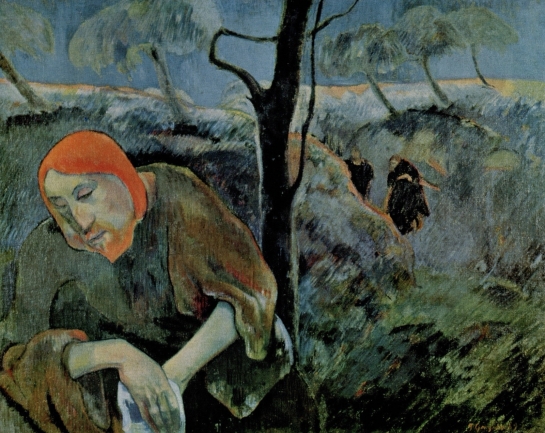
Fig. 4 Gauguin, Self-portrait as Christ on the Mount of Olives (1889). National Gallery, London.
His friend, Paul Gauguin, painted outwardly religious scenes which Vincent only did allegorically (fig. 4). However, both verbally expressed such ideas openly, identifying with Christ to the continuing horror of some art historians. Władysława Jaworska correctly described Vincent as presenting religious views in secular form but castigated Gauguin for “the profanity of the artist’s identification with Christ, in which case he presented himself explicitly as God”.4 Too many historians have failed to grasp that, for at least two millennia, artists, saints, and other spiritually inclined people have considered everyone to be God or God-like because God (or, the universal essence behind creation) is in all of us. That’s why St Augustine wrote “we call all Christians Christ” and Jesus told his followers “Ye are gods.”5 Attacking the Catholic Church’s literal interpretation of the scriptures, Gauguin wrote, as Vincent could have, that “I act a little like the Bible [in my use of symbols].”6 And, then, later summed up the two artists’ shared profession: “Art encompasses philosophy; as philosophy does art.”7
Fig. 5 Van Gogh, The Painter on the Road to Tarascon
So back to Van Gogh on the road to Tarascon. Is our artist setting out on a journey to paint nature, or presenting himself as Everyman on the journey to become perfect? It may not even be coincidence that Vincent’s figure, personifying Christ between the crosses, walks down the road to Tarascon on the border of Languedoc. It was there that esoteric Christianity flourished in the late Middle Ages with tales of chivalry, the celebrated Cathars, and the songs of troubadours. They all believed, like Vincent and Gauguin, that Christ and God are inside us, and devotion is the way. Indeed Cathars were originally called “The Good Men” for their service to others. But, equally intriguing is that Tarascon means “monster”. The riddles in such art seem endless.
1. Joan Greer, “‘Christ, This Great Artist’ – Van Gogh’s Socio-Religious Canon of Art” in Van Gogh’s Imaginary Museum: Exploring the Artist’s Inner World (Amsterdam: Van Gogh Museum) 2003, p. 67.
2. Van Gogh associated the color yellow, as in his wheatfields and haystacks, with himself because his hair and beard were blond, and it is the color of the sun, a symbol of Christ.
3. Peter Hecht, Van Gogh and Rembrandt (Amsterdam: Van Gogh Museum) 2006, p. 65
4. Władysława Jaworska. "Christ in the Garden of Olive-Trees by Gauguin. The Sacred or the Profane?" Artibus Et Historiae 19, no. 37 (1998): 77-102.
5. Augustine, City of God (London: Penguin) 2003, p. 919; John 10:34.
6. Henri Dorra, The Symbolism of Paul Gauguin: Erotica, Exotica, and the Great Dilemmas of Humanity (Berkeley: University of California Press) 2007, p. 19.
7. ibid., p. 35.
The EPPH Blog features issues and commentary.



Reader Comments