The Power of an Artist’s Imagination
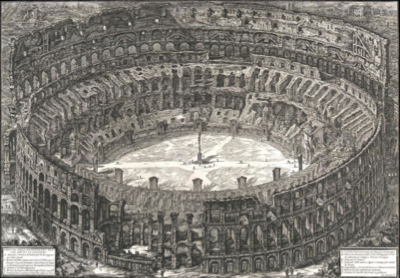
G.B.Piranesi, View of Flavio's Amphitheater called The Colosseum (1776) Etching. 19½ x 28 ins.
Remember when you look at art that artists can do almost anything. They are not like you and I (apologies to any artists out there). Their imaginations are all-powerful. Take, for instance, this 1776 etching of the Colisseum in Rome by Giambattista Piranesi. How did he imagine it? No-one had ever seen the ruins from this view-point. Balloons were not invented until a decade later. Yet he captures the massive building in all its detail as though we were actually looking down at it from 800 feet in the sky.
Did he, perhaps, also imagine the ruins as his inner eye looking upwards, with the pupil in the lighted center surrounded by ancient walls like the spokes of an iris? As we have seen, his predecessors Mantegna, Giovanni Bellini and Leonardo all used ancient stone, caves or ruins for the same purpose, to depict the age-old content of an artist's mind and the wisdom of generations. Bear in mind, too, that all Piranesi's celebrated images of prisons with their spherical openings and hanging walkways are what he sees as the inside of his own creative mind with all its potential connections.
I could be mistaken….but I find that if you don't think daringly and fail often, you won't ever see anything original. What does it matter, anyway, if you're wrong? Don't take my word for it. The pleasure, you see, is in the first perception, arrived at by yourself without help. Go for it.
Posted 18 Oct 2012: Behind the EyeHand / EyeVisual Perception
The EPPH Blog features issues and commentary.



Reader Comments