The Renaissance Portrait from Donatello to Bellini #3
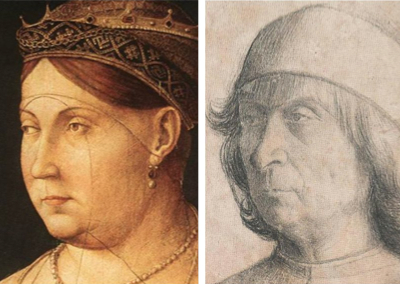
Left: Gentile Bellini, Caterina Cornaro, Queen of Cyprus, detail (c.1500)
Right: Gentile Bellini, Self-portrait or Giovanni Bellini, Portrait of Gentile Bellini, detail (c.1496)
Both portraits above will be in the exhibition at the Metropolitan Museum (Cat. #163 and #159) and may even be hung near to each other where the similarity will surely be noticed. The portrait of Caterina Cornaro, Queen of Cyprus (left), is assumed in the catalogue to be a reasonably good likeness because scholars have used it to look for the Queen’s portrait elsewhere. Strangely, for such a prominent figure, they have not been able to find one except, just once, in another painting by Gentile Bellini. There, it is said, “her face looks much the same.” Yet how good a likeness can it be when she has the same small eyes, mouth and chin as the artist (right)? Not to mention the ski-slope nose that is only slightly less prominent. Even though both humanists and artists flocked to her court on the Venetian mainland around 1500 (Giorgione was there for a time) the fact that no portrait by another artist can be found is telling. This one may not be a good likeness.
Another sign that the artist is in control of this painting, not the Queen, is a trompe l’oeil tablet hanging from a cord near her head. On it Caterina states her own importance with phrases like “the senate of Venice calls me daughter” only to end with the self-effacing remark that “greater still is the hand of Gentile Bellini, which has captured my image on such a small panel.” The artist is more important than the Queen. The conceit, I believe, is that the Queen’s figure, painted with little depth or form, looks flat like a painting. It is the trompe l’oeil sign that is in our reality; the monarch behind it is “a painting”. And she resembles the artist to symbolize the mighty power of his fertile imagination and the feminine half of his androgynous mind.
For other portrait/self-portrait comparisons of Renaissance paintings, see our Gallery: Portraits of Italian Sitters as the Artist.
Posted 02 Dec 2011: AndrogynyExhibitionsPortraitureTheory
The EPPH Blog features issues and commentary.



Reader Comments