How God became Woman
L: Illumination and text of Origen's Homiliae in Genesim, in Exodum, in Leviticum (c.1480-5) Biblioteca Estense Universitaria, Modena.
R: Detail of image at left
Art is so pregnant that it can take months for its hidden meaning to emerge in your thought. That’s why we try to enter the artist's mind, not just through social customs and the religious dogma of a period but also through art's own culture which, though barely known, is simpler to recall and more consistent. Its principal ideas have changed little over centuries. That's how my wife, a casual student like most of you, noticed the hidden content in the illumination above as soon as she saw it. She is familiar with the themes on EPPH.
The sheet is the first page of a text by Origen, the great Biblical interpreter of the third century. It was copied out sometime in the 1480's. Origen famously argued that the Hebrew Bible was written allegorically because many of the main events in Genesis are just too impossible to believe. The anonymous illuminator here also drew allegorically which the curators of a recent exhibition entirely missed.1
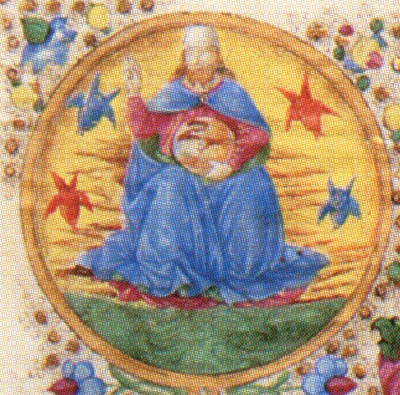
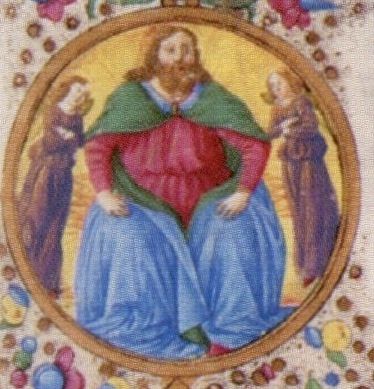
Detail of illumination at top, the first day of Creation in the upper left corner.
Let's look at the left-hand margin where the seven days of Creation are depicted in vertical sequence. God, of course, is not an old man as depicted here. Nor does He have red hair nor live in the sky.2 Nevertheless, Genesis says man was made in God's image, a concept linked to the idea that the human body (including mind) is a miniature version of God: the microcosm to the macrocosm. Such personification is spiritual allegory, a way of making abstract and difficult concepts tangible. Yet even if God presented as an old man is unremarkable today, how about God as a young and fertile woman? Have you noticed how this God looks pregnant, holding Earth like a woman supporting her womb? The artist thus conveys that the creation of light is like the moment of conception cognitively, sexually, and creatively.3
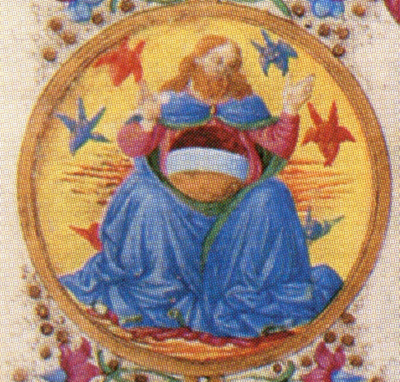
Detail of illumination at top, the second day of Creation.
The analogy is made more apparent on the second day when God, in separating land from sky, created matter. In other words, conception has now led to a real foetus. The Earth consequently swells in size and the old man looks seriously pregnant. Note too how his blue cloak draped across his shoulders has changed shape to resemble breasts seen from below his womb.
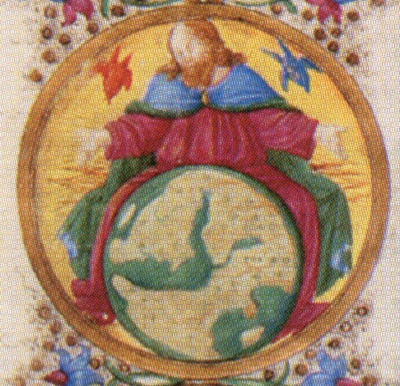
Detail of illumination at top, the third day of Creation.
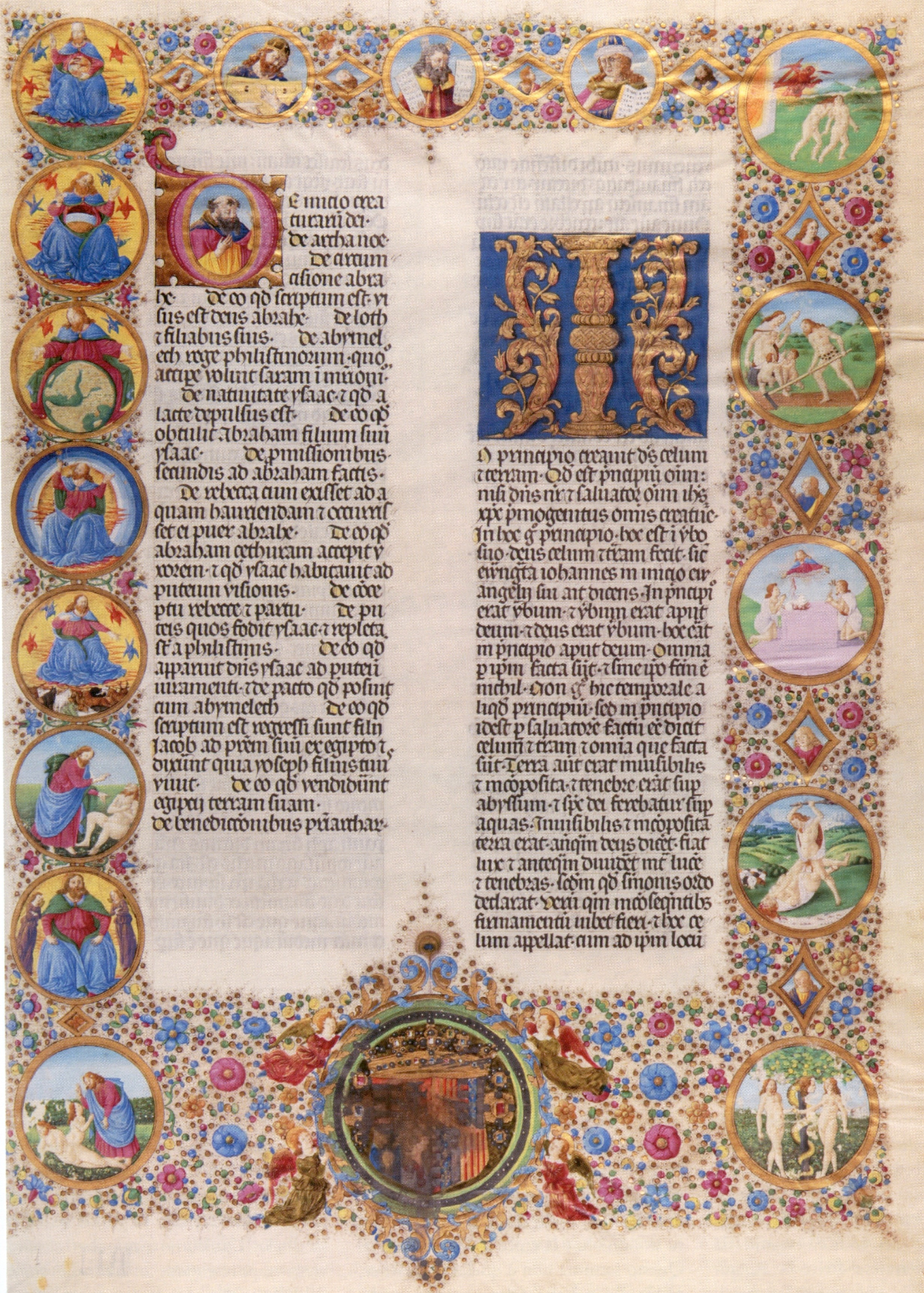
Push comes to shove on the third day when God separated the waters from the firmament. On this day, naturally, his water bag burst. The Earth is now gigantic, his legs wide open in childbirth. God delivers and the artist too.4 This is important because it supports the view that Michelangelo's allegorical use of biological functions in the Creation panels on the Sistine ceiling (as shown in Quick Guide to the Sistine Chapel) was part of the same tradition.5
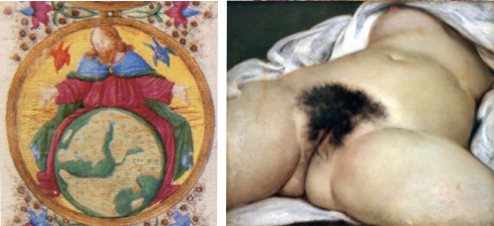
L: Detail of illumination at top, the third day of Creation; R: Courbet, The Origin of the World (1866) Oil on canvas. Musée d'Orsay, Paris
Moving to the19th century we can be certain that Gustave Courbet never saw the illumination (left). It was in Budapest. But somewhere, perhaps in engravings of the Sistine Chapel, he must have seen something like it. When he painted his close-up of a woman’s genitals (right), legs spread open, he titled it as the illuminator of Origen's text might have done: The Origin of the World.
____________________________________________
P.S. As always I could do with some help. I am still mystified by an important detail: why does God wear a white cap on the first day of Creation? Why does it not appear on the other days? What's he wearing it for anyway? The possibilities I can imagine include the fact that painters in those days wrapped cloths round their heads to keep paint off their hair, especially (metaphorically) if God-as-artist is here "painting" the heavens overhead. (See note 4.) Or, did Renaissance women wear caps in childbirth? If you have any other ideas, please let me know.
1. Mattia Corvino e Firenze: Arte e Umanesimo alla Corte del Re di Ungheria (Florence: Museo di San Marco) 2013, cat. 46, p. 174
2. God is depicted as old and bearded, not just human, because he is also a personification of ultimate Wisdom. Sapientia was one of his names as is evident from the Wisdom books of the Old Testament. Wisdom is the principal spiritual goal of all the world's major religions and of philosophy and literature too.
3. The concept that our human essence includes characteristics of both genders is as old as antiquity and has never lost favor among poets, artists and mystics. It is as common in Picasso’s work as Parmigianino’s. Michelangelo used the idea of a woman's conception in his Vatican Pietá (1499). Many others have too including, quite recently, Ron Mueck in A Girl (2006). It is also significant that creative terms are often sexual in nature: conception and reproduction, for instance. Cicero claimed that in Latin paintbrush and penis share the same etymology. For the latter, see Oskar Batschmann, “Holbein’s Hand” in Hans Holbein the Younger: The Basel Years 1515-1532 (Kunstmuseum Basel) 2006, p. 114
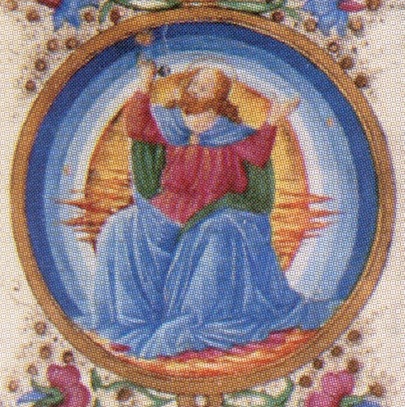
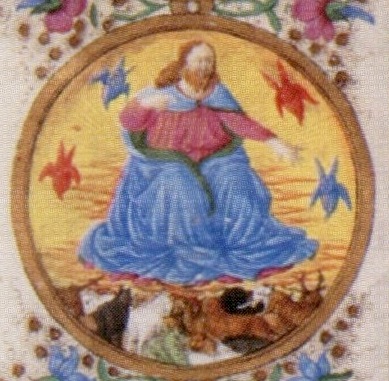
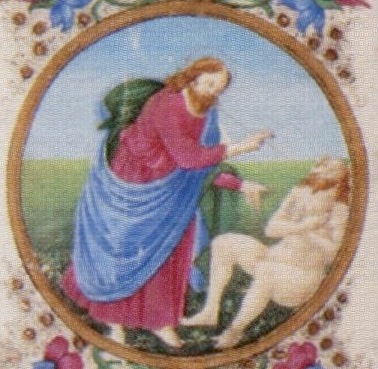
4. This God on the hidden level is not only a young woman but an artist too. Note how his right hand in the first tondo-shaped panel blesses the world but with his middle digits raised or pointing, as I often show of painters. They symbolize the artist's brush-hand, his active one. God’s left hand cradles Earth with His thumb separated as though through the hole of a palette-shaped Earth. Palettes were sometimes circular. On the second day of Creation God displays the hands of the artist, a gesture used for that purpose by generations of painters from Michelangelo to Basquiat. His hands continue to have fingers pointed on one, the thumb separated on the other. On the third day I assume he is displaying his empty hands because his initial work is done. He has given birth. On the fourth and fifth days creating stars and animals he assumes the actual pose of a painter as though he had a brush in one hand and a palette in the other. On the sixth day, creating Adam, he points with one hand and has his thumb separated on the other. The hands are even the center of attention, the link between God and Adam. With his work finally completed on the seventh day, he rests his hands on his knees in satisfaction. And, as Genesis says as though God really was a craftsman, he studied his work "and saw that it was good." For more on the brush/palette symbolism of hands, see examples under the theme Brush and Palette.
5. For a more comprehensive review of the hidden content of the Sistine Chapel see my 3-part essay "Michelangelo's Art Through Michelangelo's Eyes" (2006) and a brief addendum "Michelangelo's Skull" (2012).
The EPPH Blog features issues and commentary.



Reader Comments
And the beard grew exponentially, it appears. Could it have been added later by another artist, or by the otidinal artist to mislead his viewers? And could the cap represent a yarmulke, worn only by men?
Donna Dodderidge
09 Jan 2014
Yes, Donna, it could be a yarmulke of sorts and I hadn’t noticed the beard’s growth. Interesting.
Simon
10 Jan 2014