Giacometti’s Visual Illusion Blows My Mind
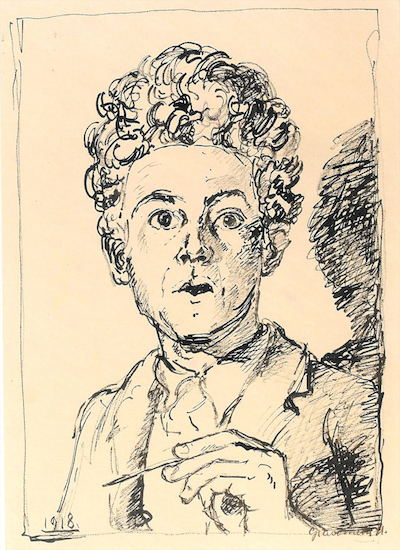
Giacometti, Self-portrait with Brush (1918)
Yesterday, after posting the entry on Giacometti’s Self-portrait with Brush (above), I saw something astonishing. It's a good reminder that even when you think you understand, there's still more to know. And it comes with perserverance and the right approach. The more you look, the more you see. What shook me was discovering a visual illusion in his Self-portrait so sophisticated that it should have been the focus of the post. It must have been a remarkable achievement for an artist who was then only 17 years old. I assume that he saw something like it in art elsewhere because that's how artists learn. Let me explain.
Even though the artist’s actual paper is below the lower edge and out-of-sight, Giacometti holds his pen as if he might raise it to draw on the very image we see. That means, as I describe in more detail in the main post, that the surface is not only a mirror in which he draws his self-portrait but also, on another level, a clear piece of glass on which he is drawing the "shadow".
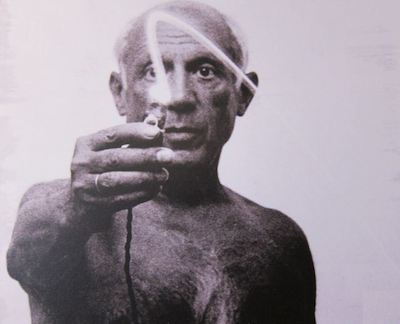
Pablo Picasso painting on glass (c.1950's)
It’s a bit like a famous film of Picasso drawing on a sheet of glass. (Interestingly, both paper and glass come in sheets.)
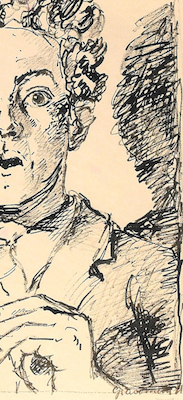
Detail of Giacometti's Self-portrait with Brush
The shadow, then, is in front of Giacometti, drawn on the glass. This is supported by how his pen’s motion, sweeping back-and-forth across the shadow’s head, does not stop at the shoulder but continues with the same pattern in front of it, at least near the edge and, again perhaps, in a dark area of scribble just below his armpit. Both areas seem to be shadows on his jacket but they can be read both ways.
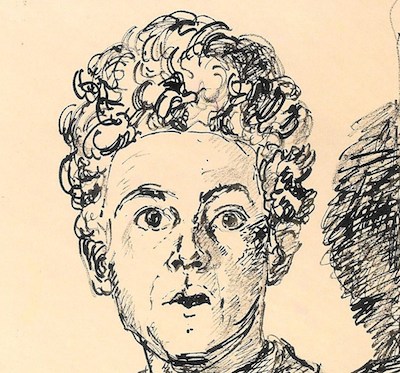
Detail of Giacometti's Self-portrait with Brush
Here, though, is what I missed. The artist’s eyes are wide open, angled slightly towards the right-hand side. Where is he looking? And why is he so surprised? They make no sense if the shadow is behind him. It was a big oversight because I should have asked myself those questions.
If one crops the image at the neck, though (as above), the perception that the assumed "shadow" is behind him is weakened because you no longer see the shoulder appearing to block it. Instead the dark silhouette becomes that of a man facing him whom we see from the back. In that event his eyes are aimed perfectly, at the silhouette in front of him. No wonder they pop out of his head. He's looking at his own shadow. However, since he is in fact "drawing" that apparent shadow on a sheet of glass, he is also amazed at the mastery of his own drawing which depicts the very moment of its creation.
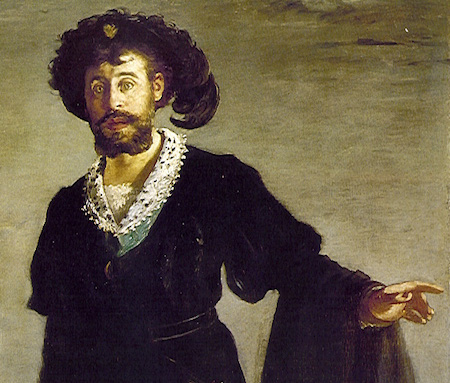
Edouard Manet, Faure as Hamlet (1877) Oil on canvas. Folkwang Museum, Essen.
In that sense, he’s like Manet’s Faure as Hamlet (1877) who not only stares at his father’s ghost on stage but also, since the painting is a mirror, is "painting" it too.1
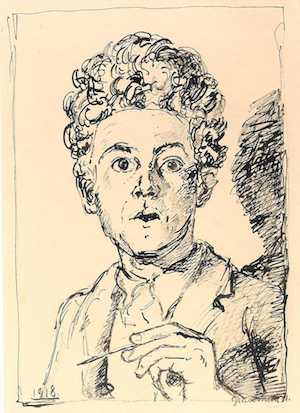
Giacometti, Self-portrait with Brush
This drawing, then, and its visual illusion are a remarkable tour-de-force full of the psychic connotations so often found in masterpieces. Any other artist who saw this work at the time, say Picasso who was thirty-seven, would have known in an instant that Giacometti had the potential to be a great master - even at 17.
From our point-of-view as dedicated art lovers, we must never forget that the more you look at the work of a major artist the more you see, especially if you spend similar amounts of time with work by a wide variety of artists. Always bear in mind, of course, that every painter paints himself. Artists never forget it. Not only that. Artists very often depict, as here, the moment of the work's conception which thus becomes an "endless Now" for centuries ever after. That, in case you missed it, is also art's way of suggesting that we all focus on the present moment as the only one that really matters, the only one that is real. The past is gone, cannot be changed and is incorrectly remembered anyway; the future may never happen. Dwelling on them will not bring happiness. There is only the Now.
For the initial entry, along with other surprises, see Giacometti’s Self-portrait with Brush (1918).
1. Note how Manet's Faure as Hamlet has a thumb that resembles an "eye" just as Giacometti himself has one under his little finger in the Self-poritrait. See entry.
Posted 18 Nov 2013: Mirrors / ReflectionGiacomettiPortraitureVisual Perception
The EPPH Blog features issues and commentary.



Reader Comments