A Hair-raising Tool to Understand Art
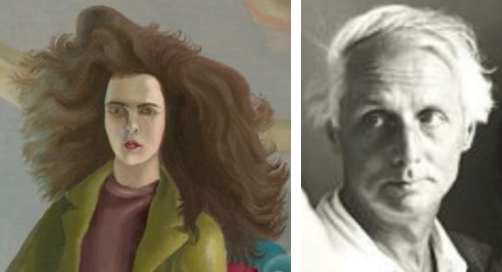
L: Detail of Carrington's Self-portrait (c. 1937-8); R: Photograph of Max Ernst (c.1938)
It's interesting to learn something new about an artwork but even more exhilarating to learn the craft itself by acquiring the mental tools used to interpret what few can see. We all paint the world the way we think it or are told to think it by convention, our parents or experts. We only see what we already think or can imagine. That's why the saying every painter paints himself is so important. It's a perennial truth. We look at the world and see our own thoughts reflected back at us. It's not just artists who do it; we all do. Few, though, get the opportunity to re-paint what they see according to new ideas or, more accurately, old ideas you were probably not aware of. That's why EPPH is not intended as a Wikipedia of interpretations re-casting individual works in a new light but as a site intended to give you the tools to interpret other art on your own. The themes help by showing repetitive demonstrations of the same methods and ideas used over centuries. Of course, I too learn new tricks all the time. It would be no fun if I did not. Leonora Carrington taught me one last week.
I was writing a novel interpretation of her Self-portrait (above left) from the late 1930's. In it an unidentifiable face can be seen within Carrington's hair. Yet when I compared the "face" to her lover's, the much-older artist Max Ernst's (above right), I noticed that the loose ends to his hair, curling this way and that, resembled the hairs escaping from her wild mane. The "face", it now seems, represents "Ernst" (read more).
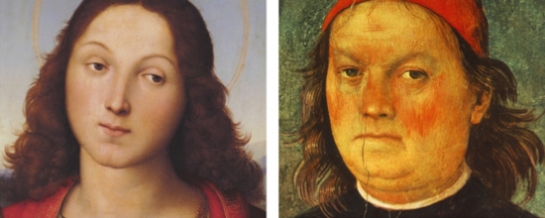
L: Detail of Raphael's Saint Sebastian (c.1502-3)
R: Detail of Perugino's Self-portrait (1497-1500)
Two days later studying Saint Sebastian (above left) by Raphael, a work painted under Perugino's influence, I noticed similarly messy hair endings. So I did what Leonora had taught me. I checked Perugino's Self-portrait (above right) and there, sure enough, he has similar loose ends and the same chin. I had never looked at hair endings that way before (read more).
Over-specialization is a well-recognized danger in art scholarship but even its most ardent critics might not imagine that studying just one painting by an Anglo-Mexican Surrealist (c.1937) would help explain a Raphael (c.1501). It did so because the methods used to create art rarely change. I would hazard a guess, in fact, that many artists have used this across the centuries. She could have seen it anywhere and, no doubt, we will too. Think of it as a tool you can use. It should come in handy one day.
Posted 18 Sep 2013: Visual MetamorphosisRaphaelPortraitureVisual Perception
The EPPH Blog features issues and commentary.



Reader Comments