Villard de Honnecourt’s Commentary on Life and God
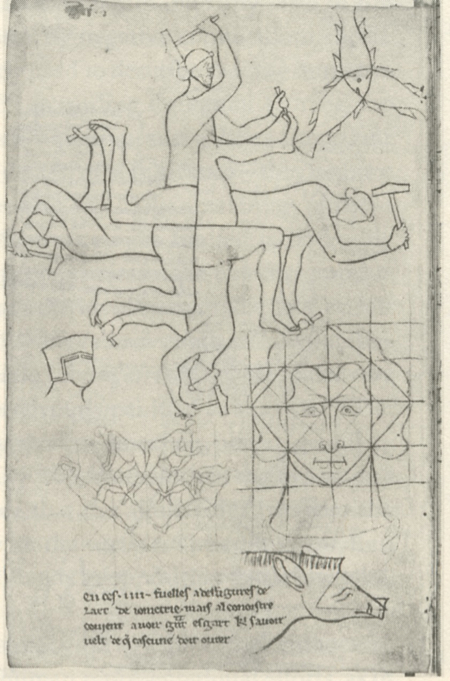
Portfolio of Villard de Honnecourt. Bibliothèque Nationale de France, Paris. MS fr. 19093, fol. 19v
Vassily Kandinsky was not just thinking of his own abstract works when he wrote that: "The greatest mistake one can make is to believe that Art is the reproduction of Nature."1 He was referring to all Art. I agree, as many of you know, but I argue more specifically that most art is a representation of the artist’s mind and that the Renaissance phrase, every painter paints himself, expresses that clearly. Yet even though Renaissance scholars might agree that Michelangelo’s art is self-centered, they would be more guarded about the work of his great rivals: Titian, Raphael and the lesser artists surrounding them. As for the sacred, gold-ground altarpieces of the Middle Ages, most scholars would treat our argument as preposterous. Thus it is with some interest that I discovered in Villard de Honnecourt's “album of drawings”, dated between 1220 and 1240, the image of a stone-carver sculpting his own foot. He is drawn M.C.Escher-like in a rotating visual illusion (above).
This image cannot be a meaningless doodle. Villard’s inscriptions concerning his album are too serious. Besides, his many images constructed around geometric shapes imply that he was trying to to represent the essential truths underlying Nature’s forms. In his day geometry was sacred. Unfortunately Villard’s profession, though often cited as architecture, is unknown but he clearly had an interest in the building of cathedrals. The typical stone-carver he represented on this leaf was thus more than likely to be working on the construction of ecclesiastical buildings because, at that date, free-standing secular sculptures had not yet appeared. Besides, the overall swastika-shape within which the stone-cutter carves his foot was, in the Middle Ages, a symbol of Christ’s victory over death, understood within esoteric Christianity as Jesus’ attainment of Wisdom. That means that this early 13th-century mason may even be God himself sculpting the world. Either way both he and Villard would have believed that the secrets of God’s universe were hidden inside each human being because, as the Bible states, Man was made in the image of God, in the image of God he was made.
1. Cited in Ulrike Becks-Malorny, Kandinsky (New York: Taschen) 2007, p. 61
Posted 02 Apr 2012: Artist as ChristKandinskyMichelangeloRaphaelTitianInner Tradition
The EPPH Blog features issues and commentary.



Reader Comments