What does ‘Every Painter Paints Himself’ actually mean?
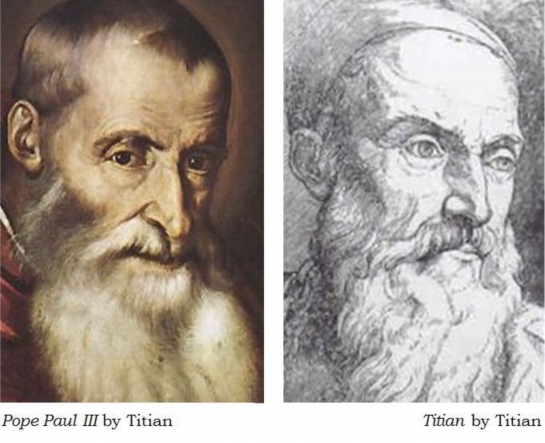
The human mind cannot escape itself, which is what the saying in the website’s name implies: “Every painter paints himself”. The phrase, occasionally credited to Michelangelo, originated in Tuscan literature around 1478, though similar ideas were common worldwide, in Buddhist texts, Chinese art theory, Greek philosophy, and early Christianity.1 The painter is a metaphor for the mind in all of them. It makes little sense, then, to reduce the adage to the banal idea that art conveys the artist’s sensibilities. Michelangelo did not think of it like that, claiming in a poem that it was true. “As, working in hard stone to make the face of someone else, one images his own…”. He had no interest in portraiture and, taken literally, his claim sounds absurd. If we read it instead as an image conceived in his head, it is undeniably true because we only experience what is outside us via sensory data flowing through us, or originating within. We cannot know what it is like to be someone else. We can only imagine other people as a male or female version of ourself. The poet Petrarch observed that “each applies to others what he has experienced in himself”, just as Michelangelo wrote elsewhere, “I only see what’s most like me inside that heart of yours”. They both knew that human experience of external reality is colored, or even created, by our internal one—by our thoughts, feelings, and imagination—making perception of the exterior world, in large part, a self-reflection. Sir Walter Raleigh put it well: “We are trapped, as it were, inside our own heads”. Thus, Michelangelo’s description of inevitably portraying his own face refers not to his physical practice, but to his mental conception, because we all paint our own reality every second of the day, making “every painter paints himself” (or herself) a universal truth. It metaphorically describes how the mind works.
* adapted from my article “The Unseen Truth of God in Early Modern Art” (2024).
Notes
1. Wen C. Fong, ed. Images of the Mind: Selections from the Edward L. Elliott Family and John B. Elliott Collections of Chinese Calligraphy and Painting at The Art Museum, Princeton University (Princeton University Press) 1984, pp. 3, 94;
Susan Bush and Hsio-yen Shih, eds. Early Chinese Texts on Painting (Harvard University Press)1985, pp. 96, 205–6;
Imre Hamar, "The Metaphor of the Painter in the Avataṃsaka-sūtra and Its Chinese Interpretations", Studia Orientalia Slovaca 13, 2014, pp. 175–98;
Theresa McNichol, "Visualising Wisdom: The Mindful Brush of Confucian Moral Artistry", Organizational Aesthetics 9, 2020, pp. 72–96;
Sonam Kachru, "The Translation of Life: Thinking of Painting in Indian Buddhist Literature" Religions 11: 467. Available online: https://www.mdpi.com/2077-1444/11/9/467/ (accessed on 12 September 2023).
2. John Frederick Nims, The Complete Poems of Michelangelo (Chicago University Press) 1998, p. 122.
3. Francis Petrarch, Letters of an Old Age: Rerum Senilium, Libri I–XVIII, vol. 1 (The Johns Hopkins University Press), p. 265;
Nims, op. cit., p. 63.
4. Katharine Eisaman Maus, Inwardness and Theater in the English Renaissance (University of Chicago Press) 1996, pp. 4, 7–8.
Posted 05 Oct 2026: Mirrors / ReflectionMichelangeloPortraitureTheoryVisual Perception
The EPPH Blog features issues and commentary.



Reader Comments